Division for Social Research in Medicines and Health, The School of Pharmacy, University of Nottingham, University Park, Nottingham NG7 2RD, UK.
Trials. 2013 Dec 1;14:411. doi: 10.1186/1745-6215-14-411.
Medication non-adherence is considered an important cause of morbidity and mortality in primary care. This study aims to determine the effectiveness, cost effectiveness and acceptability of a complex intervention delivered by community pharmacists, the New Medicine Service (NMS), compared with current practice in reducing non-adherence to, and problems with, newly prescribed medicines for chronic conditions.
METHODS/DESIGN: Research subject group: patients aged 14 years and above presenting in a community pharmacy for a newly prescribed medicine for asthma/chronic obstructive pulmonary disease (COPD); hypertension; type 2 diabetes or anticoagulant/antiplatelet agents in two geographical regions in England.
parallel group patient-level pragmatic randomized controlled trial.
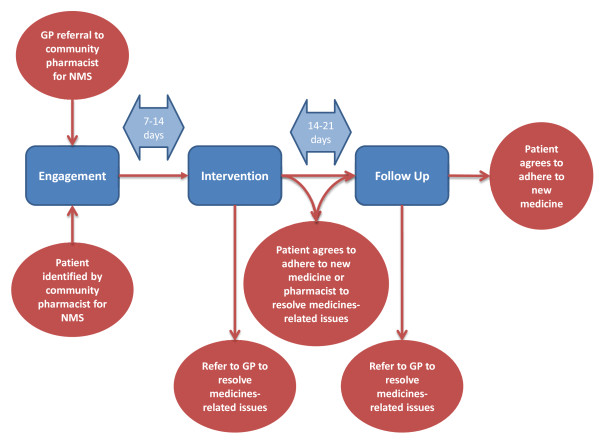
patients randomized to either: (i) current practice; or (ii) NMS intervention comprising pharmacist-delivered support for a newly prescribed medicine.
proportion of adherent patients at six, ten and 26 weeks from the date of presenting their prescriptions at the pharmacy; cost effectiveness of the intervention versus current practice at 10 weeks and 26 weeks; in-depth qualitative understanding of the operationalization of NMS in pharmacies.
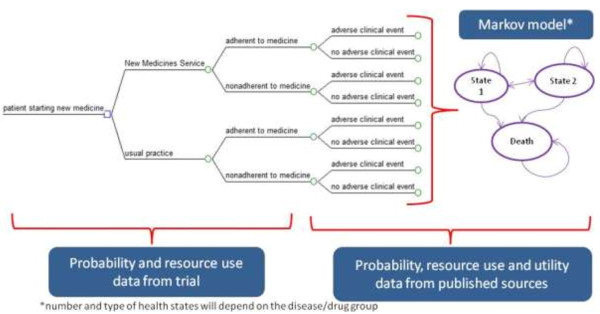
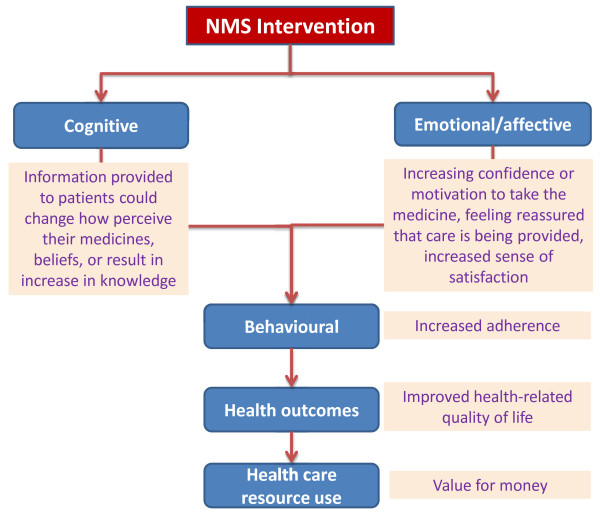
impact of NMS on: patients' understanding of their medicines, pharmacovigilance, interprofessional and patient-professional relationships and experiences of service users and stakeholders.Economic analysis: Trial-based economic analysis (cost per extra adherent patient) and long-term modeling of costs and health effects (cost per quality-adjusted-life-year) will be conducted from the perspective of National Health Service (NHS) England, comparing NMS with current practice.Qualitative analysis: a qualitative study of NMS implementation in different community settings, how organizational influences affect NMS delivery, patterns of NMS consultations and experiences of professionals and patients participating in NMS, and patients receiving current practice.
250 patients in each treatment arm would provide at least 80% power (two-tailed alpha of 0.05) to demonstrate a reduction in patient-reported non-adherence from 20% to 10% in the NMS arm compared with current practice, assuming a 20% drop-out rate.
At the time of submission of this article, 58 community pharmacies have been recruited and the interventions are being delivered. Analysis has not yet been undertaken.
Current controlled trials: ISRCTN23560818. Clinical Trials US (clinicaltrials.gov): NCT01635361.
药物依从性差被认为是初级保健中发病率和死亡率的重要原因。本研究旨在确定由社区药剂师提供的一种复杂干预措施(新药品服务,NMS)与当前实践相比,在减少新处方慢性病药物的不依从性和用药问题方面的有效性、成本效益和可接受性。
方法/设计:研究对象:在英格兰两个地理区域的社区药房新开出哮喘/慢性阻塞性肺疾病(COPD)、高血压、2 型糖尿病或抗凝/抗血小板药物的 14 岁及以上患者。
平行组患者水平实用随机对照试验。
患者随机分为:(i)当前实践;或(ii)NMS 干预,包括药剂师提供新处方药物支持。
从患者在药房出示处方之日起 6、10 和 26 周时依从性患者的比例;干预措施与 10 周和 26 周时的当前实践相比的成本效益;深入了解 NMS 在药房中的运作。
NMS 对以下方面的影响:患者对其药物的理解、药物警戒、跨专业和医患关系以及服务使用者和利益相关者的体验。经济分析:将从英国国家医疗服务体系(NHS)的角度进行基于试验的经济分析(每增加一个依从性患者的成本)和成本效益的长期建模(每质量调整生命年的成本),将 NMS 与当前实践进行比较。定性分析:对不同社区环境中的 NMS 实施情况、组织影响如何影响 NMS 交付、NMS 咨询模式以及参与 NMS 的专业人员和患者的体验以及接受当前实践的患者进行定性研究。
每组 250 名患者将提供至少 80%的功效(双侧α值为 0.05),以证明与当前实践相比,NMS 组患者报告的不依从率从 20%降低到 10%,假设 20%的脱落率。
在提交本文时,已经招募了 58 家社区药房,正在提供干预措施。尚未进行分析。
当前对照试验:ISRCTN23560818。临床试验美国(clinicaltrials.gov):NCT01635361。