Striepens Nadine, Kendrick Keith M, Hanking Vanessa, Landgraf Rainer, Wüllner Ullrich, Maier Wolfgang, Hurlemann René
1] Department of Psychiatry, University of Bonn, 53105 Bonn, Germany [2] Division of Medical Psychology, University of Bonn, 53105 Bonn, Germany.
Sci Rep. 2013 Dec 6;3:3440. doi: 10.1038/srep03440.
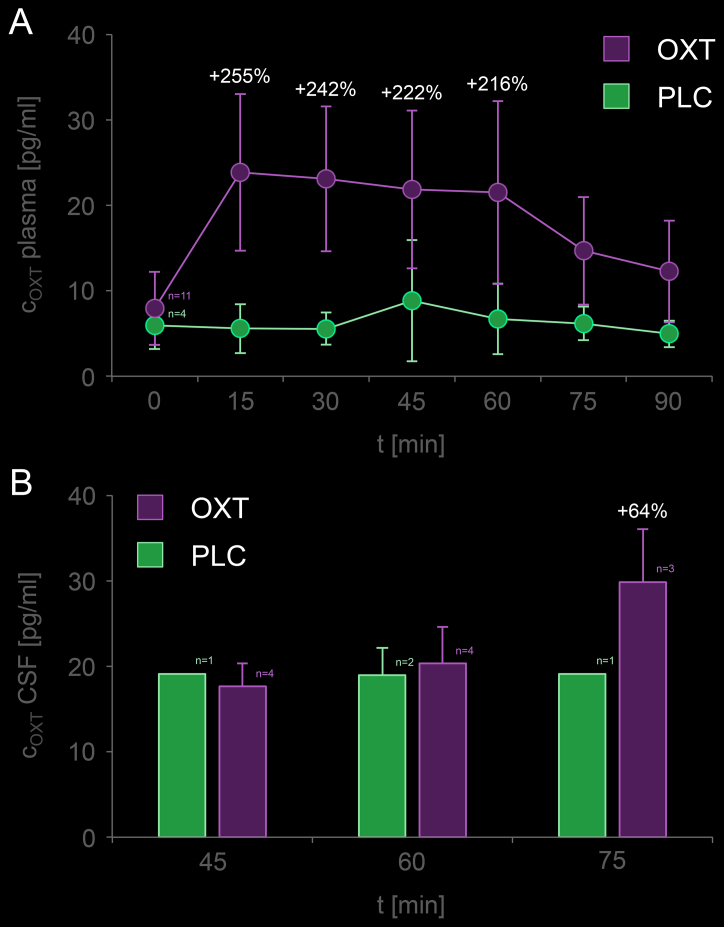
There has been an unprecedented interest in the modulatory effects of intranasal oxytocin on human social cognition and behaviour, however as yet no study has actually demonstrated that this modality of administration increases concentrations of the peptide in the brain as well as blood in humans. Here using combined blood and cerebrospinal fluid (CSF) sampling in subjects receiving either 24 IU of oxytocin (n = 11) or placebo (n = 4) we have shown that oxytocin levels significantly increased in both plasma and CSF. However, whereas oxytocin plasma concentrations peaked at 15 min after intranasal administration and decreased after 75 min, CSF concentrations took up to 75 min to reach a significant level. Moreover, there was no correlation (r = <0.10) between oxytocin plasma and CSF concentrations. Together, these data provide crucial insights into the plasma and CSF kinetics of intranasally administered oxytocin.
鼻内注射催产素对人类社会认知和行为的调节作用引起了前所未有的关注,然而,尚无研究实际证明这种给药方式能提高人体内该肽在大脑和血液中的浓度。在此,我们对接受24国际单位催产素(n = 11)或安慰剂(n = 4)的受试者进行了血液和脑脊液(CSF)联合采样,结果显示血浆和脑脊液中的催产素水平均显著升高。然而,催产素血浆浓度在鼻内给药后15分钟达到峰值,75分钟后下降,而脑脊液浓度则需要75分钟才能达到显著水平。此外,催产素血浆浓度与脑脊液浓度之间无相关性(r = <0.10)。这些数据共同为鼻内注射催产素的血浆和脑脊液动力学提供了关键见解。