
种群动力学的亚稳增长率表型。
Population dynamics of metastable growth-rate phenotypes.
机构信息
Department of Physics & Network Biology Research Laboratories, Technion, Haifa, Israel.
出版信息
PLoS One. 2013 Dec 2;8(12):e81671. doi: 10.1371/journal.pone.0081671. eCollection 2013.
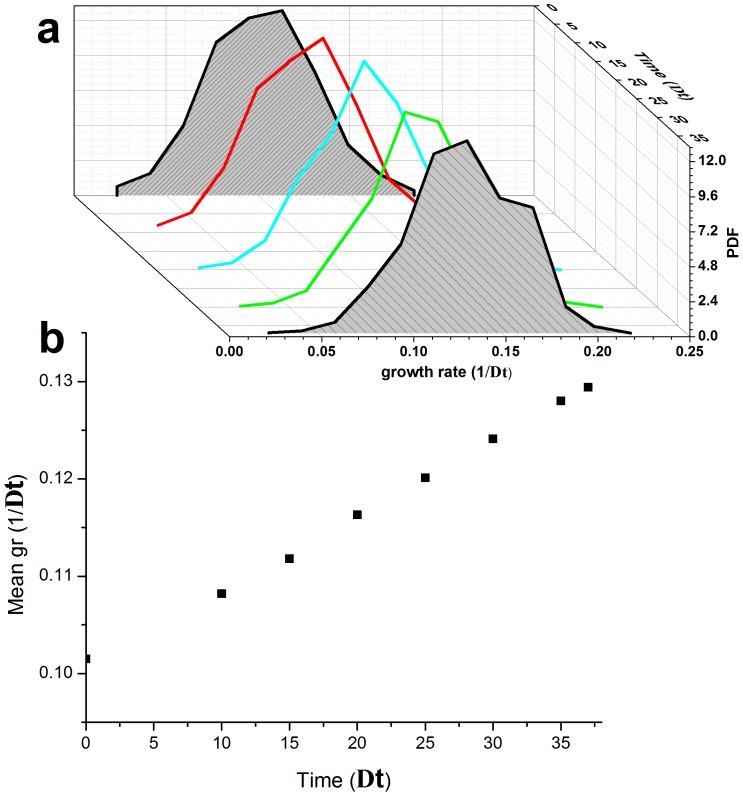
Neo-Darwinian evolution has presented a paradigm for population dynamics built on random mutations and selection with a clear separation of time-scales between single-cell mutation rates and the rate of reproduction. Laboratory experiments on evolving populations until now have concentrated on the fixation of beneficial mutations. Following the Darwinian paradigm, these experiments probed populations at low temporal resolution dictated by the rate of rare mutations, ignoring the intermediate evolving phenotypes. Selection however, works on phenotypes rather than genotypes. Research in recent years has uncovered the complexity of genotype-to-phenotype transformation and a wealth of intracellular processes including epigenetic inheritance, which operate on a wide range of time-scales. Here, by studying the adaptation dynamics of genetically rewired yeast cells, we show a novel type of population dynamics in which the intracellular processes intervene in shaping the population structure. Under constant environmental conditions, we measure a wide distribution of growth rates that coexist in the population for very long durations (>100 generations). Remarkably, the fastest growing cells do not take over the population on the time-scale dictated by the width of the growth-rate distributions and simple selection. Additionally, we measure significant fluctuations in the population distribution of various phenotypes: the fraction of exponentially-growing cells, the distributions of single-cell growth-rates and protein content. The observed fluctuations relax on time-scales of many generations and thus do not reflect noisy processes. Rather, our data show that the phenotypic state of the cells, including the growth-rate, for large populations in a constant environment is metastable and varies on time-scales that reflect the importance of long-term intracellular processes in shaping the population structure. This lack of time-scale separation between the intracellular and population processes calls for a new framework for population dynamics which is likely to be significant in a wide range of biological contexts, from evolution to cancer.
新达尔文主义进化为种群动态提供了一个范例,该范例基于随机突变和选择构建,在单细胞突变率和繁殖率之间有明确的时间尺度分离。直到现在,关于进化种群的实验室实验都集中在有益突变的固定上。遵循达尔文范式,这些实验以稀有突变率决定的低时间分辨率探测种群,忽略了中间进化的表型。然而,选择作用于表型而不是基因型。近年来的研究揭示了基因型到表型转化的复杂性,以及包括表观遗传遗传在内的丰富的细胞内过程,这些过程在广泛的时间尺度上运作。在这里,通过研究基因重布线酵母细胞的适应动力学,我们展示了一种新型的种群动态,其中细胞内过程干预塑造种群结构。在恒定的环境条件下,我们测量了广泛的增长率分布,这些分布在种群中共同存在很长时间(>100 代)。值得注意的是,最快生长的细胞并没有在由增长率分布的宽度和简单选择决定的时间尺度上接管种群。此外,我们还测量了各种表型的种群分布中的显著波动:指数生长细胞的分数、单细胞生长率和蛋白质含量的分布。观察到的波动在许多代的时间尺度上得到缓解,因此不反映噪声过程。相反,我们的数据表明,在恒定环境中,大种群的细胞表型状态,包括增长率,是亚稳态的,并随时间尺度变化,这反映了长期细胞内过程在塑造种群结构中的重要性。这种细胞内和种群过程之间缺乏时间尺度分离,需要一种新的种群动态框架,这在从进化到癌症的广泛生物背景下可能具有重要意义。


 Zotero 插件