Trypanosome Cell Biology Unit, CNRS URA2581, Institut Pasteur Paris, France.
Front Cell Infect Microbiol. 2013 Nov 13;3:71. doi: 10.3389/fcimb.2013.00071. eCollection 2013.
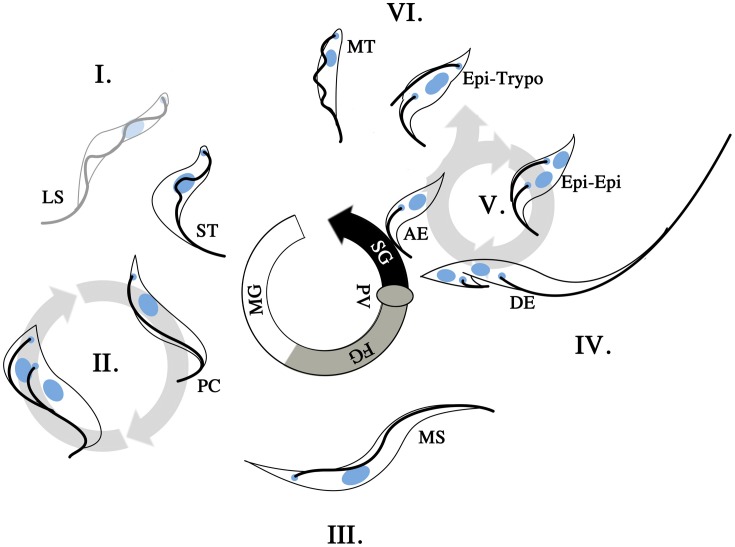
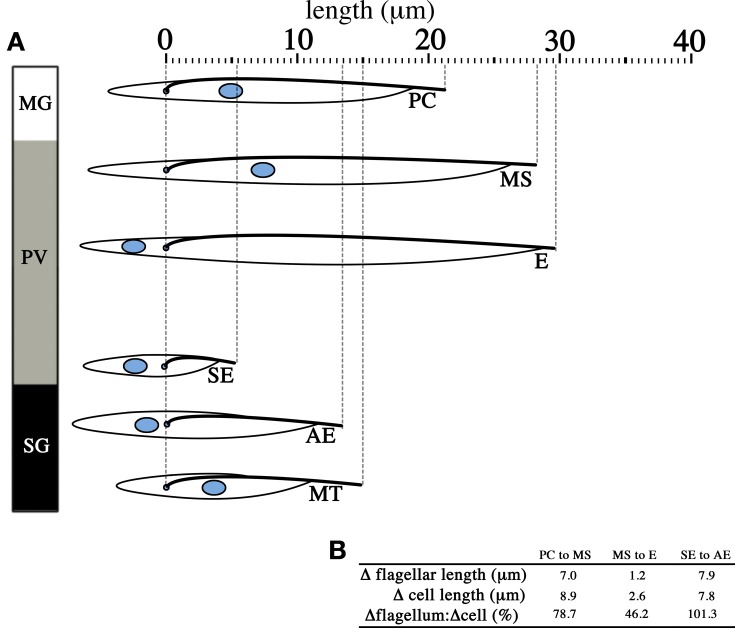
T. brucei, the causative parasite for African trypanosomiasis, faces an interesting dilemma in its life cycle. It has to successfully complete its infection cycle in the tsetse vector to be able to infect other vertebrate hosts. T. brucei has to undergo multiple morphological changes as it invades the alimentary canal of the tsetse to finally achieve infectivity in the salivary glands. In this review, we attempt to elucidate how these morphological changes are possible for a parasite that has evolved a highly robust cell structure to survive the chemically and physically diverse environments it finds itself in. To achieve this, we juxtaposed the experimental evidence that has been collected from T. brucei forms that are cultured in vitro with the observations that have been carried out on tsetse-infective forms in vivo. Although the accumulated knowledge on T. brucei biology is by no means trivial, several outstanding questions remain for how the parasite mechanistically changes its morphology as it traverses the tsetse and how those changes are triggered. However, we conclude that with recent breakthroughs allowing for the replication of the tsetse-infection process of T. brucei in vitro, these outstanding questions can finally be addressed.
布氏锥虫是引起非洲锥虫病的寄生虫,在其生命周期中面临着一个有趣的困境。它必须在采采蝇媒介中成功完成其感染周期,才能感染其他脊椎动物宿主。布氏锥虫在侵入采采蝇的消化道时,必须经历多次形态变化,最终才能在唾液腺中具有感染力。在这篇综述中,我们试图阐明,对于一种已经进化出高度稳健的细胞结构来适应其所处的化学和物理多样化环境的寄生虫,这些形态变化是如何可能发生的。为了实现这一点,我们将从体外培养的布氏锥虫形式中收集的实验证据与在体内对采采蝇感染形式进行的观察进行了对比。尽管关于布氏锥虫生物学的积累知识绝不是微不足道的,但对于寄生虫在穿越采采蝇时如何在机制上改变其形态以及这些变化是如何触发的,仍然存在几个悬而未决的问题。然而,我们得出的结论是,随着最近的突破允许在体外复制布氏锥虫的采采蝇感染过程,这些悬而未决的问题最终可以得到解决。