
ACE ID 和 ACTN3 R577X 多态性对高速力量训练后老年女性下肢功能的影响。
The influence of ACE ID and ACTN3 R577X polymorphisms on lower-extremity function in older women in response to high-speed power training.
机构信息
Department of Health Sciences, Public University of Navarra, Campus of Tudela, Av, de Tarazona s/n,, 31500 Tudela, Navarra, Spain.
出版信息
BMC Geriatr. 2013 Dec 6;13:131. doi: 10.1186/1471-2318-13-131.
BACKGROUND
We studied the influence of the ACE I/D and ACTN3 R577X polymorphisms (single or combined) on lower-extremity function in older women in response to high-speed power training.
METHODS
One hundred and thirty-nine healthy older Caucasian women participated in this study (age: 65.5 ± 8.2 years, body mass: 67.0 ± 10.0 kg and height: 1.57 ± 0.06 m). Walking speed (S10) performance and functional capacity assessed by the "get-up and go" (GUG) mobility test were measured at baseline (T1) and after a consecutive 12-week period of high-speed power training (40-75% of one repetition maximum in arm and leg extensor exercises; 3 sets 4-12 reps, and two power exercises for upper and lower extremity). Genomic DNA was extracted from blood samples, and genotyping analyses were performed by PCR methods. Genotype distributions between groups were compared by Chi-Square test and the gains in physical performance were analyzed by two-way, repeated-measures ANOVA.
RESULTS
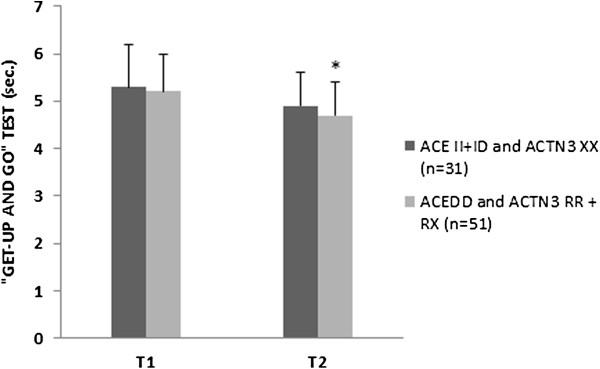
There were no significant differences between genotype groups in men or women for adjusted baseline phenotypes (P > 0.05). ACE I/D and ACTN3 polymorphisms showed a significant interaction genotype-training only in S10 (P = 0.012 and P = 0.044, respectively) and not in the GUG test (P = 0.311 and P = 0.477, respectively). Analyses of the combined effects between genotypes showed no other significant differences in all phenotypes (P < 0.05) at baseline. However, in response to high-speed power training, a significant interaction on walking speed (P = 0.048) was observed between the "power" (ACTN3 RR + RX & ACE DD) versus "non-power" muscularity-oriented genotypes (ACTN3 XX & ACE II + ID)].
CONCLUSIONS
Thus, ACE I/D and ACTN3 R577X polymorphisms are likely candidates in the modulation of exercise-related gait speed phenotype in older women but not a significant influence in mobility traits.
背景
我们研究了 ACE I/D 和 ACTN3 R577X 多态性(单一或联合)对接受高速动力训练的老年女性下肢功能的影响。
方法
本研究纳入了 139 名健康的老年白种女性(年龄:65.5 ± 8.2 岁,体重:67.0 ± 10.0 kg,身高:1.57 ± 0.06 m)。在基线(T1)和连续 12 周的高速动力训练后(手臂和腿部伸肌运动的 40-75%一次重复最大值;3 组 4-12 次重复,上肢和下肢各 2 项力量运动),使用“起身和行走”(GUG)移动测试评估步行速度(S10)表现和功能能力。从血样中提取基因组 DNA,并通过 PCR 方法进行基因分型分析。通过卡方检验比较组间基因型分布,采用双向重复测量方差分析分析体能表现的增益。
结果
男性或女性中,ACE I/D 和 ACTN3 多态性在调整后的基线表型上无显著的基因型组间差异(P > 0.05)。ACE I/D 和 ACTN3 多态性仅在 S10 中表现出显著的基因型-训练相互作用(P = 0.012 和 P = 0.044),而在 GUG 测试中无显著相互作用(P = 0.311 和 P = 0.477)。对基因型联合作用的分析表明,在所有表型的基线时均无其他显著差异(P < 0.05)。然而,在接受高速动力训练后,在步行速度方面观察到显著的交互作用(P = 0.048),这种作用发生在“力量”(ACTN3 RR + RX 和 ACE DD)与“非力量”肌肉型基因型(ACTN3 XX 和 ACE II + ID)之间。
结论
因此,ACE I/D 和 ACTN3 R577X 多态性可能是老年女性与运动相关的步态速度表型的调节因子,但对移动能力特征没有显著影响。

 Zotero 插件