Hua Susan, Wu Sherry Y
School of Biomedical Sciences and Pharmacy, The University of Newcastle Callaghan, NSW, Australia.
Front Pharmacol. 2013 Nov 21;4:143. doi: 10.3389/fphar.2013.00143.
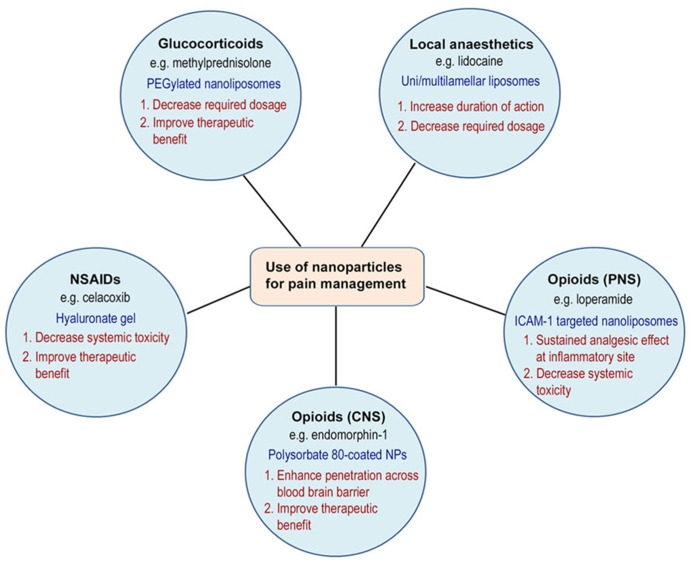
Sustained delivery of analgesic agents at target sites remains a critical issue for effective pain management. The use of nanocarriers has been reported to facilitate effective delivery of these agents to target sites while minimizing systemic toxicity. These include the use of biodegradable liposomal or polymeric carriers. Of these, liposomes present as an attractive delivery system due to their flexible physicochemical properties which allow easy manipulation in order to address different delivery considerations. Their favorable toxicity profiles and ease of large scale production also make their clinical use feasible. In this review, we will discuss the concept of using liposomes as a drug delivery carrier, their in vitro characteristics as well as in vivo behavior. Current advances in the targeted liposomal delivery of analgesic agents and their impacts on the field of pain management will be presented.
在靶位点持续递送镇痛剂仍然是有效疼痛管理的关键问题。据报道,使用纳米载体有助于将这些药物有效递送至靶位点,同时将全身毒性降至最低。这些包括使用可生物降解的脂质体或聚合物载体。其中,脂质体因其灵活的物理化学性质而成为一种有吸引力的递送系统,这种性质允许轻松操作以满足不同的递送考虑因素。它们良好的毒性特征和易于大规模生产也使它们的临床应用成为可能。在这篇综述中,我们将讨论使用脂质体作为药物递送载体的概念、它们的体外特性以及体内行为。还将介绍镇痛剂靶向脂质体递送的当前进展及其对疼痛管理领域的影响。