Arnold Christiane, Gehrig Johannes, Gispert Suzana, Seifried Carola, Kell Christian A
Cognitive Neuroscience Group, Brain Imaging Center, Goethe University, Frankfurt, Germany ; Department of Neurology, Goethe University, Frankfurt, Germany.
Neuroimage Clin. 2013 Oct 31;4:82-97. doi: 10.1016/j.nicl.2013.10.016. eCollection 2014.
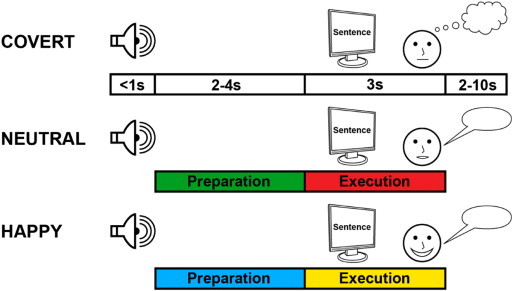
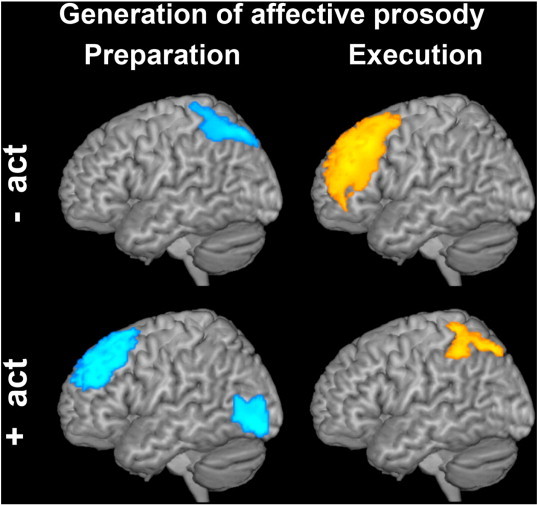
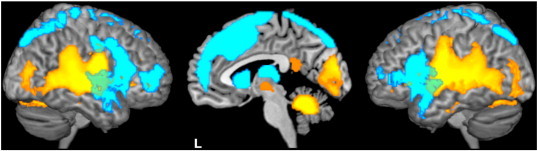
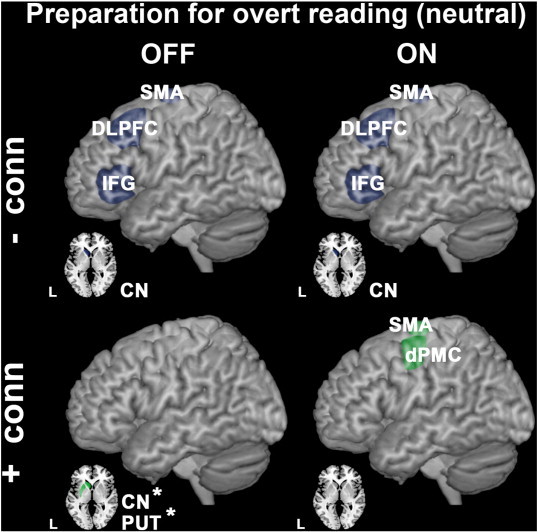
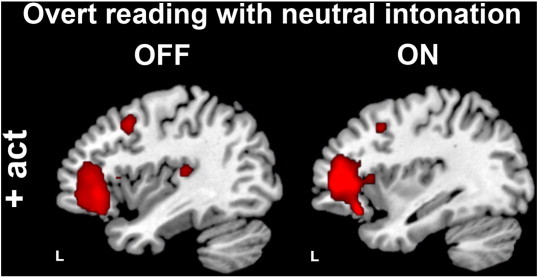
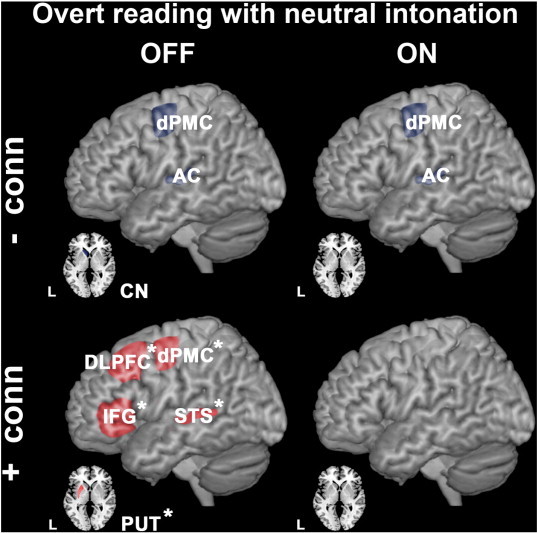
Voice and speech in Parkinson's disease (PD) patients are classically affected by a hypophonia, dysprosody, and dysarthria. The underlying pathomechanisms of these disabling symptoms are not well understood. To identify functional anomalies related to pathophysiology and compensation we compared speech-related brain activity and effective connectivity in early PD patients who did not yet develop voice or speech symptoms and matched controls. During fMRI 20 PD patients ON and OFF levodopa and 20 control participants read 75 sentences covertly, overtly with neutral, or with happy intonation. A cue-target reading paradigm allowed for dissociating task preparation from execution. We found pathologically reduced striato-prefrontal preparatory effective connectivity in early PD patients associated with subcortical (OFF state) or cortical (ON state) compensatory networks. While speaking, PD patients showed signs of diminished monitoring of external auditory feedback. During generation of affective prosody, a reduced functional coupling between the ventral and dorsal striatum was observed. Our results suggest three pathomechanisms affecting speech in PD: While diminished energization on the basis of striato-prefrontal hypo-connectivity together with dysfunctional self-monitoring mechanisms could underlie hypophonia, dysarthria may result from fading speech motor representations given that they are not sufficiently well updated by external auditory feedback. A pathological interplay between the limbic and sensorimotor striatum could interfere with affective modulation of speech routines, which affects emotional prosody generation. However, early PD patients show compensatory mechanisms that could help improve future speech therapies.
帕金森病(PD)患者的声音和言语通常会受到音量减弱、韵律障碍和构音障碍的影响。这些致残症状的潜在病理机制尚未完全明确。为了确定与病理生理学和代偿相关的功能异常,我们比较了尚未出现声音或言语症状的早期PD患者和匹配的对照组中与言语相关的大脑活动及有效连接。在功能磁共振成像(fMRI)期间,20名服用和未服用左旋多巴的PD患者以及20名对照参与者分别以默读、中性语调朗读或欢快语调朗读75个句子。一种线索-目标阅读范式使得能够区分任务准备和执行。我们发现,早期PD患者纹状体-前额叶预备有效连接在病理上降低,这与皮质下(未服药状态)或皮质(服药状态)代偿网络有关。在说话时,PD患者表现出对外在听觉反馈监测减弱的迹象。在产生情感韵律时,观察到腹侧和背侧纹状体之间的功能耦合降低。我们的结果提示了影响PD患者言语的三种病理机制:基于纹状体-前额叶连接减弱以及功能失调的自我监测机制导致的能量供应减少可能是音量减弱的基础,鉴于言语运动表征未被外在听觉反馈充分更新,构音障碍可能是由于言语运动表征消退所致。边缘系统和感觉运动纹状体之间的病理性相互作用可能会干扰言语程序的情感调节,从而影响情感韵律的产生。然而,早期PD患者表现出代偿机制,这可能有助于改善未来的言语治疗。