Centre de Génétique et de Physiologie Moléculaire et Cellulaire, CNRS UMR 5534, Université Lyon 1, Villeurbanne, France.
Eur J Appl Physiol. 2014 Feb;114(2):405-17. doi: 10.1007/s00421-013-2783-8. Epub 2013 Dec 11.
We explored whether altered expression of factors tuning mitochondrial metabolism contributes to muscular adaptations with endurance training in the condition of lowered ambient oxygen concentration (hypoxia) and whether these adaptations relate to oxygen transfer as reflected by subsarcolemmal mitochondria and oxygen metabolism in muscle.
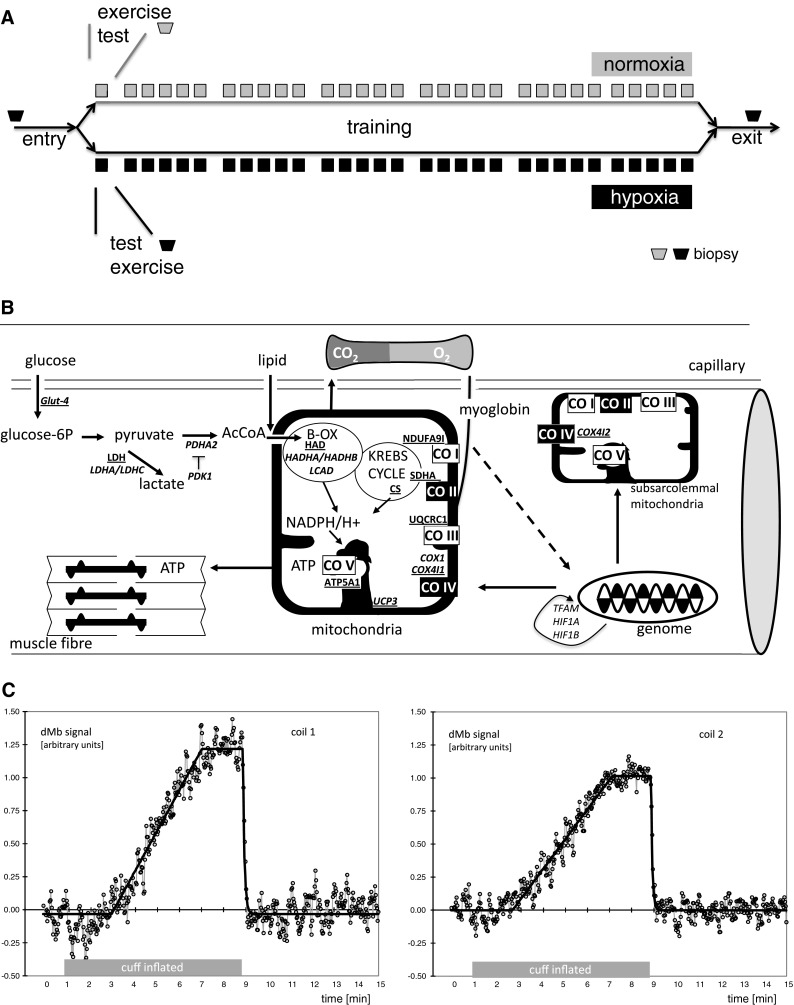
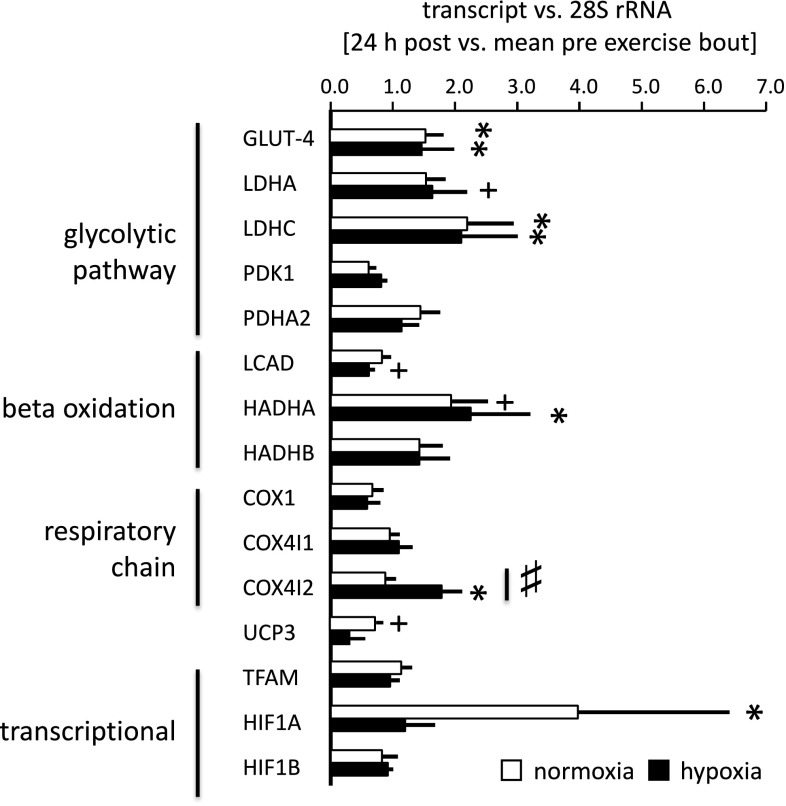
Male volunteers completed 30 bicycle exercise sessions in normoxia or normobaric hypoxia (4,000 m above sea level) at 65% of the respective peak aerobic power output. Myoglobin content, basal oxygen consumption, and re-oxygenation rates upon reperfusion after 8 min of arterial occlusion were measured in vastus muscles by magnetic resonance spectroscopy. Biopsies from vastus lateralis muscle, collected pre and post a single exercise bout, and training, were assessed for levels of transcripts and proteins being associated with mitochondrial metabolism.
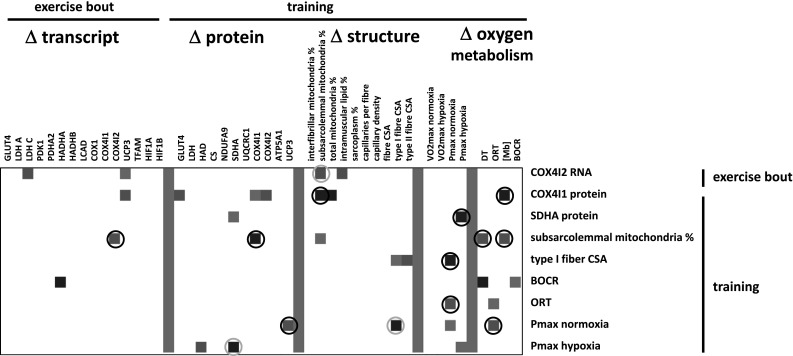
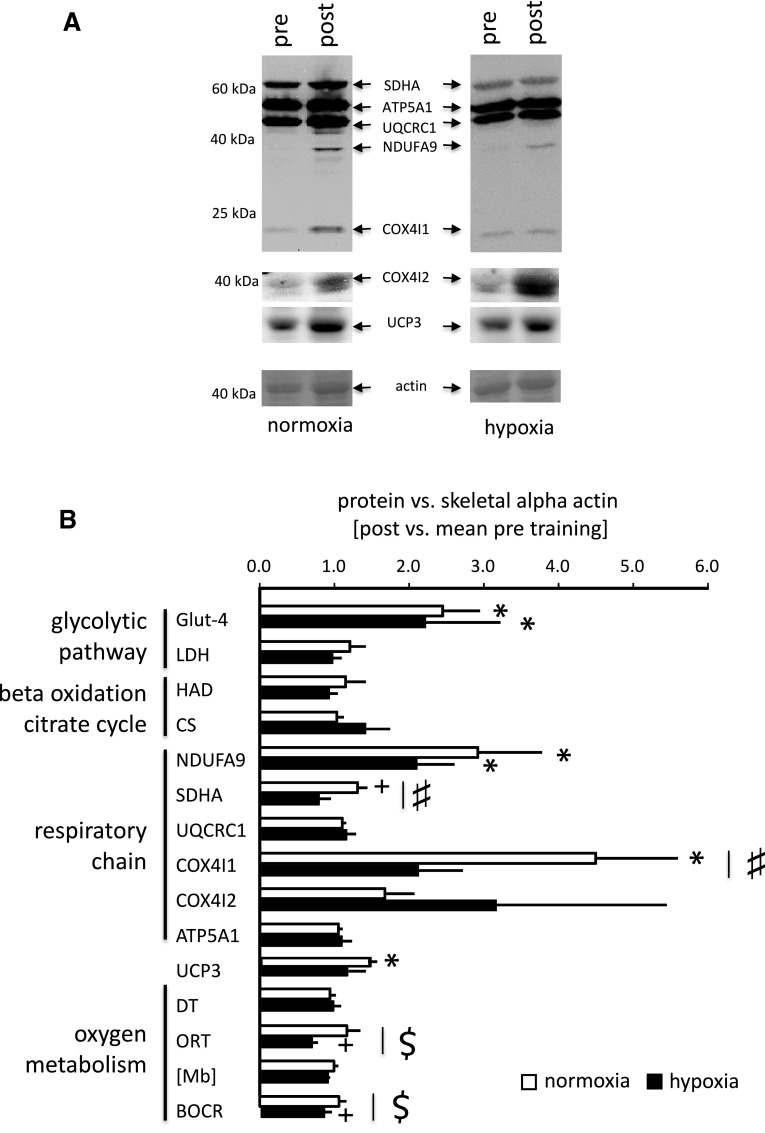
Hypoxia specifically lowered the training-induced expression of markers of respiratory complex II and IV (i.e. SDHA and isoform 1 of COX-4; COX4I1) and preserved fibre cross-sectional area. Concomitantly, trends (p < 0.10) were found for a hypoxia-specific reduction in the basal oxygen consumption rate, and improvements in oxygen repletion, and aerobic performance in hypoxia. Repeated exercise in hypoxia promoted the biogenesis of subsarcolemmal mitochondria and this was co-related to expression of isoform 2 of COX-4 with higher oxygen affinity after single exercise, de-oxygenation time and myoglobin content (r ≥ 0.75). Conversely, expression in COX4I1 with training correlated negatively with changes of subsarcolemmal mitochondria (r < -0.82).
Hypoxia-modulated adjustments of aerobic performance with repeated muscle work are reflected by expressional adaptations within the respiratory chain and modified muscle oxygen metabolism.
我们探讨了在低环境氧浓度(缺氧)条件下,调节线粒体代谢的因子表达的改变是否有助于耐力训练引起的肌肉适应,以及这些适应是否与氧转移有关,后者反映在肌纤维膜下线粒体和肌肉中的氧代谢。
男性志愿者在常氧或常压低氧(海拔 4000 米)条件下,以各自峰值有氧能力的 65%完成 30 次自行车运动。通过磁共振波谱法测量股四头肌中的肌红蛋白含量、基础氧耗量以及动脉闭塞 8 分钟后再灌注时的再氧合率。在单次运动后和训练前、后采集股外侧肌活检,评估与线粒体代谢相关的转录本和蛋白质水平。
缺氧特异性降低了训练诱导的呼吸复合物 II 和 IV 标志物(即 SDHA 和 COX-4 同工型 1;COX4I1)的表达,并保持了纤维横截面积。同时,发现基础氧耗率在缺氧时存在下降趋势(p<0.10),以及在缺氧时的氧再补充和有氧表现得到改善。缺氧时的重复运动促进了肌纤维膜下线粒体的生物发生,这与单次运动后更高氧亲和力的 COX-4 同工型 2表达以及脱氧时间和肌红蛋白含量相关(r≥0.75)。相反,COX4I1 的表达与训练时的肌纤维膜下线粒体变化呈负相关(r<−0.82)。
反复肌肉工作引起的缺氧调节的有氧运动表现变化,反映在呼吸链中的表达适应性和肌肉氧代谢的改变。