Hoving J Claire, Wilson Gillian J, Brown Gordon D
Institute of Infectious Disease and Molecular Medicine, Faculty of Health Sciences, University of Cape Town, Observatory, Cape Town, South Africa.
Cell Microbiol. 2014 Feb;16(2):185-94. doi: 10.1111/cmi.12249. Epub 2014 Jan 10.
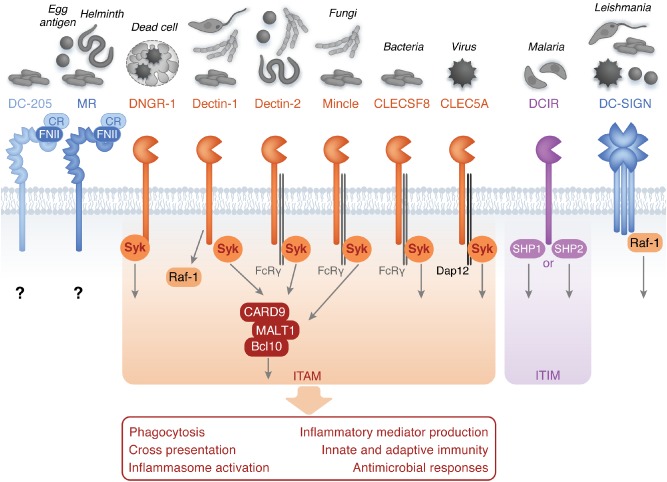
Signalling C-type lectin receptors (CLRs) are crucial in shaping the immune response to fungal pathogens, but comparably little is known about the role of these receptors in bacterial, viral and parasitic infections. CLRs have many diverse functions depending on the signalling motifs in their cytoplasmic domains, and can induce endocytic, phagocytic, antimicrobial, pro-inflammatory or anti-inflammatory responses which are either protective or not during an infection. Understanding the role of CLRs in shaping anti-microbial immunity offers great potential for the future development of therapeutics for disease intervention. In this review we will focus on the recognition of bacterial, viral and parasitic pathogens by CLRs, and how these receptors influence the outcome of infection. We will also provide a brief update on the role of CLRs in antifungal immunity.
信号传导C型凝集素受体(CLRs)在塑造针对真菌病原体的免疫反应中至关重要,但对于这些受体在细菌、病毒和寄生虫感染中的作用,人们了解得相对较少。CLRs根据其胞质结构域中的信号基序具有多种不同功能,并且可以诱导内吞、吞噬、抗菌、促炎或抗炎反应,这些反应在感染期间可能具有保护作用,也可能没有。了解CLRs在塑造抗微生物免疫中的作用为疾病干预治疗的未来发展提供了巨大潜力。在本综述中,我们将重点关注CLRs对细菌、病毒和寄生虫病原体的识别,以及这些受体如何影响感染结果。我们还将简要介绍CLRs在抗真菌免疫中的作用。