Institute of Molecular Biology (IMB), Mainz, Germany.
PLoS Comput Biol. 2013;9(12):e1003357. doi: 10.1371/journal.pcbi.1003357. Epub 2013 Dec 5.
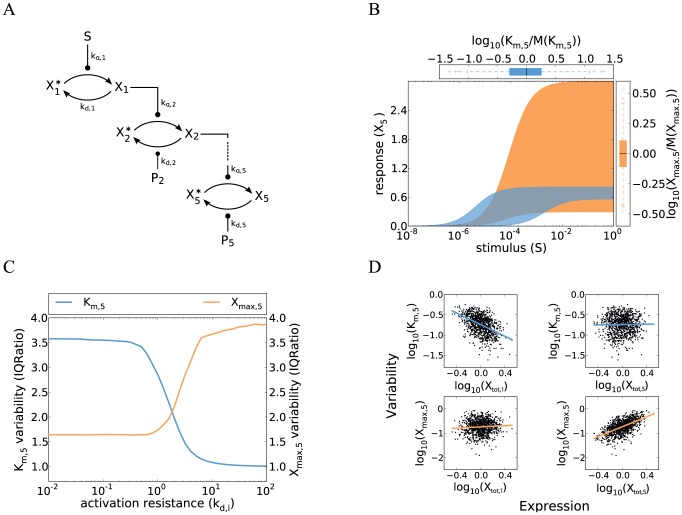
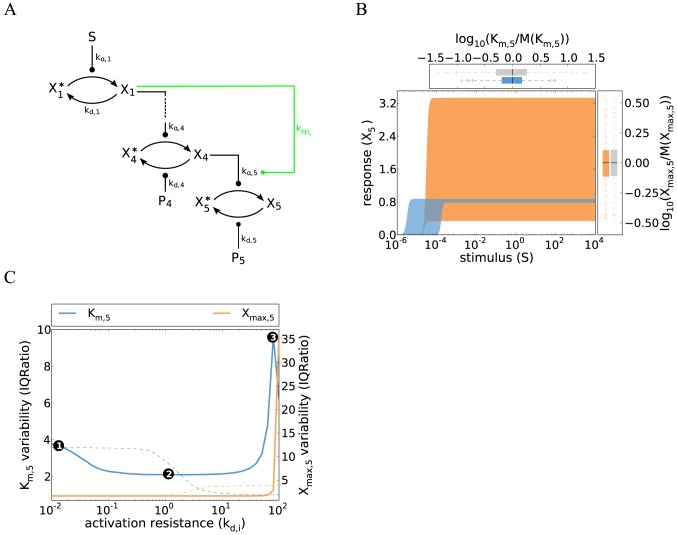
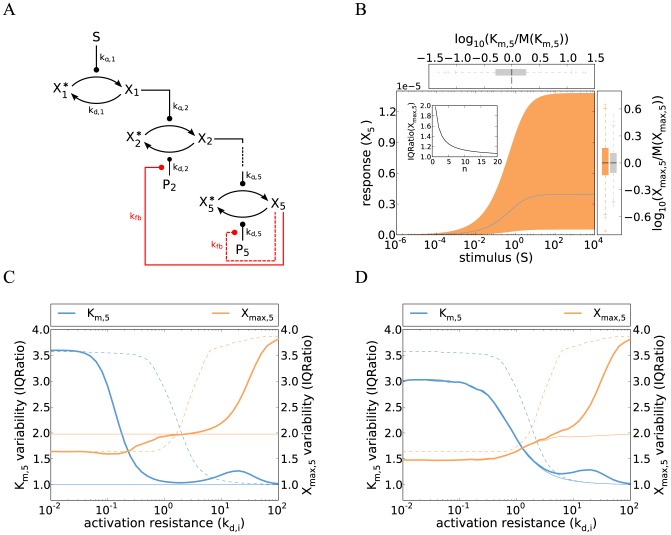
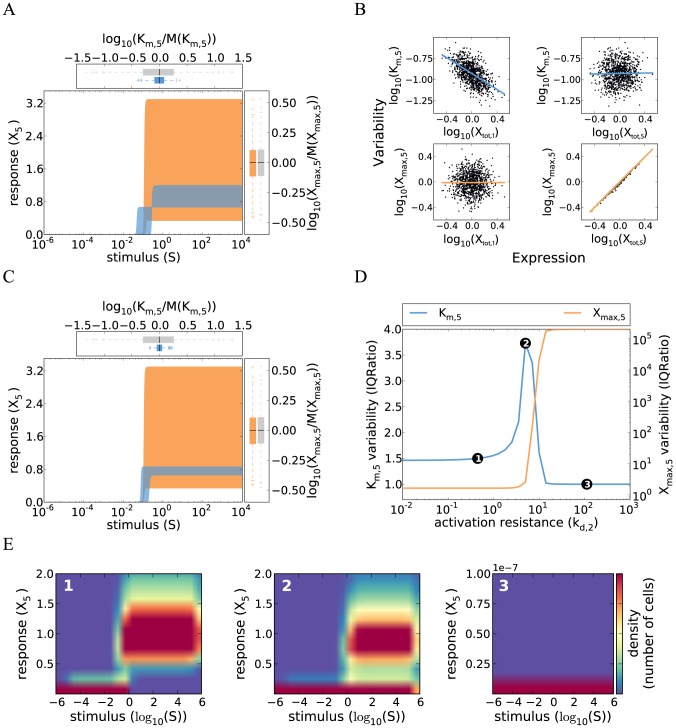
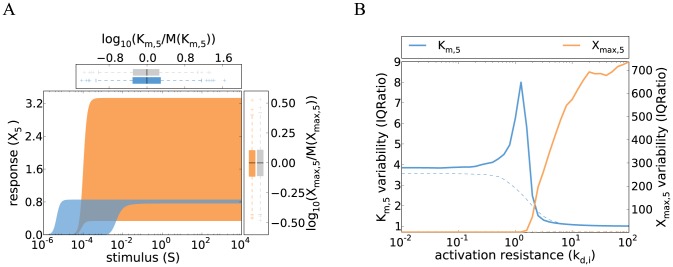
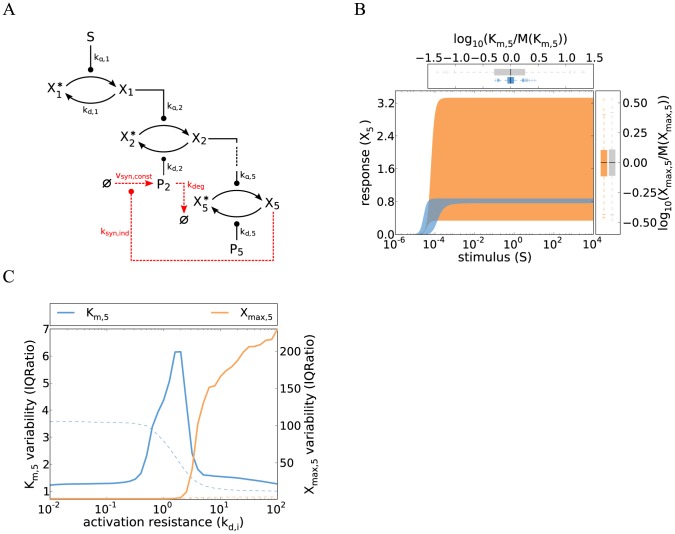
Cells reliably sense environmental changes despite internal and external fluctuations, but the mechanisms underlying robustness remain unclear. We analyzed how fluctuations in signaling protein concentrations give rise to cell-to-cell variability in protein kinase signaling using analytical theory and numerical simulations. We characterized the dose-response behavior of signaling cascades by calculating the stimulus level at which a pathway responds ('pathway sensitivity') and the maximal activation level upon strong stimulation. Minimal kinase cascades with gradual dose-response behavior show strong variability, because the pathway sensitivity and the maximal activation level cannot be simultaneously invariant. Negative feedback regulation resolves this trade-off and coordinately reduces fluctuations in the pathway sensitivity and maximal activation. Feedbacks acting at different levels in the cascade control different aspects of the dose-response curve, thereby synergistically reducing the variability. We also investigated more complex, ultrasensitive signaling cascades capable of switch-like decision making, and found that these can be inherently robust to protein concentration fluctuations. We describe how the cell-to-cell variability of ultrasensitive signaling systems can be actively regulated, e.g., by altering the expression of phosphatase(s) or by feedback/feedforward loops. Our calculations reveal that slow transcriptional negative feedback loops allow for variability suppression while maintaining switch-like decision making. Taken together, we describe design principles of signaling cascades that promote robustness. Our results may explain why certain signaling cascades like the yeast pheromone pathway show switch-like decision making with little cell-to-cell variability.
细胞能够可靠地感知环境变化,尽管存在内部和外部波动,但稳健性背后的机制仍不清楚。我们使用分析理论和数值模拟分析了信号蛋白浓度的波动如何导致蛋白激酶信号在细胞间产生变异性。我们通过计算信号通路响应的刺激水平(“通路灵敏度”)和强刺激时的最大激活水平来表征信号级联的剂量反应行为。具有逐渐剂量反应行为的最小激酶级联显示出很强的变异性,因为通路灵敏度和最大激活水平不能同时不变。负反馈调节解决了这种权衡,并协调降低了通路灵敏度和最大激活的波动。反馈作用于级联中的不同水平,控制着剂量反应曲线的不同方面,从而协同降低变异性。我们还研究了更复杂的、超敏感的信号级联,这些级联能够进行类似于开关的决策,并且发现这些级联可以对蛋白浓度波动固有地稳健。我们描述了如何主动调节超敏感信号系统的细胞间变异性,例如,通过改变磷酸酶的表达或通过反馈/前馈回路。我们的计算表明,缓慢的转录负反馈回路允许在保持类似于开关的决策的同时抑制变异性。总之,我们描述了促进稳健性的信号级联设计原则。我们的结果可能解释了为什么某些信号级联,如酵母交配途径,具有很少的细胞间变异性但具有类似于开关的决策。