Department of Community Health Sciences, Brock University, St Catharines ON, Canada.
BMC Pediatr. 2013 Dec 17;13:208. doi: 10.1186/1471-2431-13-208.
Adverse childhood experiences (ACEs), such as abuse, household dysfunction, and neglect, have been shown to increase adults' risk of developing chronic conditions and risk factors for chronic conditions, including cardiovascular disease (CVD). Much less work has investigated the effect of ACEs on children's physical health status that may lead to adult chronic health conditions. Therefore, the present study examined the relationship between ACEs and early childhood risk factors for adult cardiovascular disease.
1 234 grade six to eight students participated in school-based data collection, which included resting measures of blood pressure (BP), heart rate (HR), body mass index (BMI) and waist circumference (WC). Parents of these children completed an inventory of ACEs taken from the Childhood Trust Events Survey. Linear regression models were used to assess the relationship between experiencing more than 4 ACEs experienced, systolic BP, HR, BMI and WC. In additional analysis, ACEs were assessed ordinally in their relationship with systolic BP, HR, and BMI as well as clinical obesity and hypertension status.
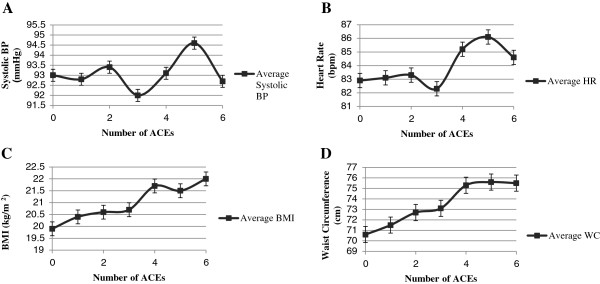
After adjustment for family education, income, age, sex, physical activity, and parental history of hypertension, and WC for HR models, four or more ACEs had a significant effect on HR (b = 1.8 bpm, 95% CI (0.1-3.6)) BMI (b =1.1 kg/m2, 95% CI (0.5-1.8)), and WC (b = 3.6 cm, 95% CI (1.8-5.3)). A dose-response relationship between ACE accumulation and both BMI and WC was also found to be significant. Furthermore, accumulation of 4 or more ACEs was significantly associated with clinical obesity (95th percentile), after controlling for the aforementioned covariates.
In a community sample of grade six to eight children, accumulation of 4 or more ACEs significantly increased BMI, WC and resting HR. Therefore, risk factors related to reported associations between ACEs and cardiovascular outcomes among adults are identifiable in childhood suggesting earlier interventions to reduce CVD risk are required.
不良的童年经历(ACEs),如虐待、家庭功能障碍和忽视,已被证明会增加成年人患慢性病和慢性病风险因素的风险,包括心血管疾病(CVD)。但很少有研究调查 ACEs 对儿童身体健康状况的影响,而这些影响可能会导致成年人的慢性健康问题。因此,本研究调查了 ACEs 与儿童期成年人心血管疾病的早期危险因素之间的关系。
1234 名六年级至八年级的学生参与了基于学校的数据分析,其中包括静息血压(BP)、心率(HR)、体重指数(BMI)和腰围(WC)的测量。这些孩子的家长完成了儿童信托事件调查中 ACEs 的清单。线性回归模型用于评估经历超过 4 次 ACEs 与收缩压、HR、BMI 和 WC 之间的关系。在进一步的分析中,ACEs 以其与收缩压、HR 和 BMI 以及临床肥胖和高血压状态的关系进行了有序评估。
在校正了家庭教育、收入、年龄、性别、体力活动以及父母高血压病史和 WC 与 HR 模型后,4 次或更多 ACEs 对 HR(b=1.8 bpm,95%CI(0.1-3.6))、BMI(b=1.1 kg/m2,95%CI(0.5-1.8))和 WC(b=3.6 cm,95%CI(1.8-5.3))有显著影响。此外,还发现 ACE 积累与 BMI 和 WC 之间的剂量反应关系具有统计学意义。此外,在控制了上述协变量后,积累 4 次或更多 ACEs 与临床肥胖(第 95 百分位数)显著相关。
在六年级至八年级儿童的社区样本中,4 次或更多 ACEs 的积累显著增加了 BMI、WC 和静息 HR。因此,可识别与 ACEs 和成年人心血管结局之间报告的关联相关的风险因素在儿童期就存在,这表明需要采取早期干预措施来降低 CVD 风险。