Ferizi Uran, Schneider Torben, Panagiotaki Eleftheria, Nedjati-Gilani Gemma, Zhang Hui, Wheeler-Kingshott Claudia A M, Alexander Daniel C
Department of Computer Science and Centre for Medical Image Computing, University College London, London, UK; NMR Research Unit, Department of Neuroinflammation, Institute of Neurology, University College London, London, UK.
Magn Reson Med. 2014 Dec;72(6):1785-92. doi: 10.1002/mrm.25080. Epub 2013 Dec 17.
Diffusion magnetic resonance imaging (MRI) microstructure imaging provides a unique noninvasive probe into tissue microstructure. The technique relies on biophysically motivated mathematical models, relating microscopic tissue features to the magnetic resonance (MR) signal. This work aims to determine which compartment models of diffusion MRI are best at describing measurements from in vivo human brain white matter.
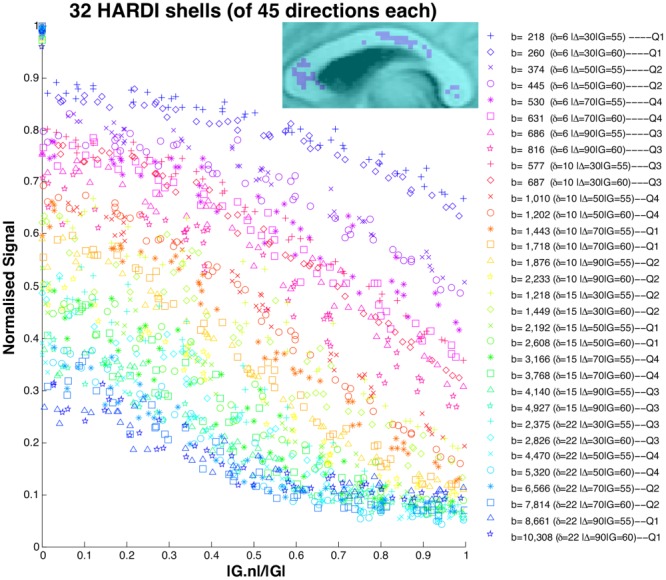
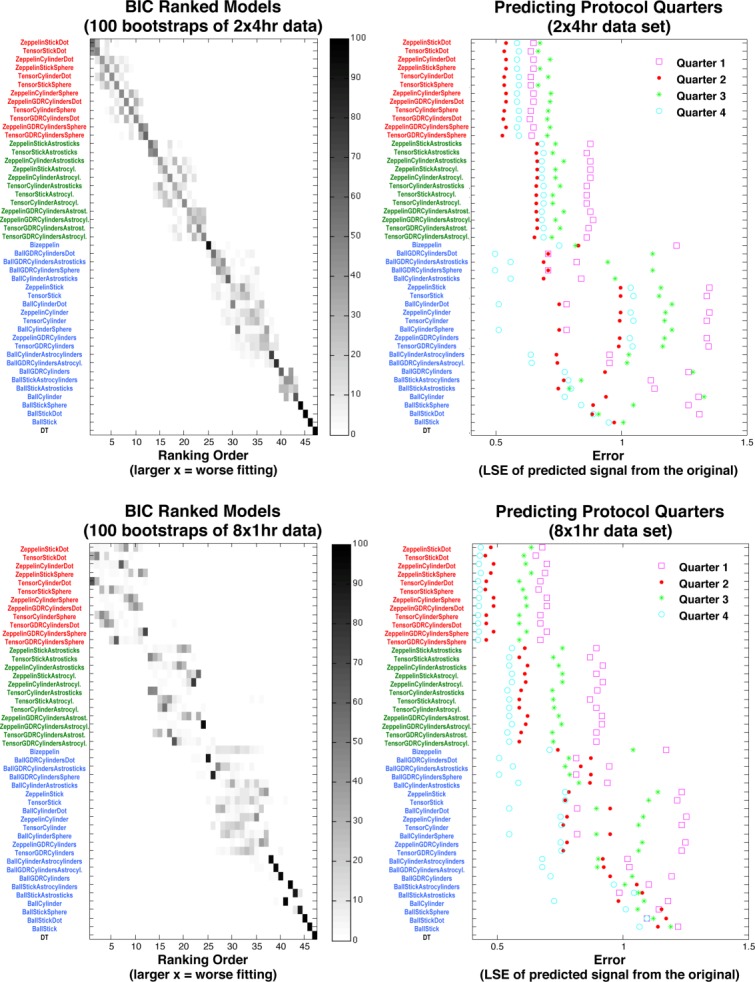
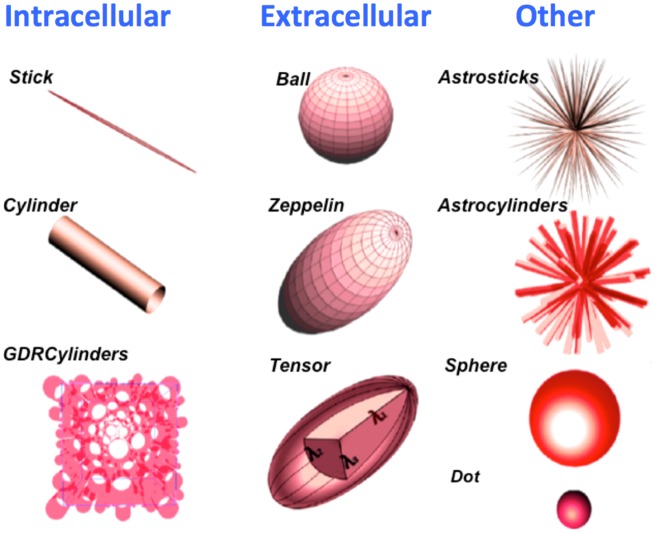
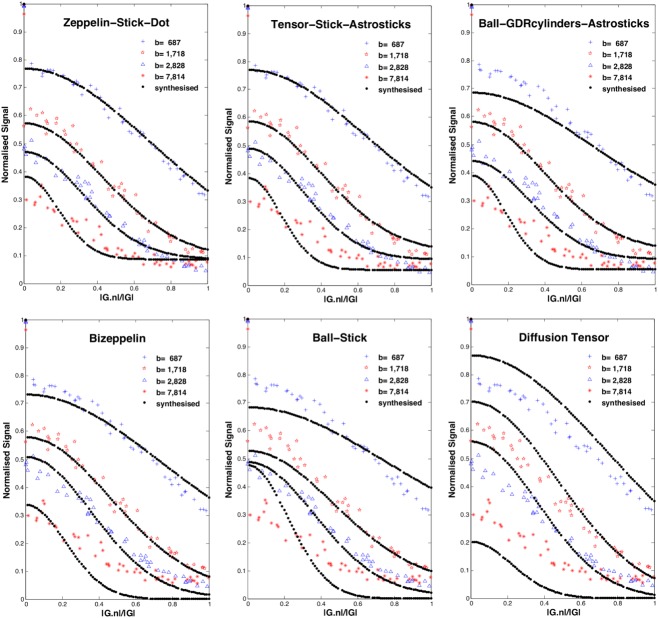
Recent work shows that three compartment models, designed to capture intra-axonal, extracellular, and isotropically restricted diffusion, best explain multi-b-value data sets from fixed rat corpus callosum. We extend this investigation to in vivo by using a live human subject on a clinical scanner. The analysis compares models of one, two, and three compartments and ranks their ability to explain the measured data. We enhance the original methodology to further evaluate the stability of the ranking.
As with fixed tissue, three compartment models explain the data best. However, a clearer hierarchical structure and simpler models emerge. We also find that splitting the scanning into shorter sessions has little effect on the ranking of models, and that the results are broadly reproducible across sessions.
Three compartments are required to explain diffusion MR measurements from in vivo corpus callosum, which informs the choice of model for microstructure imaging applications in the brain.
扩散磁共振成像(MRI)微观结构成像为研究组织微观结构提供了一种独特的非侵入性手段。该技术依赖于基于生物物理学原理的数学模型,将微观组织特征与磁共振(MR)信号联系起来。本研究旨在确定哪种扩散MRI的房室模型最能描述活体人类脑白质的测量结果。
近期研究表明,旨在捕捉轴突内、细胞外和各向同性受限扩散的三室模型,能最好地解释来自固定大鼠胼胝体的多b值数据集。我们通过在临床扫描仪上对一名活体人类受试者进行研究,将这一调查扩展到活体研究。分析比较了一室、二室和三室模型,并对它们解释测量数据的能力进行排名。我们改进了原始方法,以进一步评估排名的稳定性。
与固定组织一样,三室模型对数据的解释效果最佳。然而,出现了更清晰的层次结构和更简单的模型。我们还发现,将扫描分成较短的时间段对模型排名影响不大,并且结果在各时间段之间具有广泛的可重复性。
需要三室模型来解释活体胼胝体的扩散MR测量结果,这为脑部微观结构成像应用中的模型选择提供了依据。