Ferizi Uran, Scherrer Benoit, Schneider Torben, Alipoor Mohammad, Eufracio Odin, Fick Rutger H J, Deriche Rachid, Nilsson Markus, Loya-Olivas Ana K, Rivera Mariano, Poot Dirk H J, Ramirez-Manzanares Alonso, Marroquin Jose L, Rokem Ariel, Pötter Christian, Dougherty Robert F, Sakaie Ken, Wheeler-Kingshott Claudia, Warfield Simon K, Witzel Thomas, Wald Lawrence L, Raya José G, Alexander Daniel C
Centre for Medical Image Computing, Department of Computer Science, University College London, UK.
Department of Radiology, New York University School of Medicine, USA.
NMR Biomed. 2017 Sep;30(9). doi: 10.1002/nbm.3734. Epub 2017 Jun 23.
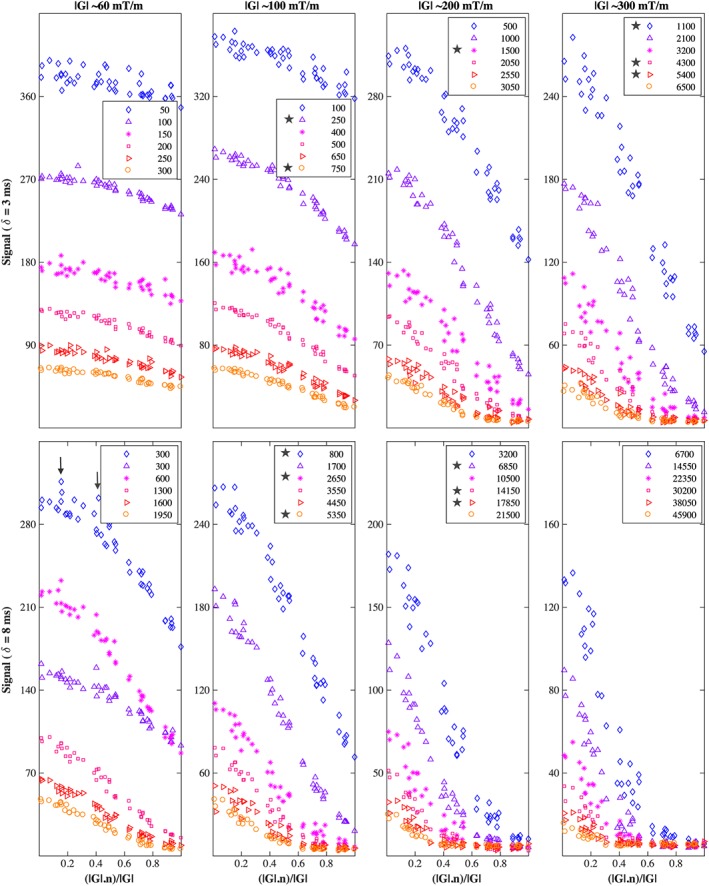
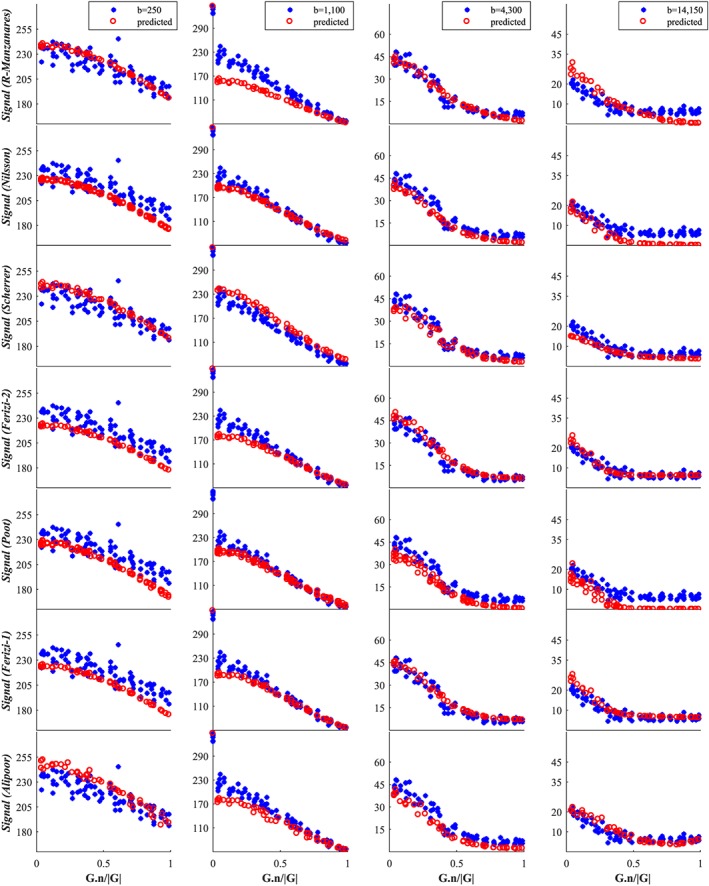
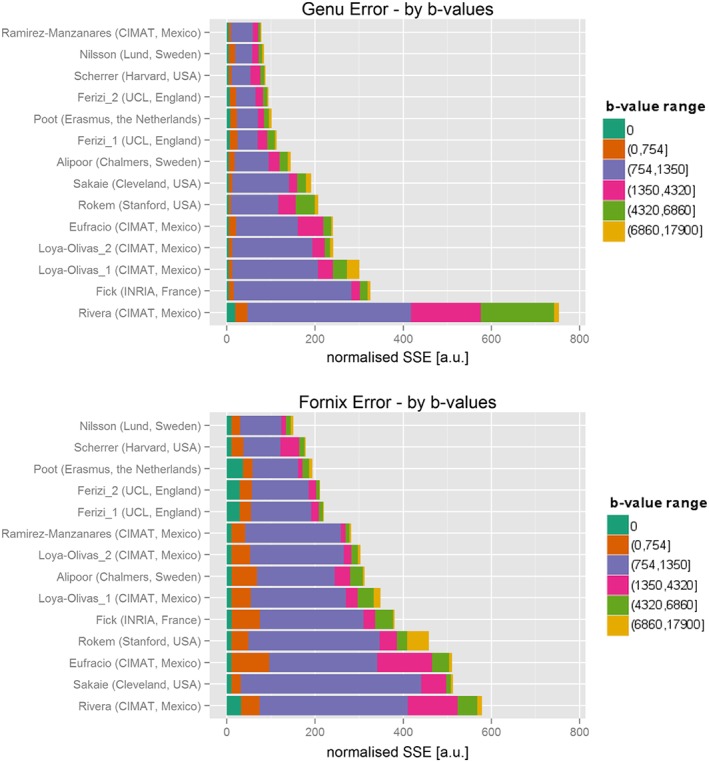
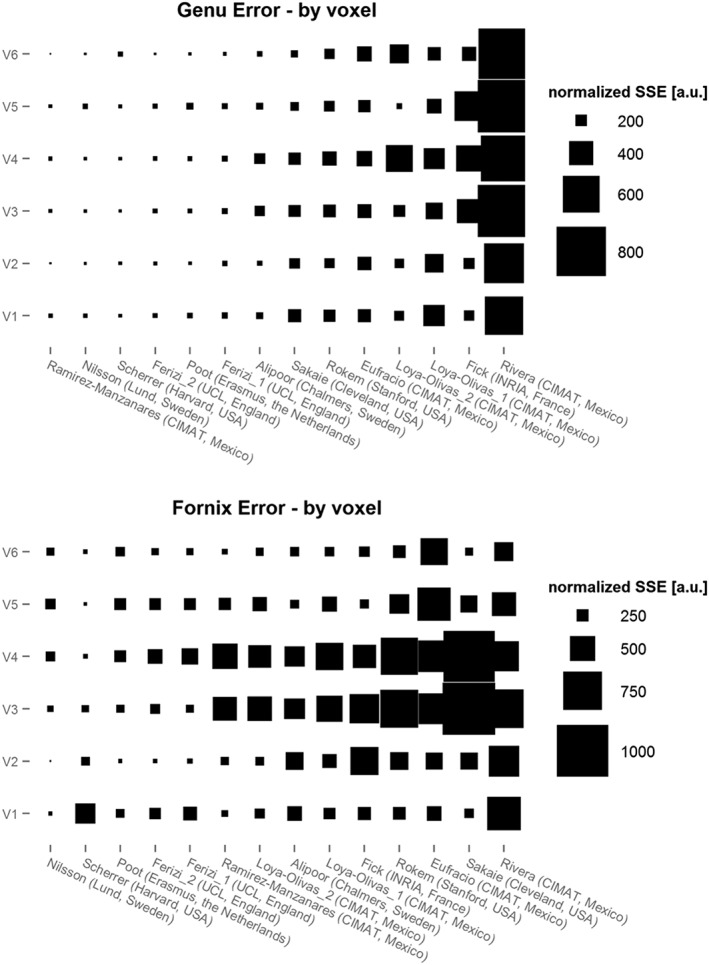
A large number of mathematical models have been proposed to describe the measured signal in diffusion-weighted (DW) magnetic resonance imaging (MRI). However, model comparison to date focuses only on specific subclasses, e.g. compartment models or signal models, and little or no information is available in the literature on how performance varies among the different types of models. To address this deficiency, we organized the 'White Matter Modeling Challenge' during the International Symposium on Biomedical Imaging (ISBI) 2015 conference. This competition aimed to compare a range of different kinds of models in their ability to explain a large range of measurable in vivo DW human brain data. Specifically, we assessed the ability of models to predict the DW signal accurately for new diffusion gradients and b values. We did not evaluate the accuracy of estimated model parameters, as a ground truth is hard to obtain. We used the Connectome scanner at the Massachusetts General Hospital, using gradient strengths of up to 300 mT/m and a broad set of diffusion times. We focused on assessing the DW signal prediction in two regions: the genu in the corpus callosum, where the fibres are relatively straight and parallel, and the fornix, where the configuration of fibres is more complex. The challenge participants had access to three-quarters of the dataset and their models were ranked on their ability to predict the remaining unseen quarter of the data. The challenge provided a unique opportunity for a quantitative comparison of diverse methods from multiple groups worldwide. The comparison of the challenge entries reveals interesting trends that could potentially influence the next generation of diffusion-based quantitative MRI techniques. The first is that signal models do not necessarily outperform tissue models; in fact, of those tested, tissue models rank highest on average. The second is that assuming a non-Gaussian (rather than purely Gaussian) noise model provides little improvement in prediction of unseen data, although it is possible that this may still have a beneficial effect on estimated parameter values. The third is that preprocessing the training data, here by omitting signal outliers, and using signal-predicting strategies, such as bootstrapping or cross-validation, could benefit the model fitting. The analysis in this study provides a benchmark for other models and the data remain available to build up a more complete comparison in the future.
已经提出了大量数学模型来描述扩散加权磁共振成像(DW-MRI)中的测量信号。然而,迄今为止的模型比较仅集中在特定的子类上,例如隔室模型或信号模型,并且文献中几乎没有关于不同类型模型之间性能如何变化的信息。为了弥补这一不足,我们在2015年国际生物医学成像研讨会(ISBI)会议期间组织了“白质建模挑战赛”。该竞赛旨在比较一系列不同类型的模型解释大量可测量的体内DW人脑数据的能力。具体来说,我们评估了模型针对新的扩散梯度和b值准确预测DW信号的能力。由于难以获得真实值,我们没有评估估计模型参数的准确性。我们使用了马萨诸塞州总医院的Connectome扫描仪,其梯度强度高达300 mT/m,并采用了广泛的扩散时间。我们专注于评估两个区域的DW信号预测:胼胝体的膝部,此处纤维相对笔直且平行;以及穹窿,此处纤维的构型更为复杂。挑战赛参与者可以使用四分之三的数据集,并根据他们预测其余四分之一未见数据的能力对其模型进行排名。该挑战赛为全球多个团队的不同方法进行定量比较提供了独特的机会。对挑战赛参赛作品的比较揭示了一些有趣的趋势,这些趋势可能会对下一代基于扩散的定量MRI技术产生潜在影响。第一个趋势是信号模型不一定优于组织模型;事实上,在测试的模型中,组织模型的平均排名最高。第二个趋势是,假设非高斯(而不是纯高斯)噪声模型在预测未见数据方面几乎没有改进,尽管这仍有可能对估计的参数值产生有益影响。第三个趋势是,对训练数据进行预处理,在这里是通过省略信号异常值,并使用诸如自助法或交叉验证等信号预测策略,可能会有利于模型拟合。本研究中的分析为其他模型提供了一个基准,并且这些数据仍然可用,以便在未来进行更全面的比较。