Department of Neurochemistry and Molecular Biology, Leibniz Institute for Neurobiology Magdeburg, Germany.
Research Group Presynaptic Plasticity, Leibniz Institute for Neurobiology Magdeburg, Germany.
Front Cell Neurosci. 2013 Dec 3;7:244. doi: 10.3389/fncel.2013.00244.
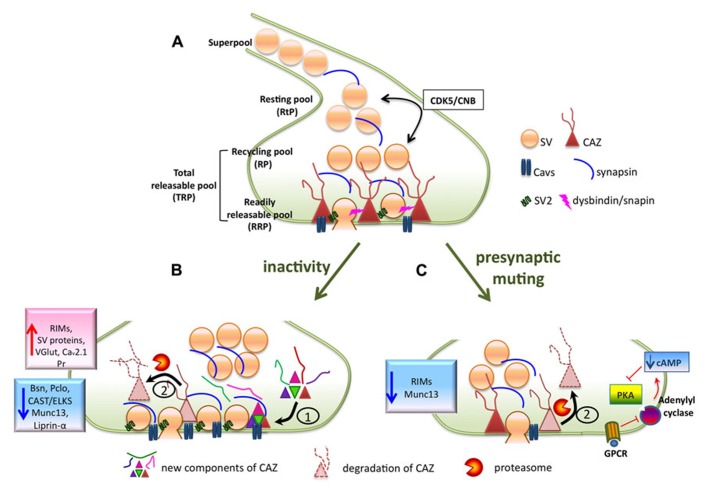
Homeostatic plasticity is a process by which neurons adapt to the overall network activity to keep their firing rates in a reasonable range. At the cellular level this kind of plasticity comprises modulation of cellular excitability and tuning of synaptic strength. In this review we concentrate on presynaptic homeostatic plasticity controlling the efficacy of neurotransmitter release from presynaptic boutons. While morphological and electrophysiological approaches were successful to describe homeostatic plasticity-induced changes in the presynaptic architecture and function, cellular and molecular mechanisms underlying those modifications remained largely unknown for a long time. We summarize the latest progress made in the understanding of homeostasis-induced regulation of different steps of the synaptic vesicle cycle and the molecular machineries involved in this process. We particularly focus on the role of presynaptic scaffolding proteins, which functionally and spatially organize synaptic vesicle clusters, neurotransmitter release sites and the associated endocytic machinery. These proteins turned out to be major presynaptic substrates for remodeling during homeostatic plasticity. Finally, we discuss cellular processes and signaling pathways acting during homeostatic molecular remodeling and their potential involvement in the maladaptive plasticity occurring in multiple neuropathologic conditions such as neurodegeneration, epilepsy and neuropsychiatric disorders.
稳态可塑性是神经元适应整体网络活动的过程,以保持其发射率在合理范围内。在细胞水平上,这种可塑性包括细胞兴奋性的调制和突触强度的调谐。在这篇综述中,我们集中讨论了控制神经递质从突触前末梢释放效率的突触前稳态可塑性。虽然形态学和电生理学方法成功地描述了稳态可塑性诱导的突触前结构和功能的变化,但很长一段时间以来,这些修饰背后的细胞和分子机制在很大程度上仍然未知。我们总结了在理解参与这一过程的不同突触囊泡循环步骤的稳态诱导调节以及相关分子机制方面所取得的最新进展。我们特别关注突触前支架蛋白的作用,这些蛋白在功能和空间上组织突触囊泡簇、神经递质释放位点和相关的内吞机制。这些蛋白质被证明是稳态可塑性过程中重塑的主要突触前底物。最后,我们讨论了在稳态分子重塑过程中起作用的细胞过程和信号通路,以及它们在多种神经病理条件(如神经退行性变、癫痫和神经精神障碍)中发生的适应性可塑性中的潜在作用。