Departamento de Inteligencia Artificial, Facultad de Informática, Universidad Politécnica de Madrid Madrid, Spain ; Intelligent Systems Group, Department of Computer Science and Artificial Intelligence, University of The Basque Country San Sebastian, Spain.
Department Biological Sciences, Columbia University New York, NY, USA.
Front Neural Circuits. 2013 Dec 3;7:185. doi: 10.3389/fncir.2013.00185. eCollection 2013.
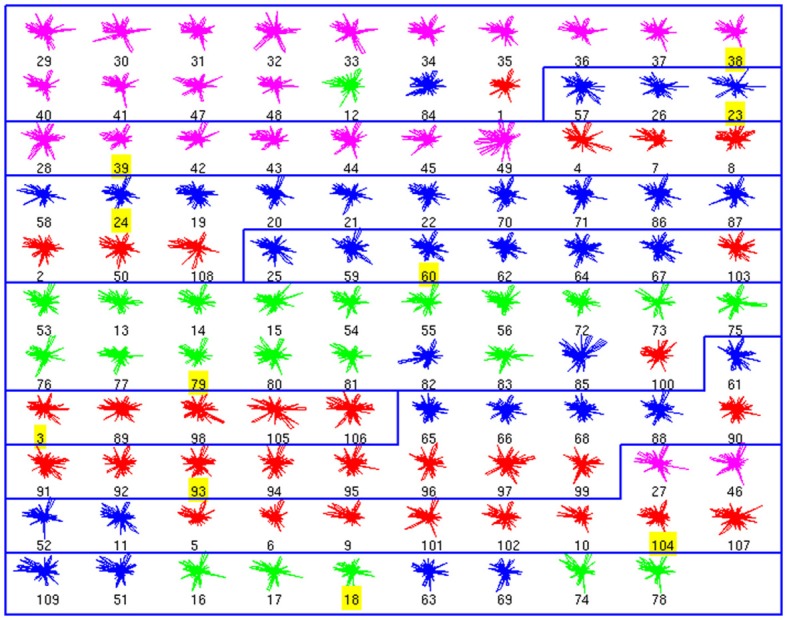
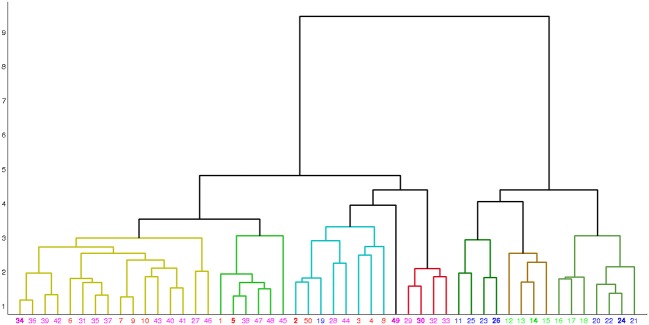
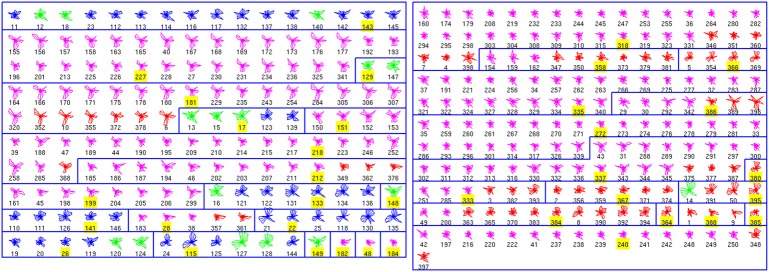
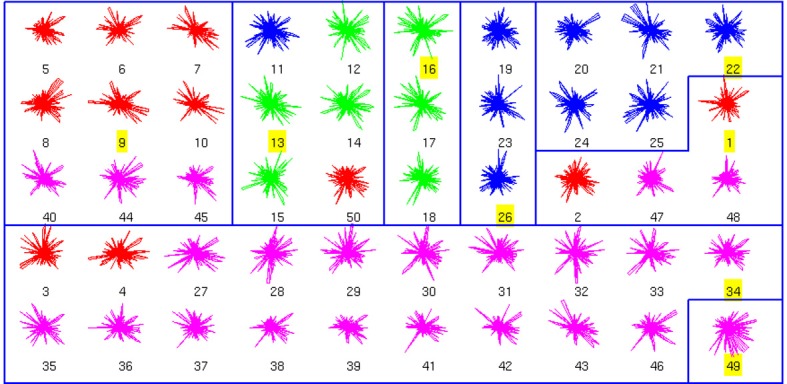
In spite of over a century of research on cortical circuits, it is still unknown how many classes of cortical neurons exist. In fact, neuronal classification is a difficult problem because it is unclear how to designate a neuronal cell class and what are the best characteristics to define them. Recently, unsupervised classifications using cluster analysis based on morphological, physiological, or molecular characteristics, have provided quantitative and unbiased identification of distinct neuronal subtypes, when applied to selected datasets. However, better and more robust classification methods are needed for increasingly complex and larger datasets. Here, we explored the use of affinity propagation, a recently developed unsupervised classification algorithm imported from machine learning, which gives a representative example or exemplar for each cluster. As a case study, we applied affinity propagation to a test dataset of 337 interneurons belonging to four subtypes, previously identified based on morphological and physiological characteristics. We found that affinity propagation correctly classified most of the neurons in a blind, non-supervised manner. Affinity propagation outperformed Ward's method, a current standard clustering approach, in classifying the neurons into 4 subtypes. Affinity propagation could therefore be used in future studies to validly classify neurons, as a first step to help reverse engineer neural circuits.
尽管皮质电路的研究已经超过一个世纪,但仍不清楚皮质神经元存在多少类。事实上,神经元分类是一个难题,因为不清楚如何指定神经元细胞类,以及什么是定义它们的最佳特征。最近,基于形态、生理或分子特征的无监督聚类分析,在应用于选定的数据集时,为特定的神经元亚型提供了定量和无偏的识别。然而,对于越来越复杂和更大的数据集,需要更好和更稳健的分类方法。在这里,我们探讨了使用亲和传播的方法,这是一种从机器学习中引入的新的无监督分类算法,它为每个聚类提供了一个有代表性的示例或代表。作为一个案例研究,我们将亲和传播应用于一个 337 个中间神经元的测试数据集,这些神经元属于四个之前根据形态和生理特征确定的亚型。我们发现,亲和传播以盲目的、非监督的方式正确地对大多数神经元进行了分类。亲和传播在将神经元分为 4 个亚型方面优于 Ward 方法,这是一种当前的标准聚类方法。因此,亲和传播可以在未来的研究中用于有效分类神经元,作为帮助反向工程神经电路的第一步。