Bernstein Center for Computational Neuroscience Berlin, Germany ; Department of Physics, Humboldt Universität zu Berlin Berlin, Germany.
Front Comput Neurosci. 2013 Nov 29;7:164. doi: 10.3389/fncom.2013.00164. eCollection 2013.
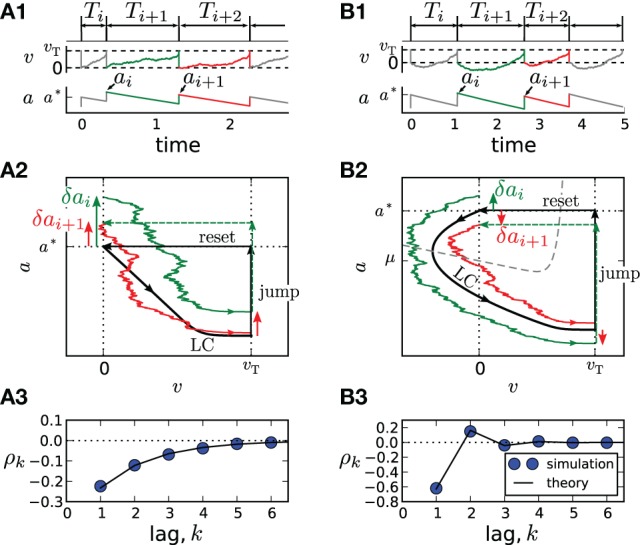
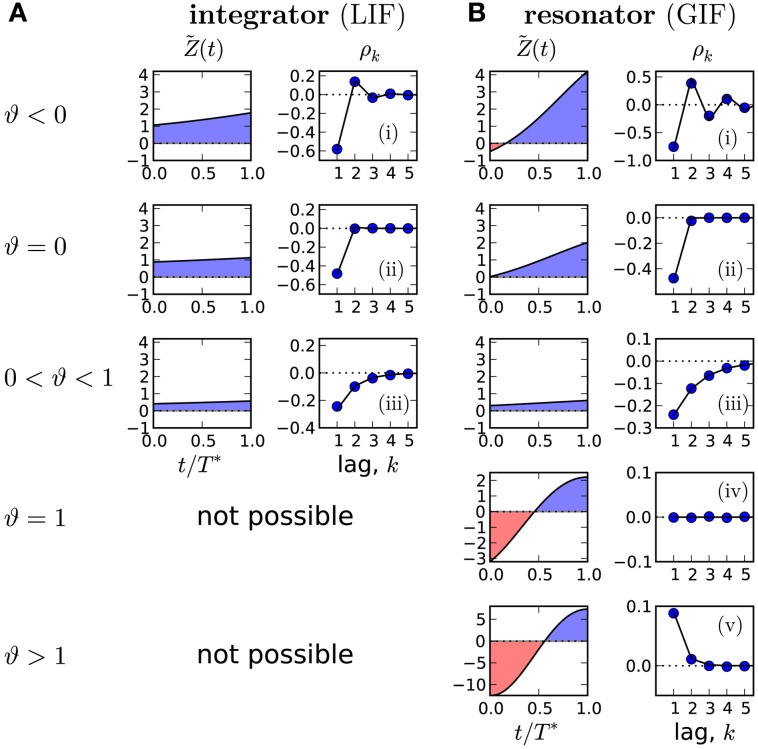
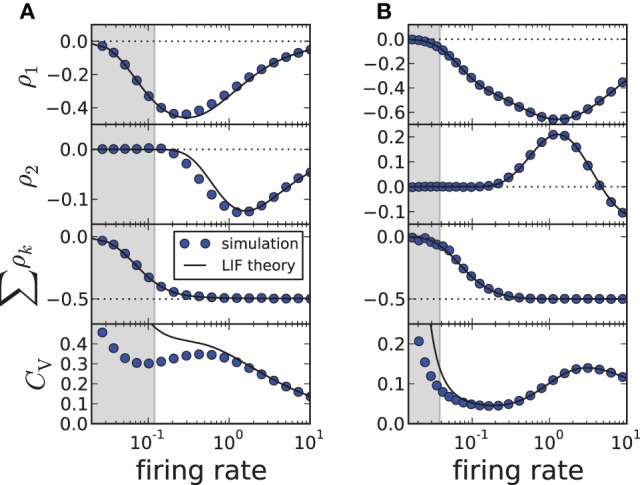
Neural firing is often subject to negative feedback by adaptation currents. These currents can induce strong correlations among the time intervals between spikes. Here we study analytically the interval correlations of a broad class of noisy neural oscillators with spike-triggered adaptation of arbitrary strength and time scale. Our weak-noise theory provides a general relation between the correlations and the phase-response curve (PRC) of the oscillator, proves anti-correlations between neighboring intervals for adapting neurons with type I PRC and identifies a single order parameter that determines the qualitative pattern of correlations. Monotonically decaying or oscillating correlation structures can be related to qualitatively different voltage traces after spiking, which can be explained by the phase plane geometry. At high firing rates, the long-term variability of the spike train associated with the cumulative interval correlations becomes small, independent of model details. Our results are verified by comparison with stochastic simulations of the exponential, leaky, and generalized integrate-and-fire models with adaptation.
神经放电通常受到适应电流的负反馈。这些电流可以在尖峰之间的时间间隔之间产生强烈的相关性。在这里,我们分析研究了具有任意强度和时间尺度的尖峰触发适应的广泛类噪声神经振荡器的间隔相关性。我们的弱噪声理论提供了振荡器的相关性和相位响应曲线 (PRC) 之间的一般关系,证明了具有 I 型 PRC 的适应神经元的相邻间隔之间的负相关,并确定了一个确定相关性定性模式的单一阶参数。单调衰减或振荡的相关结构可以与尖峰后定性不同的电压轨迹相关联,这可以通过相平面几何来解释。在高发射率下,与累积间隔相关性相关的尖峰序列的长期可变性变得很小,与模型细节无关。我们的结果通过与具有适应的指数、泄漏和广义积分和触发模型的随机模拟进行比较得到了验证。