Kabachinski Greg, Yamaga Masaki, Kielar-Grevstad D Michelle, Bruinsma Stephen, Martin Thomas F J
Department of Biochemistry, University of Wisconsin, Madison, WI 53706.
Mol Biol Cell. 2014 Feb;25(4):508-21. doi: 10.1091/mbc.E12-11-0829. Epub 2013 Dec 19.
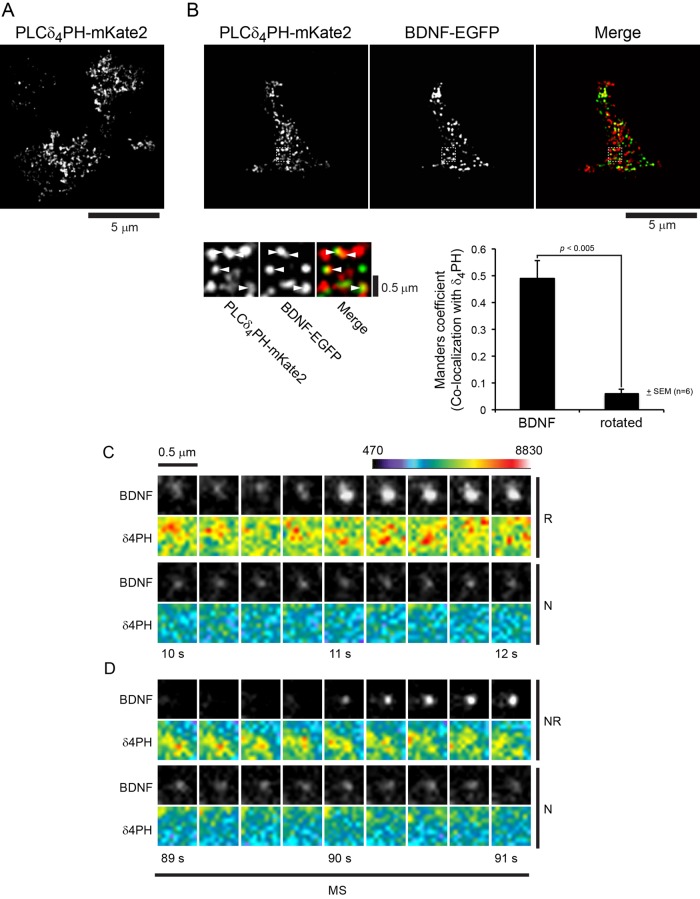
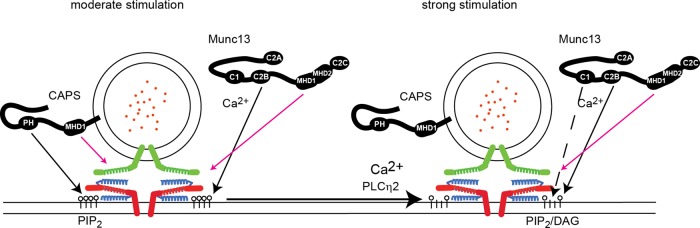
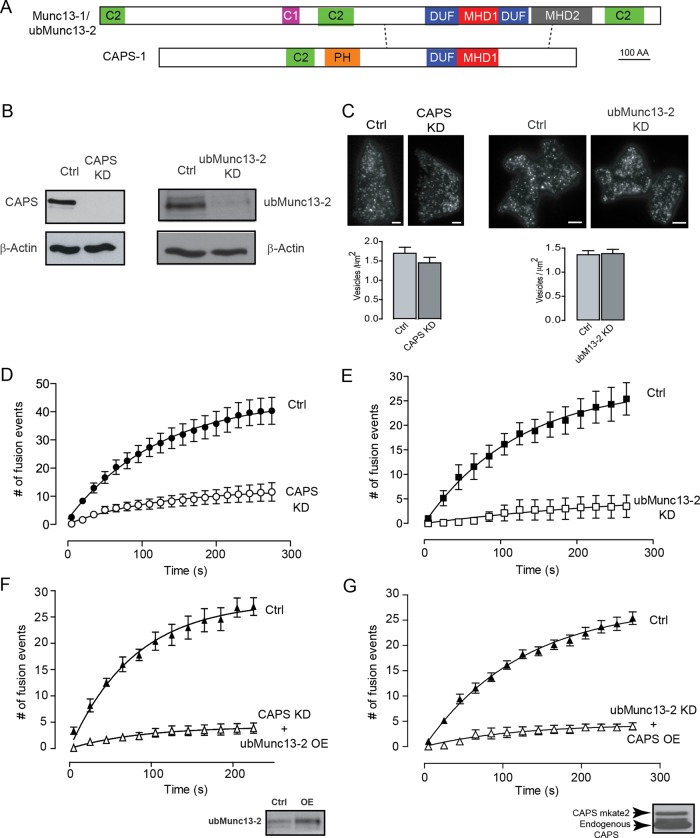
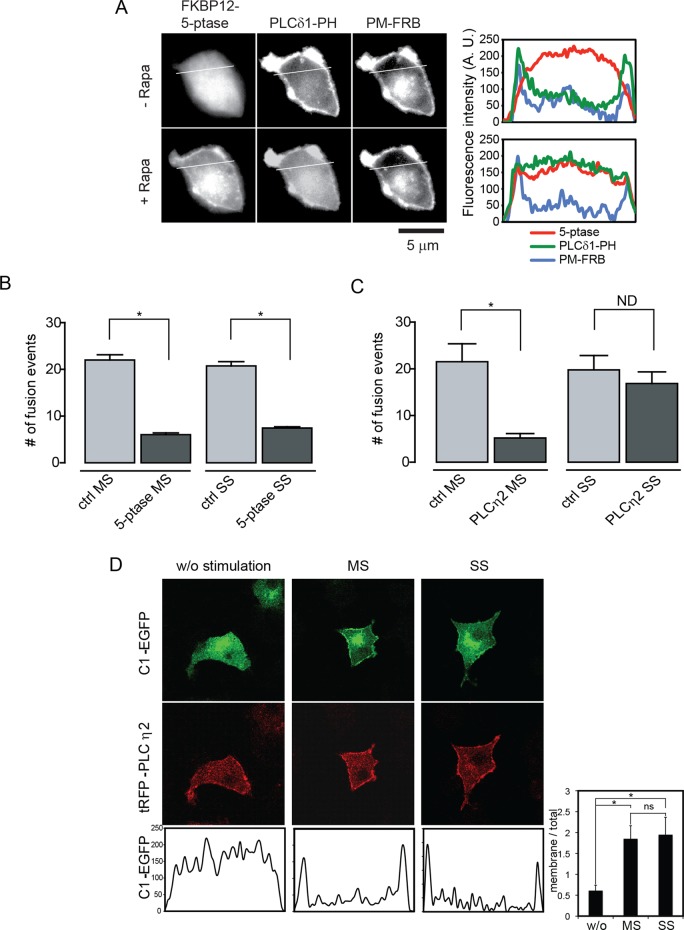
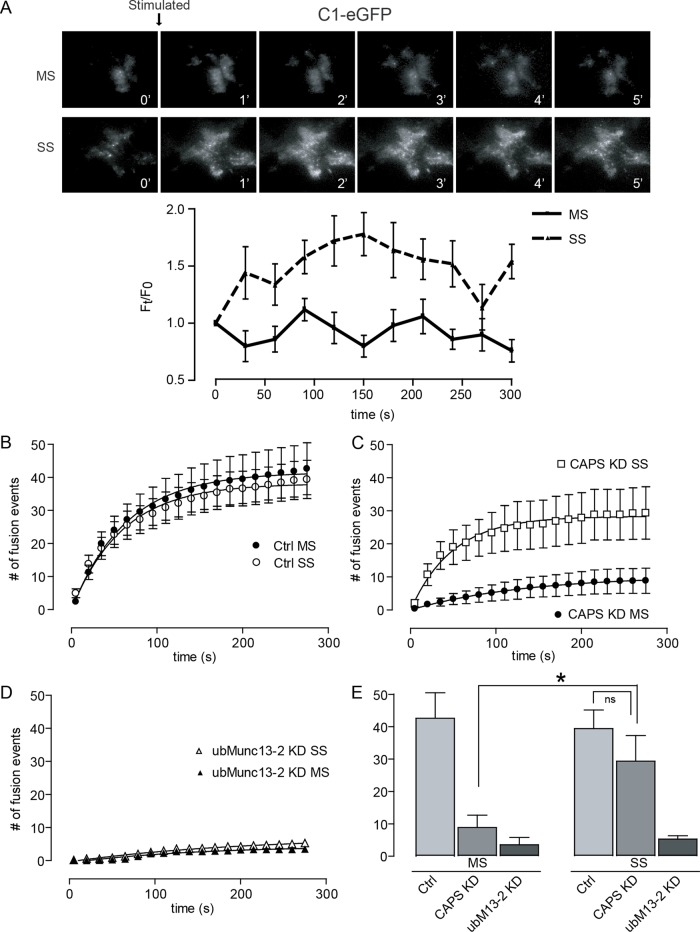
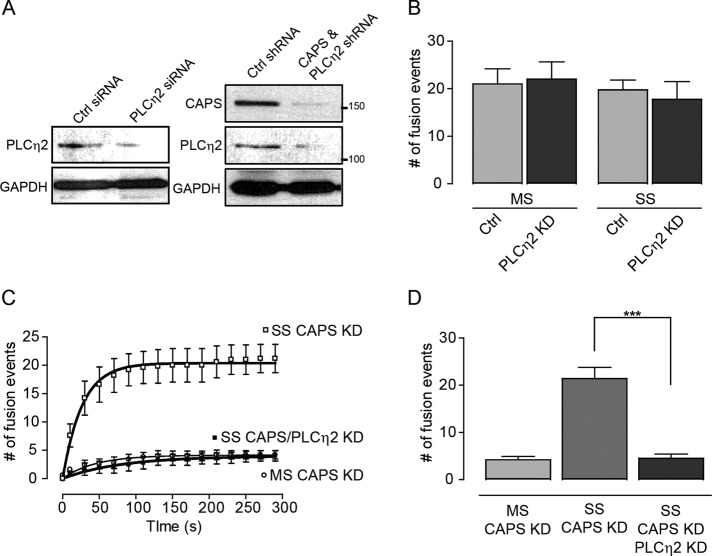
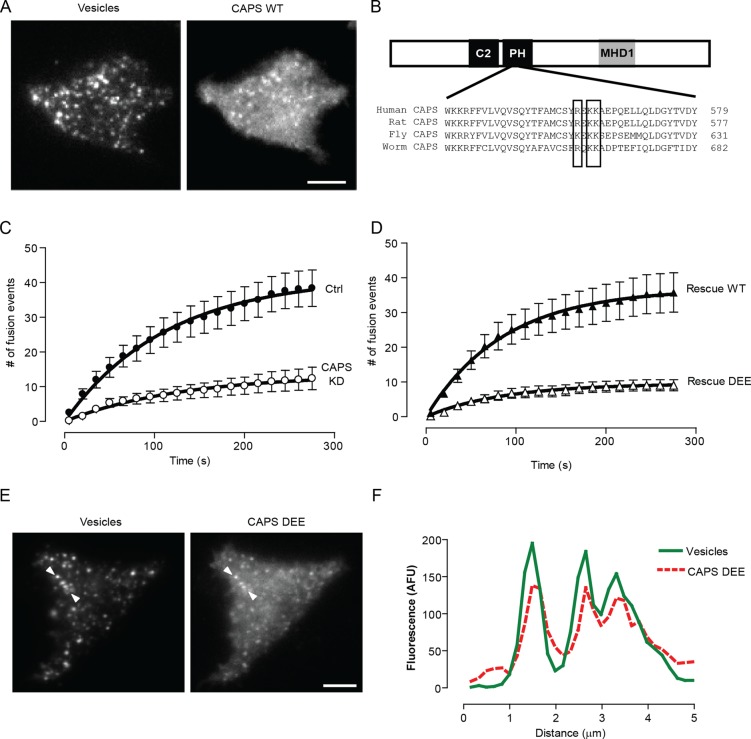
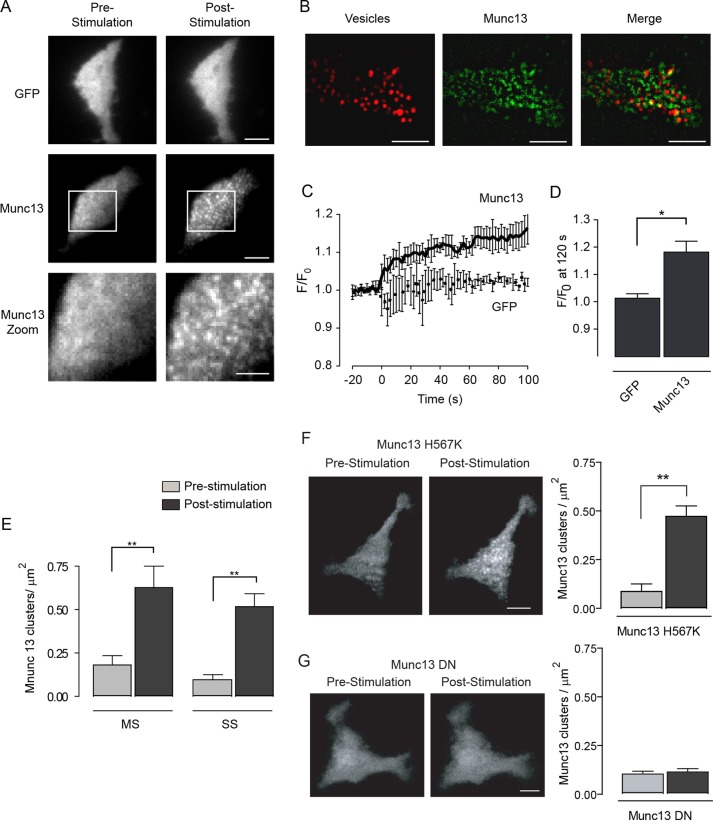
Phosphoinositides provide compartment-specific signals for membrane trafficking. Plasma membrane phosphatidylinositol 4,5-bisphosphate (PIP2) is required for Ca(2+)-triggered vesicle exocytosis, but whether vesicles fuse into PIP2-rich membrane domains in live cells and whether PIP2 is metabolized during Ca(2+)-triggered fusion were unknown. Ca(2+)-dependent activator protein in secretion 1 (CAPS-1; CADPS/UNC31) and ubMunc13-2 (UNC13B) are PIP2-binding proteins required for Ca(2+)-triggered vesicle exocytosis in neuroendocrine PC12 cells. These proteins are likely effectors for PIP2, but their localization during exocytosis had not been determined. Using total internal reflection fluorescence microscopy in live cells, we identify PIP2-rich membrane domains at sites of vesicle fusion. CAPS is found to reside on vesicles but depends on plasma membrane PIP2 for its activity. Munc13 is cytoplasmic, but Ca(2+)-dependent translocation to PIP2-rich plasma membrane domains is required for its activity. The results reveal that vesicle fusion into PIP2-rich membrane domains is facilitated by sequential PIP2-dependent activation of CAPS and PIP2-dependent recruitment of Munc13. PIP2 hydrolysis only occurs under strong Ca(2+) influx conditions sufficient to activate phospholipase Cη2 (PLCη2). Such conditions reduce CAPS activity and enhance Munc13 activity, establishing PLCη2 as a Ca(2+)-dependent modulator of exocytosis. These studies provide a direct view of the spatial distribution of PIP2 linked to vesicle exocytosis via regulation of lipid-dependent protein effectors CAPS and Munc13.
磷酸肌醇为膜运输提供特定区域的信号。质膜磷脂酰肌醇4,5 - 二磷酸(PIP2)是Ca(2+)触发的囊泡胞吐作用所必需的,但在活细胞中囊泡是否融合到富含PIP2的膜结构域以及在Ca(2+)触发的融合过程中PIP2是否被代谢尚不清楚。分泌1中的Ca(2+)依赖性激活蛋白(CAPS - 1;CADPS/UNC31)和泛素化的Munc13 - 2(UNC13B)是神经内分泌PC12细胞中Ca(2+)触发的囊泡胞吐作用所必需的PIP2结合蛋白。这些蛋白可能是PIP2的效应器,但它们在胞吐过程中的定位尚未确定。利用活细胞中的全内反射荧光显微镜,我们在囊泡融合位点鉴定出富含PIP2的膜结构域。发现CAPS存在于囊泡上,但其活性依赖于质膜PIP2。Munc13位于细胞质中,但其活性需要Ca(2+)依赖性转运到富含PIP2的质膜结构域。结果表明,通过CAPS的PIP2依赖性顺序激活和Munc13的PIP2依赖性募集促进了囊泡融合到富含PIP2的膜结构域。PIP2水解仅在足以激活磷脂酶Cη2(PLCη2)的强Ca(2+)内流条件下发生。这种条件会降低CAPS活性并增强Munc13活性,确立PLCη2为胞吐作用的Ca(2+)依赖性调节剂。这些研究通过调节脂质依赖性蛋白效应器CAPS和Munc13,直接观察了与囊泡胞吐作用相关的PIP2的空间分布。