Wilmer Eye Institute, Johns Hopkins University School of Medicine and Hospital, Baltimore, Maryland.
Department of Ophthalmology and Visual Sciences, Illinois Eye and Ear Infirmary, University of Illinois College of Medicine, Chicago.
JAMA Ophthalmol. 2014 Feb;132(2):168-73. doi: 10.1001/jamaophthalmol.2013.6426.
Thickening of the center of the retina, diabetic macular edema (DME), is the most common cause of visual loss due to diabetes mellitus. Treatment of DME has improved dramatically, and the prompt diagnosis of DME and referral of these patients have become more critical. Nonetheless, awareness of and care for DME in the US population is uncharacterized.
To characterize eye care and awareness of eye disease among persons with DME in the general US population.
DESIGN, SETTING, AND PARTICIPANTS: Cross-sectional analysis of data from participants in the 2005 to 2008 National Health and Nutrition Examination Survey 40 years or older with diabetes mellitus and fundus photographs.
Among persons with DME, (1) awareness that diabetes has affected their eyes; (2) report on the last time they visited a diabetes specialist; (3) report on their last eye examination with pupil dilation; and (4) prevalence of visual impairment.
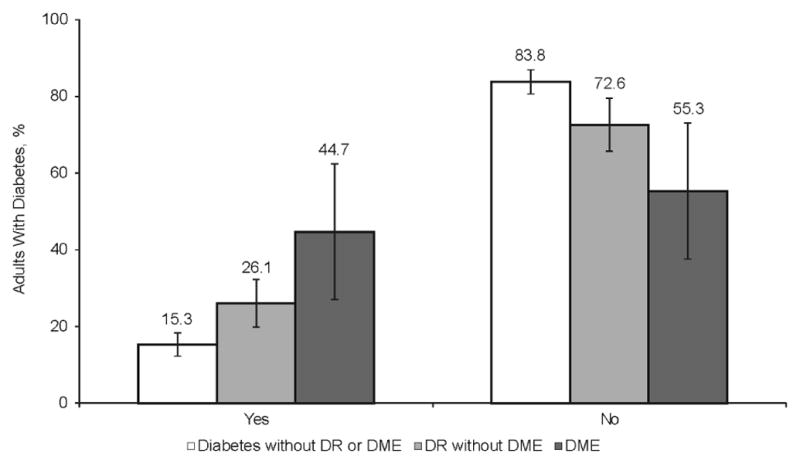
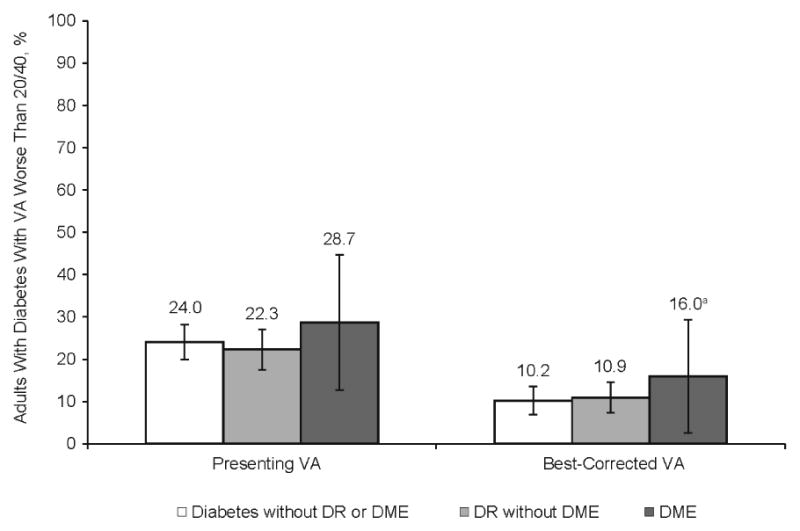
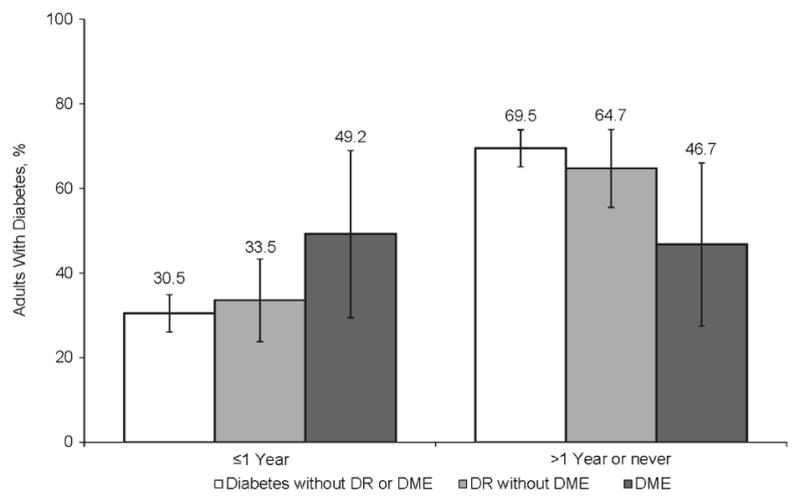
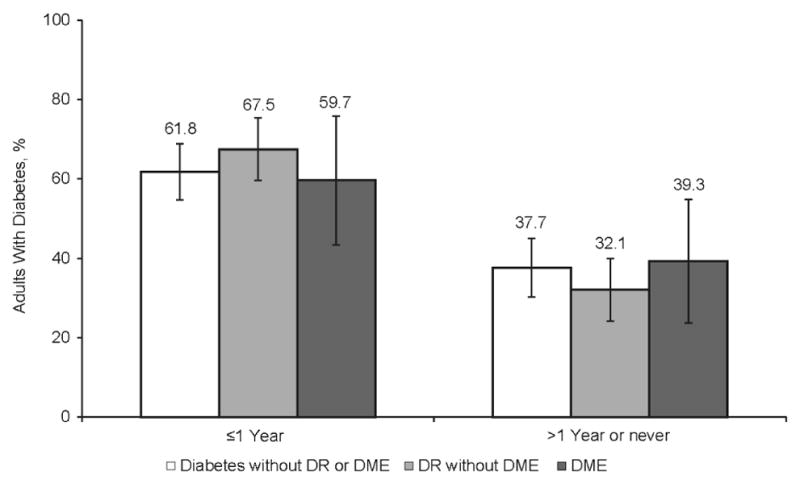
In 2010, only 44.7% (95% CI, 27.0%-62.4%) of US adults 40 years or older with DME reported being told by a physician that diabetes had affected their eyes or that they had retinopathy; 46.7% (95% CI, 27.5%-66.0%), that they had visited a diabetes nurse educator, dietician, or nutritionist for their diabetes mellitus more than 1 year ago or never; and 59.7% (95% CI, 43.5%-75.9%), that they had received an eye examination with pupil dilation in the last year. Among persons with DME, 28.7% (95% CI, 12.7%-44.7%) were visually impaired (defined as visual acuity worse than 20/40 in the eye with DME) based on visual acuity at the initial examination and 16.0% (95% CI, 2.5%-29.4%) based on best-corrected visual acuity.
Many persons with diabetes mellitus in the United States are not getting care that can prevent visual impairment and blindness. Strategies to increase awareness are warranted, especially given the recent availability of improved therapies for DME.
视网膜中心增厚,即糖尿病性黄斑水肿(DME),是糖尿病导致视力丧失的最常见原因。DME 的治疗已经有了显著改善,因此及时诊断和转介这些患者变得更加关键。尽管如此,美国人群对 DME 的认识和关注仍不明确。
描述美国一般人群中 DME 患者的眼部护理和眼病意识。
设计、设置和参与者:对 2005 年至 2008 年全国健康和营养调查中年龄在 40 岁及以上、患有糖尿病并拍摄眼底照片的参与者进行的横断面数据分析。
在患有 DME 的人群中,(1)了解糖尿病对眼睛的影响;(2)报告他们最后一次就诊糖尿病专家的时间;(3)报告他们最后一次接受散瞳眼部检查的时间;(4)视力障碍的发生率。
在 2010 年,只有 44.7%(95%CI,27.0%-62.4%)的美国 40 岁及以上患有 DME 的成年人报告称,医生曾告诉他们糖尿病影响了他们的眼睛或他们患有视网膜病变;46.7%(95%CI,27.5%-66.0%)的人报告说,他们曾在 1 年以上或从未接受过糖尿病护士教育者、营养师或营养学家的治疗;59.7%(95%CI,43.5%-75.9%)的人在过去一年中接受过散瞳眼部检查。在患有 DME 的人群中,根据初次检查的视力,28.7%(95%CI,12.7%-44.7%)的人视力受损(定义为 DME 眼中视力低于 20/40),16.0%(95%CI,2.5%-29.4%)的人根据最佳矫正视力受损。
美国许多糖尿病患者没有接受可以预防视力损害和失明的治疗。需要采取提高认识的策略,特别是考虑到最近出现了治疗 DME 的改善疗法。