Dillahunt-Aspillaga Christina, Jorgensen-Smith Tammy, Ehlke Sarah, Sosinski Melanie, Monroe Douglas, Thor Jennifer
Department of Rehabilitation and Mental Health Counseling, University of South Florida, Tampa, Florida, United States of America ; Brain Injury Association of Florida, Inc., Tallahassee, Florida, United States of America.
Department of Rehabilitation and Mental Health Counseling, University of South Florida, Tampa, Florida, United States of America.
PLoS One. 2013 Dec 17;8(12):e82896. doi: 10.1371/journal.pone.0082896. eCollection 2013.
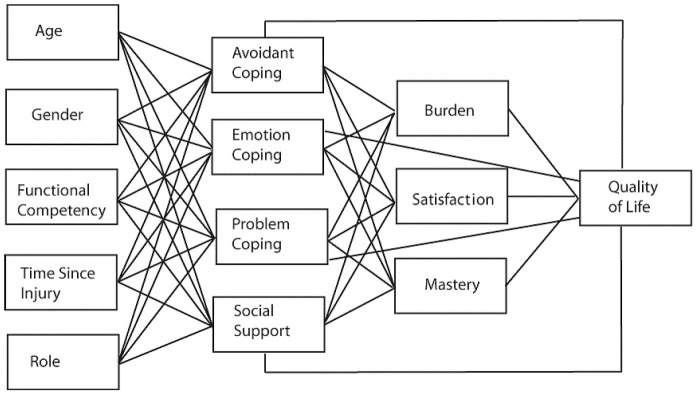
Sustaining a Traumatic Brain Injury results in familial strain due to the significant impact the injury has upon the role and function of individuals and their families at home and in the community. Using the Stress Process Model of Caregiving, a caregiver needs assessment survey was developed and conducted to better understand the needs of individuals with a Traumatic Brain Injury and their caregivers. Survey results indicate that caregivers experience many challenges including unmet needs in areas of relational supports such as maintaining relationships, long-term emotional and financial support for themselves and the survivor, and the need for a patient or caregiver advocate. Implications for future practice are presented.
遭受创伤性脑损伤会导致家庭压力,因为该损伤对个人及其家庭在家庭和社区中的角色与功能产生重大影响。运用照料压力过程模型,开发并开展了一项照料者需求评估调查,以更好地了解创伤性脑损伤患者及其照料者的需求。调查结果表明,照料者面临诸多挑战,包括在关系支持方面未得到满足的需求,如维持人际关系、为自身和幸存者提供长期情感和经济支持,以及需要患者或照料者权益倡导者。文中还阐述了对未来实践的启示。