Department of Psychology, Colorado State University Fort Collins, CO, USA.
Front Neurosci. 2013 Dec 6;7:229. doi: 10.3389/fnins.2013.00229. eCollection 2013.
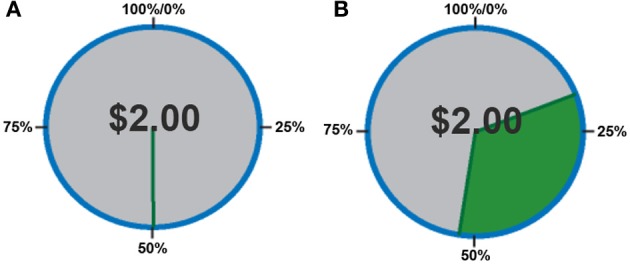
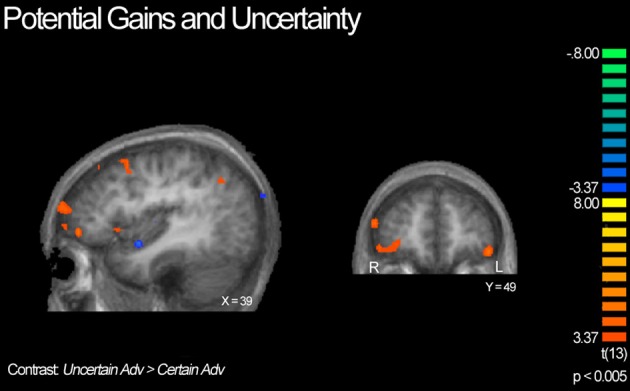
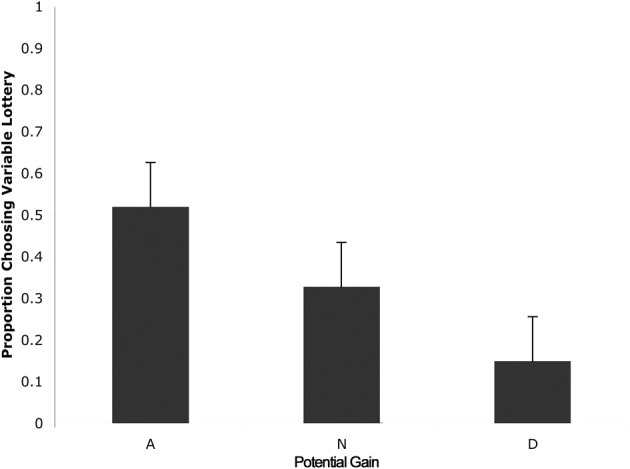
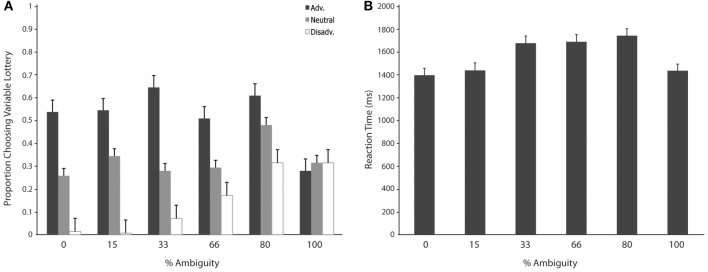
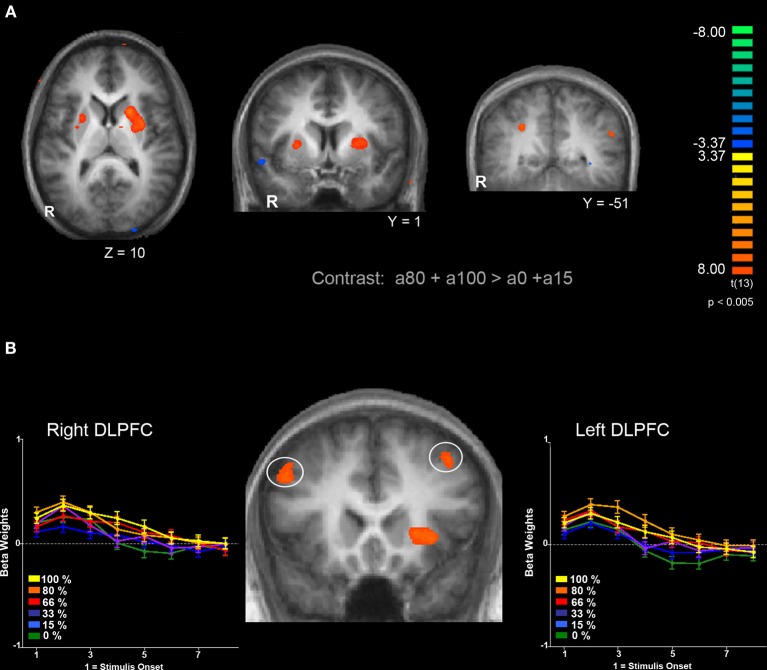
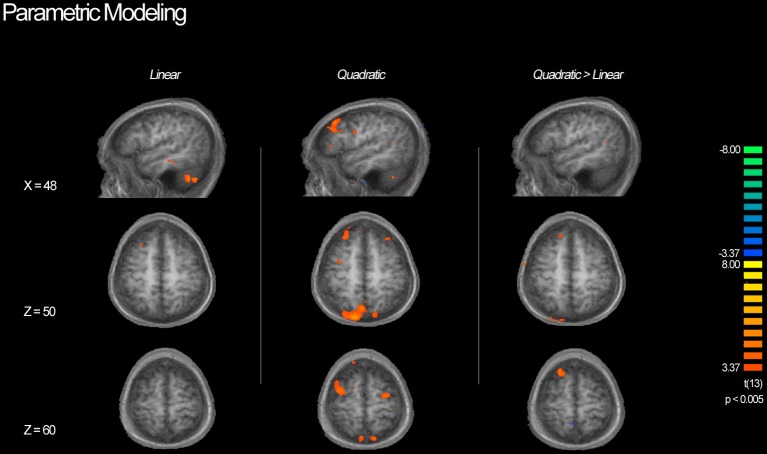
Data from previous neuroimaging studies exploring neural activity associated with uncertainty suggest varying levels of activation associated with changing degrees of uncertainty in neural regions that mediate choice behavior. The present study used a novel task that parametrically controlled the amount of information hidden from the subject; levels of uncertainty ranged from full ambiguity (no information about probability of winning) through multiple levels of partial ambiguity, to a condition of risk only (zero ambiguity with full knowledge of the probability of winning). A parametric analysis compared a linear model in which weighting increased as a function of level of ambiguity, and an inverted-U quadratic models in which partial ambiguity conditions were weighted most heavily. Overall we found that risk and all levels of ambiguity recruited a common "fronto-parietal-striatal" network including regions within the dorsolateral prefrontal cortex, intraparietal sulcus, and dorsal striatum. Activation was greatest across these regions and additional anterior and superior prefrontal regions for the quadratic function which most heavily weighs trials with partial ambiguity. These results suggest that the neural regions involved in decision processes do not merely track the absolute degree ambiguity or type of uncertainty (risk vs. ambiguity). Instead, recruitment of prefrontal regions may result from greater degree of difficulty in conditions of partial ambiguity: when information regarding reward probabilities important for decision making is hidden or not easily obtained the subject must engage in a search for tractable information. Additionally, this study identified regions of activity related to the valuation of potential gains associated with stimuli or options (including the orbitofrontal and medial prefrontal cortices and dorsal striatum) and related to winning (including orbitofrontal cortex and ventral striatum).
先前的神经影像学研究数据表明,在调节选择行为的神经区域中,与不确定性相关的神经活动存在不同程度的激活,这些区域与不断变化的不确定性程度有关。本研究使用了一种新的任务,该任务可以参数化地控制从主体隐藏的信息量;不确定性水平从完全模糊(没有关于获胜概率的信息)到多个部分模糊水平,再到仅存在风险的条件(完全知道获胜概率时没有模糊性)。参数分析比较了一个线性模型,该模型中权重随模糊程度的增加而增加,以及一个倒置的二次模型,其中部分模糊条件的权重最重。总的来说,我们发现风险和所有模糊水平都招募了一个共同的“额顶-纹状体”网络,包括背外侧前额叶皮层、顶内沟和背侧纹状体内部的区域。对于二次函数,激活最大,该函数对具有部分模糊性的试验进行了最严重的加权,包括这些区域以及额外的前侧和上侧前额叶区域。这些结果表明,参与决策过程的神经区域不仅跟踪绝对程度的模糊性或不确定性类型(风险与模糊性)。相反,前额叶区域的募集可能是由于部分模糊条件下难度较大:当与决策相关的奖励概率信息被隐藏或不容易获得时,主体必须进行搜索以获取可处理的信息。此外,本研究还确定了与刺激或选项的潜在收益估值相关的活动区域(包括眶额和内侧前额叶皮层以及背侧纹状体)以及与获胜相关的区域(包括眶额皮层和腹侧纹状体)。