Freitag Sonja, Seddouki Rachida, Dulon Madeleine, Kersten Jan Felix, Larsson Tore J, Nienhaus Albert
Department for the Principle of Prevention and Rehabilitation, BGW-Institution for Statutory Accident Insurance and Prevention in the Health and Welfare Services, Pappelallee 33/35/37, 22089 Hamburg, Germany;
Ann Occup Hyg. 2014 Apr;58(3):317-25. doi: 10.1093/annhyg/met071. Epub 2013 Dec 26.
To examine the influence of the two following factors on the proportion of time that nurses spend in a forward-bending trunk posture: (i) the bed height during basic care activities at the bedside and (ii) the work method during basic care activities in the bathroom. A further aim was to examine the connection between the proportion of time spent in a forward-bending posture and the perceived exertion.
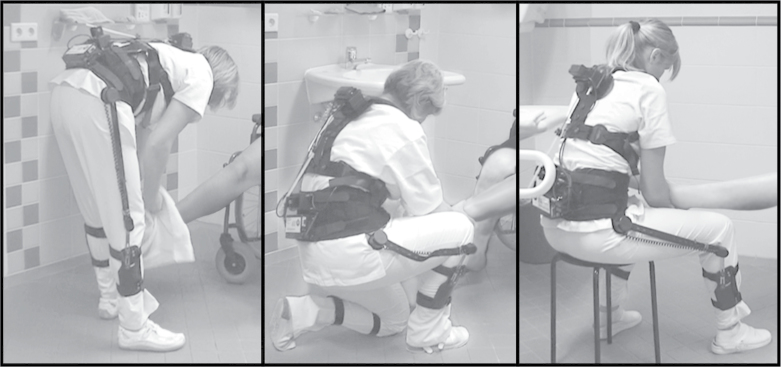
Twelve nurses in a geriatric nursing home each performed a standardized care routine at the bedside and in the bathroom. The CUELA (German abbreviation for 'computer-assisted recording and long-term analysis of musculoskeletal loads') measuring system was used to record all trunk inclinations. Each participant conducted three tests with the bed at different heights (knee height, thigh height, and hip height) and in the bathroom, three tests were performed with different work methods (standing, kneeling, and sitting). After each test, participants rated their perceived exertion on the 15-point Borg scale (6 = no exertion at all and 20 = exhaustion).
If the bed was raised from knee to thigh level, the proportion of time spent in an upright position increased by 8.2% points. However, the effect was not significant (P = 0.193). Only when the bed was raised to hip height, there was a significant increase of 19.8% points (reference: thigh level; P = 0.003) and 28.0% points (reference: knee height; P < 0.001). Bathroom tests: compared with the standing work method, the kneeling and sitting work methods led to a significant increase in the proportion of time spent in an upright posture, by 19.4% points (P = 0.003) and 25.7% points (P < 0.001), respectively. The greater the proportion of time spent in an upright position, the lower the Borg rating (P < 0.001) awarded.
The higher the proportion of time that nursing personnel work in an upright position, the less strenuous they perceive the work to be. Raising the bed to hip height and using a stool in the bathroom significantly increase the proportion of time that nursing personnel work in an upright position. Nursing staff can spend a considerably greater proportion of their time in an ergonomic posture if stools and height-adjustable beds are provided in healthcare institutions.
研究以下两个因素对护士处于躯干前屈姿势的时间比例的影响:(i)床边基础护理活动时的床高;(ii)浴室基础护理活动时的工作方法。另一个目的是研究处于前屈姿势的时间比例与感知到的用力程度之间的联系。
一家老年护理院的12名护士在床边和浴室各进行了一次标准化护理流程。使用CUELA(德语“肌肉骨骼负荷的计算机辅助记录和长期分析”的缩写)测量系统记录所有躯干倾斜度。每位参与者在床处于不同高度(膝盖高度、大腿高度和臀部高度)时进行三次测试,在浴室中,用不同的工作方法(站立、跪姿和坐姿)进行三次测试。每次测试后,参与者用15点的Borg量表对他们感知到的用力程度进行评分(6 = 完全没有用力,20 = 疲惫不堪)。
如果床从膝盖高度升高到大腿高度,处于直立姿势的时间比例增加了8.2个百分点。然而,该效果不显著(P = 0.193)。只有当床升高到臀部高度时,才会有显著增加,分别增加了19.8个百分点(参照:大腿高度;P = 0.003)和28.0个百分点(参照:膝盖高度;P < 0.001)。浴室测试:与站立工作方法相比,跪姿和坐姿工作方法使处于直立姿势的时间比例显著增加,分别增加了19.4个百分点(P = 0.003)和25.7个百分点(P < 0.001)。处于直立姿势的时间比例越高,Borg评分(P < 0.001)越低。
护理人员处于直立姿势工作的时间比例越高,他们感觉工作越轻松。将床升高到臀部高度并在浴室使用凳子可显著增加护理人员处于直立姿势工作的时间比例。如果医疗机构提供凳子和可调节高度的床,护理人员可以在更符合人体工程学的姿势下花费相当大比例 的时间。