Maryland Pathogen Research Institute, University of Maryland College Park, MD, USA.
Maryland Pathogen Research Institute, University of Maryland College Park, MD, USA ; CosmosID Inc. College Park, MD, USA.
Front Cell Infect Microbiol. 2013 Dec 11;3:97. doi: 10.3389/fcimb.2013.00097. eCollection 2013.
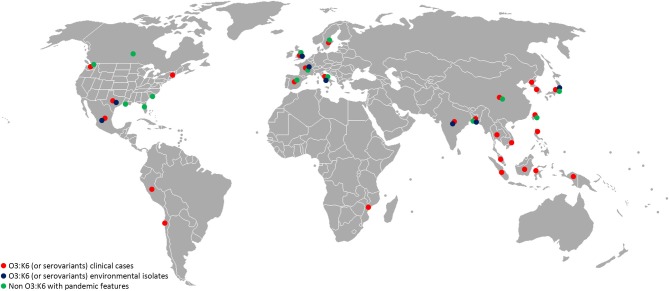
Vibrio parahaemolyticus, autochthonous to estuarine, marine, and coastal environments throughout the world, is the causative agent of food-borne gastroenteritis. More than 80 serotypes have been described worldwide, based on antigenic properties of the somatic (O) and capsular (K) antigens. Serovar O3:K6 emerged in India in 1996 and subsequently was isolated worldwide, leading to the conclusion that the first V. parahaemolyticus pandemic had taken place. Most strains of V. parahaemolyticus isolated from the environment or seafood, in contrast to clinical strains, do not produce a thermostable direct hemolysin (TDH) and/or a TDH-related hemolysin (TRH). Type 3 secretion systems (T3SSs), needle-like apparatuses able to deliver bacterial effectors into host cytoplasm, were identified as triggering cytotoxicity and enterotoxicity. Type 6 secretion systems (T6SS) predicted to be involved in intracellular trafficking and vesicular transport appear to play a role in V. parahaemolyticus virulence. Recent advances in V. parahaemolyticus genomics identified several pathogenicity islands (VpaIs) located on either chromosome in both epidemic and pandemic strains and comprising additional colonization factors, such as restriction-modification complexes, chemotaxis proteins, classical bacterial surface virulence factors, and putative colicins. Furthermore, studies indicate strains lacking toxins and genomic regions associated with pathogenicity may also be pathogenic, suggesting other important virulence factors remain to be identified. The unique repertoire of virulence factors identified to date, their occurrence and distribution in both epidemic and pandemic strains worldwide are described, with the aim of highlighting the complexity of V. parahaemolyticus pathogenicity as well as its dynamic genome.
副溶血性弧菌是一种栖息于世界各地港湾、海洋和沿海环境中的本土细菌,是食源性肠胃炎的病原体。根据其菌体(O)抗原和荚膜(K)抗原的抗原特性,全世界已描述了超过 80 种血清型。1996 年,血清型 O3:K6 在印度出现,随后在全球范围内被分离出来,这导致了第一次副溶血性弧菌大流行的结论。与临床分离株相比,从环境或海鲜中分离出来的大多数副溶血性弧菌菌株不产生耐热直接溶血素(TDH)和/或 TDH 相关溶血素(TRH)。III 型分泌系统(T3SS)是一种能够将细菌效应器输送到宿主细胞质中的针状装置,被鉴定为触发细胞毒性和肠毒性的原因。预测参与细胞内运输和囊泡运输的 VI 型分泌系统(T6SS)似乎在副溶血性弧菌的毒力中发挥作用。副溶血性弧菌基因组学的最新进展确定了位于流行株和大流行株染色体上的几个致病性岛(VpaIs),并包含了其他定植因子,如限制修饰复合物、趋化蛋白、经典细菌表面毒力因子和潜在的 colicins。此外,研究表明,缺乏毒素和与致病性相关的基因组区域的菌株也可能具有致病性,这表明其他重要的毒力因子仍有待确定。目前已确定的独特毒力因子库、它们在全球流行株和大流行株中的存在和分布情况进行了描述,旨在强调副溶血性弧菌致病性的复杂性及其动态基因组。