School of Psychology, University of Newcastle, Callaghan, New South Wales, Australia.
PLoS One. 2013 Dec 31;8(12):e84907. doi: 10.1371/journal.pone.0084907. eCollection 2013.
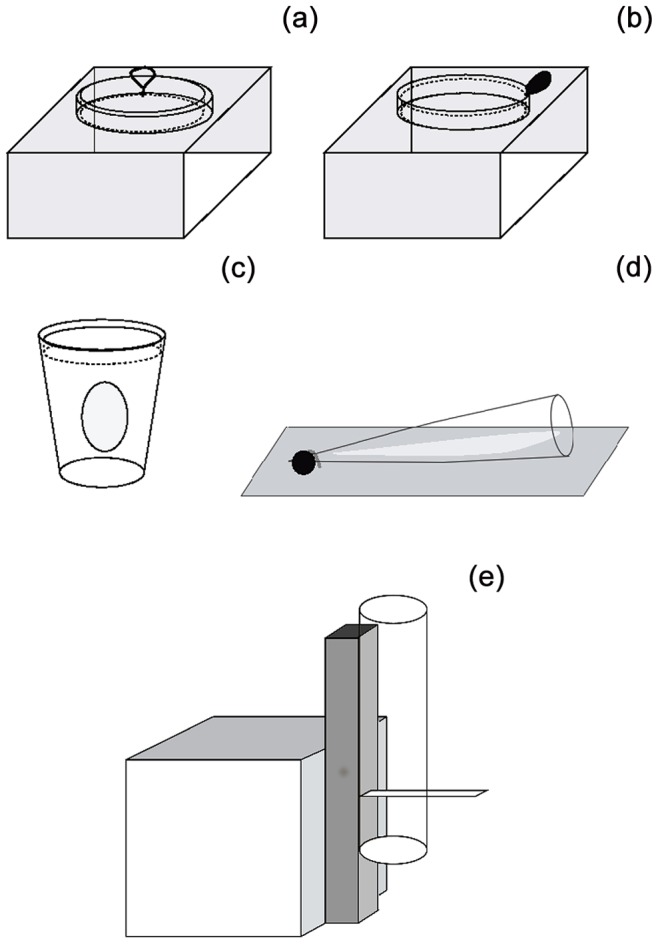
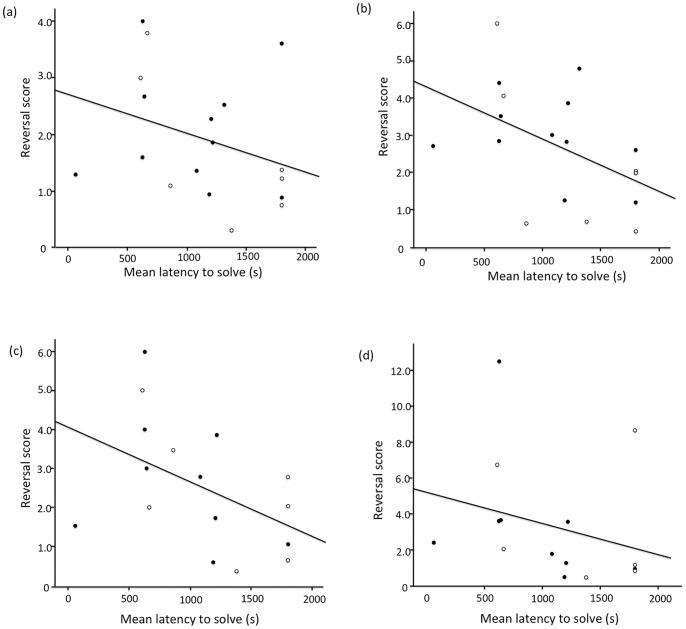
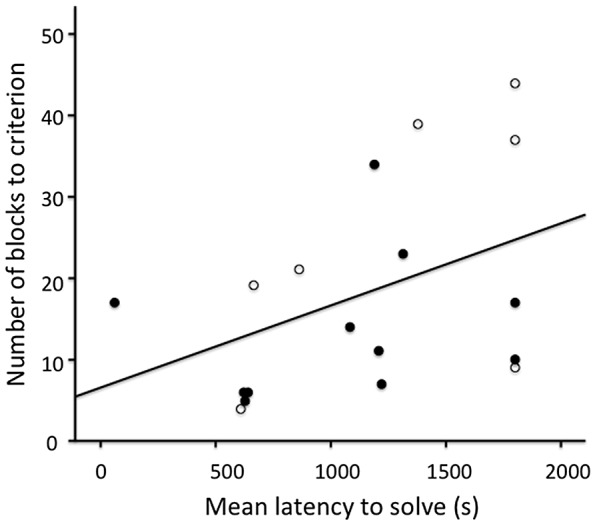
Behavioural innovations are increasingly thought to provide a rich source of phenotypic plasticity and evolutionary change. Innovation propensity shows substantial variation across avian taxa and provides an adaptive mechanism by which behaviour is flexibly adjusted to changing environmental conditions. Here, we tested for the first time the prediction that inter-individual variation in innovation propensity is equally a measure of behavioural flexibility. We used Indian mynas, Sturnus tristis, a highly successful worldwide invader. Results revealed that mynas that solved an extractive foraging task more quickly learnt to discriminate between a cue that predicted food, and one that did not more quickly. However, fast innovators were slower to change their behaviour when the significance of the food cues changed. This unexpected finding appears at odds with the well-established view that avian taxa with larger brains relative to their body size, and therefore greater neural processing power, are both faster, and more flexible learners. We speculate that the existence of this relationship across taxa can be reconciled with its absence within species by assuming that fast, innovative learners and non innovative, slow, flexible learners constitute two separate individual strategies, which are both underpinned by enhanced neural processing power. This idea is consistent with the recent proposal that individuals may differ consistently in 'cognitive style', differentially trading off speed against accuracy in cognitive tasks.
行为创新被认为是表型可塑性和进化变化的丰富来源。创新倾向在鸟类分类群中表现出很大的差异,为行为根据环境条件的变化灵活调整提供了一种适应机制。在这里,我们首次测试了这样一个预测,即创新倾向的个体间变异同样是行为灵活性的一个衡量标准。我们使用了印度八哥,一种在全球范围内非常成功的入侵物种。结果表明,在解决提取觅食任务方面更快的八哥能够更快地学会区分预测食物的线索和不预测食物的线索。然而,当食物线索的重要性发生变化时,快速创新者改变行为的速度较慢。这一意外的发现似乎与一个既定观点相矛盾,即相对于其体型而言,大脑较大的鸟类分类群具有更快和更灵活的学习能力。我们推测,在物种内部不存在这种关系,可以通过假设快速创新的学习者和非创新的缓慢灵活的学习者构成两种不同的个体策略来调和这种关系,这两种策略都得到了增强的神经处理能力的支持。这一观点与最近提出的个体在“认知风格”上可能存在一致性的观点一致,即在认知任务中,个体在速度和准确性之间进行不同的权衡。