Department of Environmental Medicine, New York University School of Medicine, New York, NY, USA.
Department of Environmental Health Sciences, Mailman School of Public Health, Columbia University, New York City, NY, USA.
Atherosclerosis. 2014 Jan;232(1):234-41. doi: 10.1016/j.atherosclerosis.2013.11.035. Epub 2013 Nov 19.
Anthropometric measures such as waist-hip-ratio (WHR), waist-height-ratio (WHtR), waist circumference, Mid-upper arm circumference (MUAC), and upper thigh circumference, have been linked to the risk of cardiovascular disease (CVD). However, their relationships with subclinical atherosclerosis are unclear. Studies in normal-weight populations, especially in Asian countries where leanness is prevalent, are lacking.
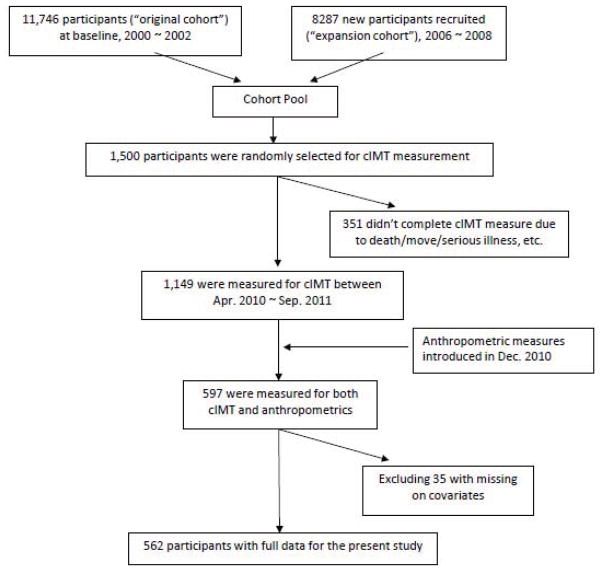
We conducted a cross-sectional study to assess the associations of WHR, WHtR, waist circumference, hip circumference, body mass index (BMI), MUAC and upper thigh circumference with carotid intima-media thickness (cIMT) among 562 middle-aged participants free of CVD in rural Bangladesh.
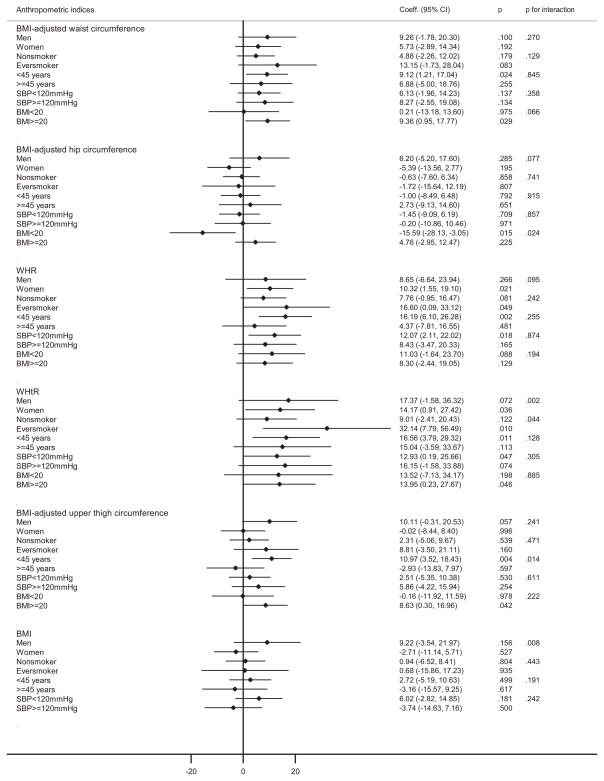
After adjusting for age and sex, WHR and waist circumference but not BMI showed a positive significant association with cIMT. In multivariate analysis, each standard deviation (SD) increase of WHR (0.08) or WHtR (0.07) was associated with an 8.96 μm (95% CI, 1.12-16.81) or 11.45 μm (95%CI, 0.86-22.04) difference in cIMT, respectively, after controlling for age, sex, BMI, smoking status, education level, and systolic blood pressure (SBP). The associations of WHR and WHtR with cIMT were independent of the influence of other anthropometric measures. The associations of other anthropometric measures and cIMT were not apparent.
In our relatively lean, healthy Asian population, WHR and WHtR appear to be better predictors of early atherosclerosis than other common surrogates of adiposity.
腰臀比(WHR)、腰高比(WHtR)、腰围、中上臂围(MUAC)和大腿上部周长等人体测量指标与心血管疾病(CVD)风险相关。然而,它们与亚临床动脉粥样硬化的关系尚不清楚。在正常体重人群中的研究,尤其是在以苗条为流行的亚洲国家,缺乏相关研究。
我们进行了一项横断面研究,以评估在孟加拉国农村地区 562 名无 CVD 的中年参与者中,WHR、WHtR、腰围、臀围、体重指数(BMI)、MUAC 和大腿上部周长与颈动脉内膜中层厚度(cIMT)之间的关系。
在校正年龄和性别后,WHR 和腰围与 cIMT 呈正相关,而 BMI 则没有。在多变量分析中,WHR(0.08)或 WHtR(0.07)每增加一个标准差(SD),与 cIMT 分别增加 8.96 μm(95%CI,1.12-16.81)或 11.45 μm(95%CI,0.86-22.04)相关,在控制年龄、性别、BMI、吸烟状况、教育程度和收缩压(SBP)后。WHR 和 WHtR 与 cIMT 的相关性独立于其他人体测量指标的影响。其他人体测量指标与 cIMT 的相关性不明显。
在我们相对较瘦、健康的亚洲人群中,WHR 和 WHtR 似乎比其他常见的肥胖替代指标更好地预测早期动脉粥样硬化。