Charlton Karen E, Batterham Marijka J, Buchanan Li Min, Mackerras Dorothy
School of Medicine, Faculty of Science, Medicine and Health, University of Wollongong, Wollongong, New South Wales, Australia.
BMJ Open. 2014 Jan 8;4(1):e003799. doi: 10.1136/bmjopen-2013-003799.
To determine the effect of adjustment for intraindividual variation on estimations of urinary iodine concentrations (UIC), prevalence of iodine deficiency and population distribution of iodine status.
Community-dwelling older adults from New South Wales, Australia.
84 healthy men and women aged 60-95 years were recruited prior to introduction of the mandatory iodine fortification programme.
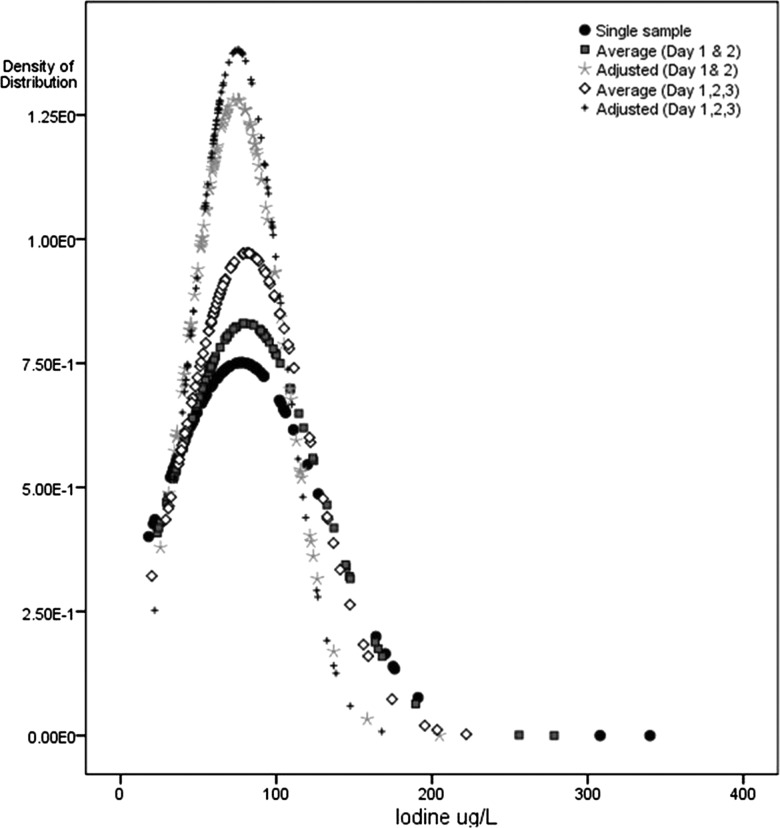
UIC data were collected from three spot urine samples, each 1 week apart. Repeated measures analysis of variance were determined between-person (sb) and total (sobs) SDs. Adjusted UIC values were calculated as ((person's UIC-group mean)×(sb/sobs))+group mean, and a corrected UIC distribution was calculated.
The sb/sobs for using three samples and two samples were 0.83 and 0.79, respectively. Following adjustment for intraindividual variation, the proportion with UIC <50 μg/L reduced from 33% to 19%, while the proportion with UIC ≥100 μg/L changed from 21% to 17%. The 95th centile for UIC decreased from 176 to 136 μg/L. Adjustment by taking averages yielded a lesser degree of contraction in the distribution than the analysis of variance method.
The addition of information about intraindividual variability has potential for increasing the interpretability of UIC data collected to monitor the iodine status of a population.
确定个体内变异调整对尿碘浓度(UIC)估计值、碘缺乏患病率及碘营养状况人群分布的影响。
澳大利亚新南威尔士州的社区居住老年人。
在强制性碘强化计划实施之前,招募了84名年龄在60 - 95岁之间的健康男性和女性。
从三份随机尿样中收集UIC数据,每份尿样间隔1周。采用重复测量方差分析确定个体间标准差(sb)和总标准差(sobs)。调整后的UIC值计算为((个体UIC - 组均值)×(sb/sobs))+组均值,并计算校正后的UIC分布。
使用三个样本和两个样本时的sb/sobs分别为0.83和0.79。在对个体内变异进行调整后,UIC<50μg/L的比例从33%降至19%,而UIC≥100μg/L的比例从21%变为17%。UIC的第95百分位数从176μg/L降至136μg/L。采用取平均值进行调整时,分布的收缩程度小于方差分析方法。
增加个体内变异性信息有可能提高为监测人群碘营养状况而收集的UIC数据的可解释性。