Division of General Medical Disciplines, Stanford University, Stanford, California, United States of America ; Center for Health Policy and the Center for Primary Care and Outcomes Research, Stanford University, Stanford, California, United States of America.
PLoS One. 2014 Jan 3;9(1):e84025. doi: 10.1371/journal.pone.0084025. eCollection 2014.
To determine the extent to which the narrowing of child mortality across wealth gradients has been related to foreign aid to the health sector in low- and middle-income countries.
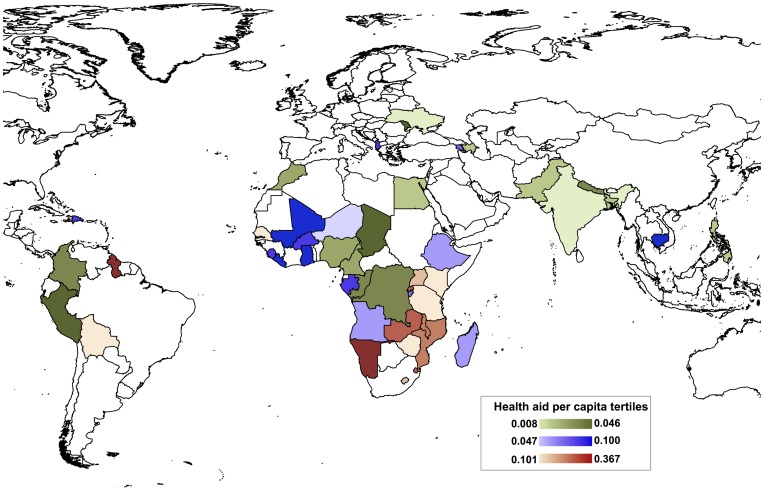
Mortality and wealth data on 989,901 under-5 children from 957,674 households in 49 aid recipient countries in Africa, Asia, South America, and the Caribbean between 1993 and 2012 were used in the analysis. Declines in under-5 mortality in the four poorest wealth quantiles were compared to the decline among the wealthiest at varying levels of health aid per capita using fixed effects multivariable regression models and controlling for maternal education, urbanization, and domestic spending on health among recipient countries.
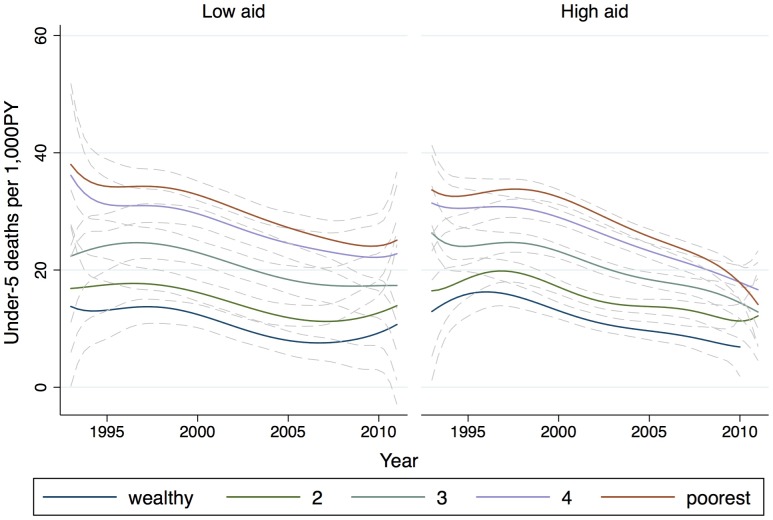
Each additional dollar in total health aid per capita was associated with 5.7 fewer deaths per 10,000 child-years among children in the poorest relative to the wealthiest households (p<0.001). This was also true when measured in percent declines (1.90% faster decline in under-5 mortality among the poorest compared with the wealthiest with each dollar in total health aid, p = 0.008). The association was stronger when using health aid specifically for malaria than total health aid, 12.60% faster decline among the poorest compared with the wealthiest with each dollar in malaria aid, p = 0.001.
Foreign aid to the health sector is preferentially related to reductions in under-5 mortality among the poorest compared with the wealthiest. Health aid addressing malaria, which imposes a disproportionate burden among the poor, may explain the observed effect.
确定在多大程度上,儿童死亡率在贫富梯度上的缩小与向中低收入国家卫生部门提供的外援有关。
利用来自非洲、亚洲、南美洲和加勒比地区 49 个受援国的 957674 户家庭的 989901 名 5 岁以下儿童的死亡率和财富数据,对 1993 年至 2012 年间的情况进行分析。使用固定效应多变量回归模型,比较了 4 个最贫穷财富四分位数中 5 岁以下儿童死亡率的下降情况,以及在不同人均卫生援助水平上最富裕四分位数的下降情况,并控制了受援国的孕产妇教育、城市化和国内卫生支出。
人均总卫生援助每增加 1 美元,最贫穷家庭的儿童每 10000 个儿童年死亡人数就会减少 5.7 人(p<0.001)。按百分比下降衡量也是如此(最贫穷家庭的 5 岁以下儿童死亡率比最富裕家庭下降 1.90%,每增加 1 美元总卫生援助,p=0.008)。当使用专门用于疟疾的卫生援助而不是总卫生援助时,这种关联更为强烈,最贫穷家庭的儿童死亡率比最富裕家庭下降 12.60%,每增加 1 美元疟疾援助,p=0.001。
向卫生部门提供的外援与最贫穷家庭的儿童死亡率下降幅度较大,而与最富裕家庭的死亡率下降幅度较小有关。针对疟疾的卫生援助(这种援助在贫困人口中造成了不成比例的负担)可能解释了观察到的效果。