Department of Psychology, University of Pennsylvania, Philadelphia, Pennsylvania, United States of America.
PLoS One. 2014 Jan 7;9(1):e84338. doi: 10.1371/journal.pone.0084338. eCollection 2014.
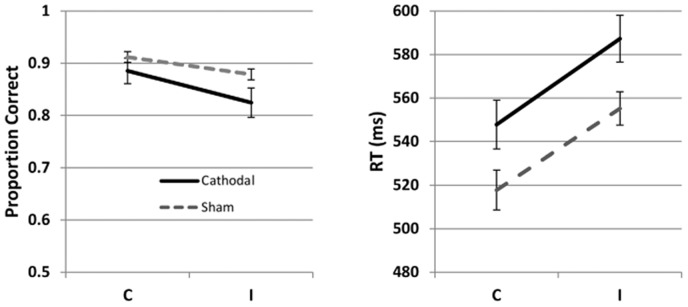
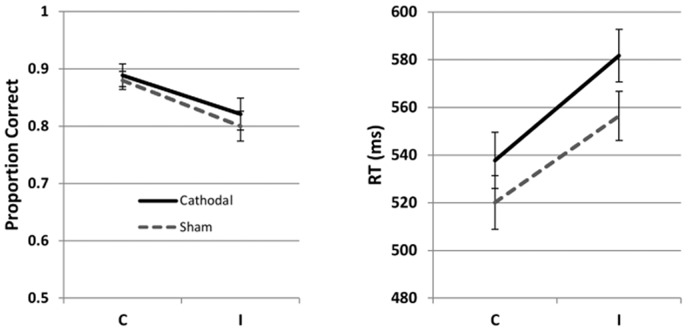
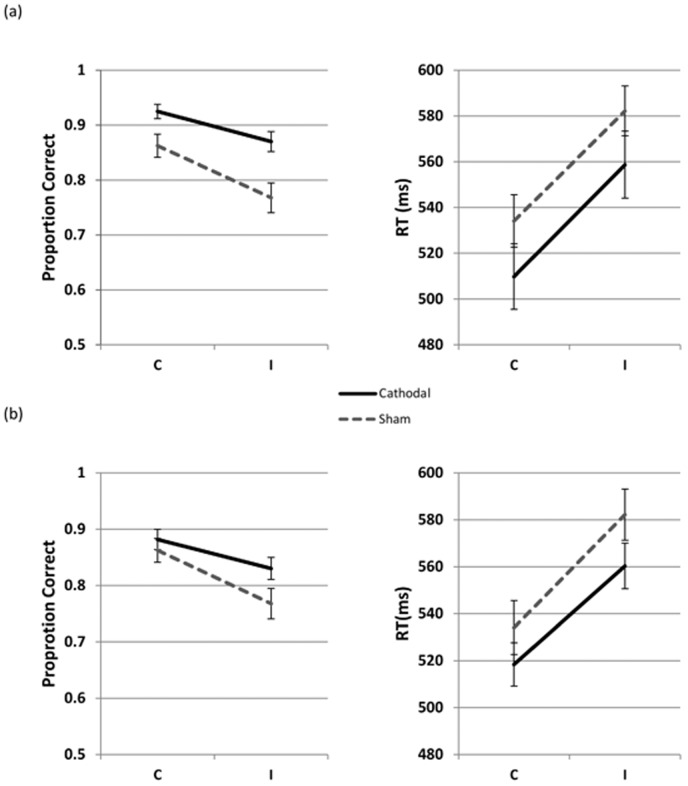
Cathodal Transcranial Direct Current Stimulation (C-tDCS) has been reported, across different studies, to facilitate or hinder performance, or simply to have no tangible effect on behavior. This discrepancy is most prominent when C-tDCS is used to alter a cognitive function, questioning the assumption that cathodal stimulation always compromises performance. In this study, we aimed to study the effect of two variables on performance in a simple cognitive task (letter Flanker), when C-tDCS was applied to the left prefrontal cortex (PFC): (1) the time of testing relative to stimulation (during or after), and (2) the nature of the cognitive activity during stimulation in case of post-tDCS testing. In three experiments, we had participants either perform the Flanker task during C-tDCS (Experiment 1), or after C-tDCS. When the Flanker task was administered after C-tDCS, we varied whether during stimulation subjects were engaged in activities that posed low (Experiment 2) or high (Experiment 3) demands on the PFC. Our findings show that the nature of the task during C-tDCS has a systematic influence on the outcome, while timing per se does not.
经不同研究报告,阴极经颅直流电刺激(C-tDCS)可促进或阻碍表现,或对行为无明显影响。当 C-tDCS 用于改变认知功能时,这种差异最为明显,这质疑了阴极刺激总是会影响表现的假设。在这项研究中,我们旨在研究两种变量对简单认知任务(字母 Flanker)表现的影响,当 C-tDCS 施加于左前额叶皮质(PFC)时:(1)相对于刺激的测试时间(刺激期间或之后),以及(2)在刺激期间如果进行 post-tDCS 测试,认知活动的性质。在三个实验中,我们让参与者在 C-tDCS 期间执行 Flanker 任务(实验 1),或在 C-tDCS 之后执行。当 Flanker 任务在 C-tDCS 之后进行时,我们在刺激期间让参与者进行低(实验 2)或高(实验 3)PFC 要求的活动,以改变任务性质。我们的发现表明,C-tDCS 期间任务的性质对结果有系统影响,而时间本身并没有影响。