• 文献检索
  • 文档翻译
  • 深度研究
  • 学术资讯
  • Suppr Zotero 插件Zotero 插件
  • 邀请有礼
  • 套餐&价格
  • 历史记录
应用&插件
Suppr Zotero 插件Zotero 插件浏览器插件Mac 客户端Windows 客户端微信小程序
定价
高级版会员购买积分包购买API积分包
服务
文献检索文档翻译深度研究API 文档MCP 服务
关于我们
关于 Suppr公司介绍联系我们用户协议隐私条款
关注我们

Suppr 超能文献

核心技术专利:CN118964589B侵权必究
粤ICP备2023148730 号-1Suppr @ 2026

文献检索

告别复杂PubMed语法,用中文像聊天一样搜索,搜遍4000万医学文献。AI智能推荐,让科研检索更轻松。

立即免费搜索

文件翻译

保留排版,准确专业,支持PDF/Word/PPT等文件格式,支持 12+语言互译。

免费翻译文档

深度研究

AI帮你快速写综述,25分钟生成高质量综述,智能提取关键信息,辅助科研写作。

立即免费体验

用于深部经颅磁刺激的线圈设计考量

Coil design considerations for deep transcranial magnetic stimulation.

作者信息

Deng Zhi-De, Lisanby Sarah H, Peterchev Angel V

机构信息

Department of Psychiatry and Behavioral Sciences, Duke University, Durham, NC, USA.

Department of Psychiatry and Behavioral Sciences, Duke University, Durham, NC, USA; Department of Psychology and Neuroscience, Duke University, Durham, NC, USA.

出版信息

Clin Neurophysiol. 2014 Jun;125(6):1202-12. doi: 10.1016/j.clinph.2013.11.038. Epub 2013 Dec 22.

DOI:10.1016/j.clinph.2013.11.038
PMID:24411523
原文链接:https://pmc.ncbi.nlm.nih.gov/articles/PMC4020988/
Abstract

OBJECTIVES

To explore the field characteristics and design tradeoffs of coils for deep transcranial magnetic stimulation (dTMS).

METHODS

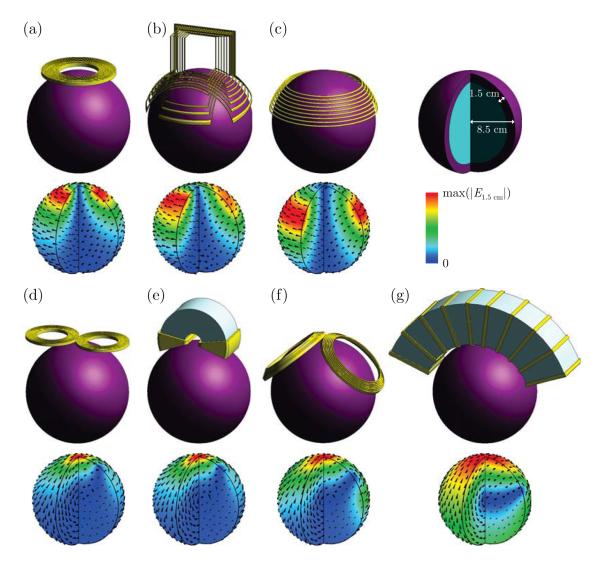
We simulated parametrically two dTMS coil designs on a spherical head model using the finite element method, and compare them with five commercial TMS coils, including two that are FDA approved for the treatment of depression (ferromagnetic-core figure-8 and H1 coil).

RESULTS

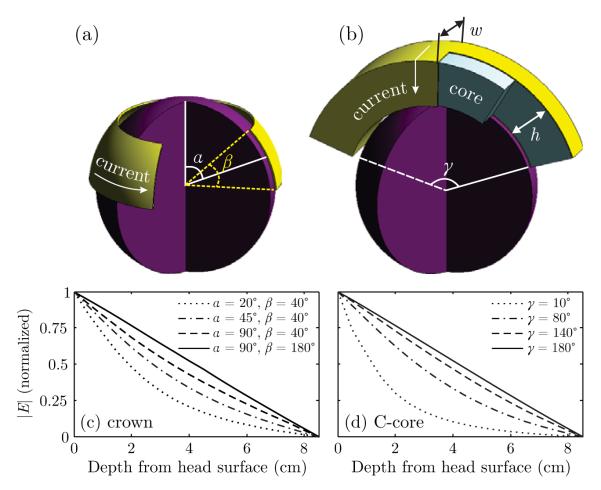
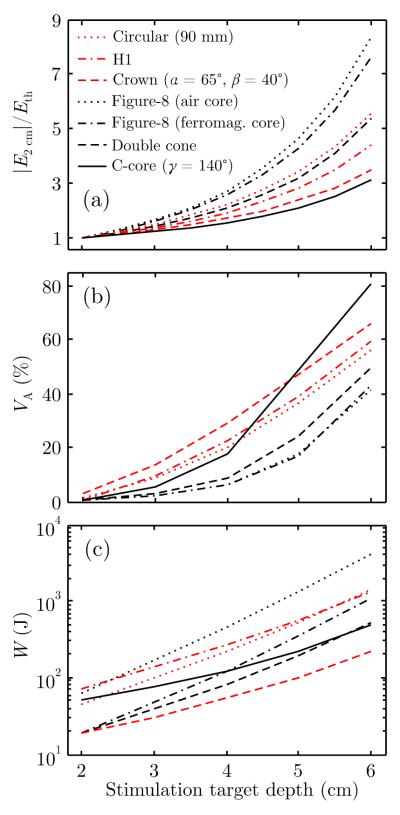
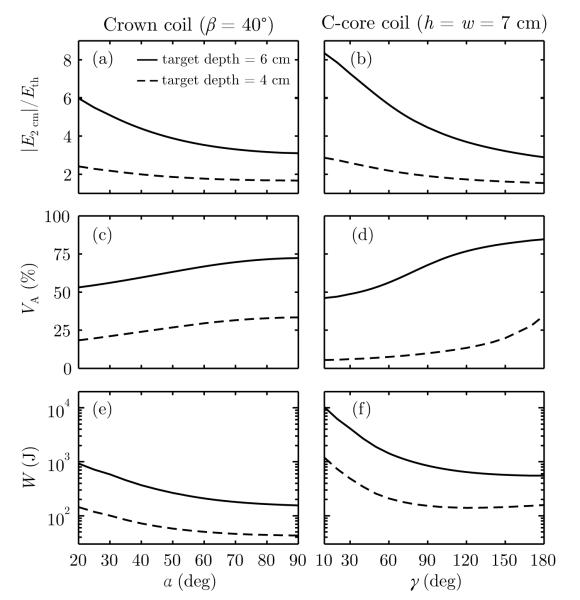
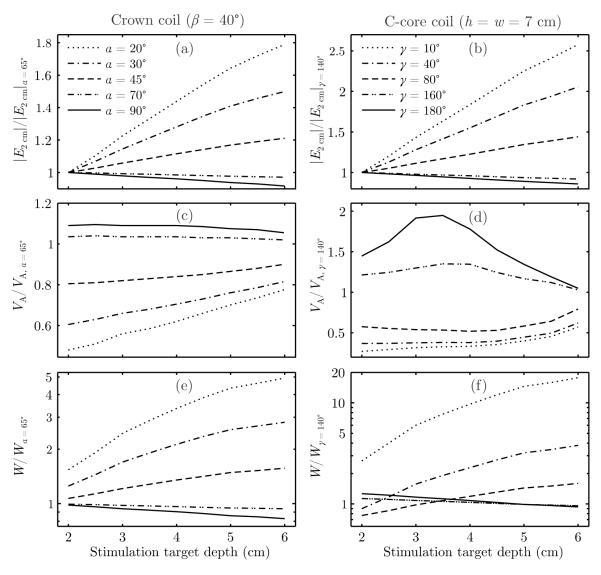
Smaller coils have a focality advantage over larger coils; however, this advantage diminishes with increasing target depth. Smaller coils have the disadvantage of producing stronger field in the superficial cortex and requiring more energy. When the coil dimensions are large relative to the head size, the electric field decay in depth becomes linear, indicating that, at best, the electric field attenuation is directly proportional to the depth of the target. Ferromagnetic cores improve electrical efficiency for targeting superficial brain areas; however magnetic saturation reduces the effectiveness of the core for deeper targets, especially for highly focal coils. Distancing winding segments from the head, as in the H1 coil, increases the required stimulation energy.

CONCLUSIONS

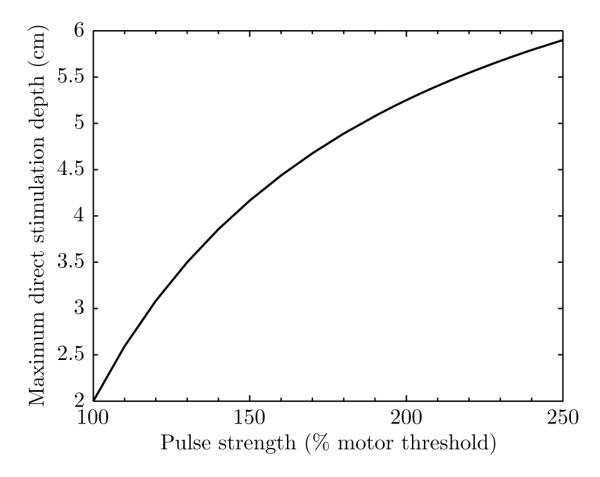
Among standard commercial coils, the double cone coil offers high energy efficiency and balance between stimulated volume and superficial field strength. Direct TMS of targets at depths of ~4 cm or more results in superficial stimulation strength that exceeds the upper limit in current rTMS safety guidelines. Approaching depths of ~6 cm is almost certainly unsafe considering the excessive superficial stimulation strength and activated brain volume.

SIGNIFICANCE

Coil design limitations and tradeoffs are important for rational and safe exploration of dTMS.

摘要

目的

探讨用于深部经颅磁刺激(dTMS)的线圈的场特性和设计权衡。

方法

我们使用有限元方法在球形头部模型上对两种dTMS线圈设计进行参数模拟,并将它们与五种商用TMS线圈进行比较,其中包括两种已获美国食品药品监督管理局(FDA)批准用于治疗抑郁症的线圈(铁磁芯8字形线圈和H1线圈)。

结果

较小的线圈比较大的线圈具有聚焦优势;然而,随着目标深度的增加,这种优势会减弱。较小的线圈的缺点是在浅表皮质产生更强的场且需要更多能量。当线圈尺寸相对于头部尺寸较大时,电场深度衰减变为线性,这表明,充其量,电场衰减与目标深度成正比。铁磁芯提高了针对浅表脑区的电效率;然而,磁饱和会降低铁芯对较深目标的有效性,特别是对于高度聚焦的线圈。如H1线圈那样将绕组段与头部保持一定距离会增加所需的刺激能量。

结论

在标准商用线圈中,双锥线圈具有高能效,并且在刺激体积和浅表场强之间实现了平衡。对深度约4厘米或更深的目标进行直接TMS会导致浅表刺激强度超过当前重复经颅磁刺激(rTMS)安全指南中的上限。考虑到过度的浅表刺激强度和激活的脑体积,接近约6厘米的深度几乎肯定是不安全的。

意义

线圈设计的局限性和权衡对于合理、安全地探索dTMS很重要。

https://cdn.ncbi.nlm.nih.gov/pmc/blobs/5782/4020988/1890108da70a/nihms-552436-f0006.jpg
https://cdn.ncbi.nlm.nih.gov/pmc/blobs/5782/4020988/6f725c506c85/nihms-552436-f0001.jpg
https://cdn.ncbi.nlm.nih.gov/pmc/blobs/5782/4020988/08475374d194/nihms-552436-f0002.jpg
https://cdn.ncbi.nlm.nih.gov/pmc/blobs/5782/4020988/861654fbb56c/nihms-552436-f0003.jpg
https://cdn.ncbi.nlm.nih.gov/pmc/blobs/5782/4020988/1e39f70d1f2c/nihms-552436-f0004.jpg
https://cdn.ncbi.nlm.nih.gov/pmc/blobs/5782/4020988/fdf9715f30d4/nihms-552436-f0005.jpg
https://cdn.ncbi.nlm.nih.gov/pmc/blobs/5782/4020988/1890108da70a/nihms-552436-f0006.jpg
https://cdn.ncbi.nlm.nih.gov/pmc/blobs/5782/4020988/6f725c506c85/nihms-552436-f0001.jpg
https://cdn.ncbi.nlm.nih.gov/pmc/blobs/5782/4020988/08475374d194/nihms-552436-f0002.jpg
https://cdn.ncbi.nlm.nih.gov/pmc/blobs/5782/4020988/861654fbb56c/nihms-552436-f0003.jpg
https://cdn.ncbi.nlm.nih.gov/pmc/blobs/5782/4020988/1e39f70d1f2c/nihms-552436-f0004.jpg
https://cdn.ncbi.nlm.nih.gov/pmc/blobs/5782/4020988/fdf9715f30d4/nihms-552436-f0005.jpg
https://cdn.ncbi.nlm.nih.gov/pmc/blobs/5782/4020988/1890108da70a/nihms-552436-f0006.jpg

相似文献

1
Coil design considerations for deep transcranial magnetic stimulation.用于深部经颅磁刺激的线圈设计考量
Clin Neurophysiol. 2014 Jun;125(6):1202-12. doi: 10.1016/j.clinph.2013.11.038. Epub 2013 Dec 22.
2
Electric field depth-focality tradeoff in transcranial magnetic stimulation: simulation comparison of 50 coil designs.经颅磁刺激中的电场深度-聚焦权衡:50 种线圈设计的模拟比较。
Brain Stimul. 2013 Jan;6(1):1-13. doi: 10.1016/j.brs.2012.02.005. Epub 2012 Mar 21.
3
Coil design considerations for deep-brain transcranial magnetic stimulation (dTMS).用于深部脑经颅磁刺激(dTMS)的线圈设计考量
Annu Int Conf IEEE Eng Med Biol Soc. 2008;2008:5675-9. doi: 10.1109/IEMBS.2008.4650502.
4
Design of transcranial magnetic stimulation coils with optimal trade-off between depth, focality, and energy.设计一种经颅磁刺激线圈,在深度、聚焦性和能量之间达到最佳折衷。
J Neural Eng. 2018 Aug;15(4):046033. doi: 10.1088/1741-2552/aac967. Epub 2018 Jun 1.
5
Comparison of the induced fields using different coil configurations during deep transcranial magnetic stimulation.深部经颅磁刺激期间使用不同线圈配置时感应场的比较。
PLoS One. 2017 Jun 6;12(6):e0178422. doi: 10.1371/journal.pone.0178422. eCollection 2017.
6
Comprehensive Survey on Improved Focality and Penetration Depth of Transcranial Magnetic Stimulation Employing Multi-Coil Arrays.关于采用多线圈阵列提高经颅磁刺激的聚焦性和穿透深度的综合研究
Int J Environ Res Public Health. 2017 Nov 14;14(11):1388. doi: 10.3390/ijerph14111388.
7
Antidepressant outcomes of high-frequency repetitive transcranial magnetic stimulation (rTMS) with F8-coil and deep transcranial magnetic stimulation (DTMS) with H1-coil in major depression: a systematic review and meta-analysis.高频重复经颅磁刺激(rTMS)F8 线圈与深部经颅磁刺激(DTMS)H1 线圈治疗抑郁症的抗抑郁效果:系统评价与荟萃分析。
BMC Psychiatry. 2019 May 7;19(1):139. doi: 10.1186/s12888-019-2106-7.
8
Calculating the induced electromagnetic fields in real human head by deep transcranial magnetic stimulation.通过深部经颅磁刺激计算真实人类头部中的感应电磁场。
Annu Int Conf IEEE Eng Med Biol Soc. 2013;2013:795-8. doi: 10.1109/EMBC.2013.6609620.
9
Three-dimensional distribution of the electric field induced in the brain by transcranial magnetic stimulation using figure-8 and deep H-coils.使用8字形线圈和深部H型线圈经颅磁刺激在大脑中诱导产生的电场的三维分布。
J Clin Neurophysiol. 2007 Feb;24(1):31-8. doi: 10.1097/WNP.0b013e31802fa393.
10
Computational Study Toward Deep Transcranial Magnetic Stimulation Using Coaxial Circular Coils.基于同轴圆形线圈的深部经颅磁刺激的计算研究
IEEE Trans Biomed Eng. 2015 Dec;62(12):2911-9. doi: 10.1109/TBME.2015.2452261. Epub 2015 Jul 2.

引用本文的文献

1
[Deep transcranial magnetic stimulation coil design and multi-objective slime mould algorithm].[深部经颅磁刺激线圈设计与多目标黏菌算法]
Sheng Wu Yi Xue Gong Cheng Xue Za Zhi. 2025 Aug 25;42(4):716-723. doi: 10.7507/1001-5515.202412058.
2
Repetitive transcranial magnetic stimulation for enhancing motor function after spinal cord injury: a narrative review.重复经颅磁刺激改善脊髓损伤后运动功能:一项叙述性综述
Front Neurol. 2025 Jul 2;16:1587060. doi: 10.3389/fneur.2025.1587060. eCollection 2025.
3
The Role of Hemispheric Sensory Shifts: Impacts on Stretch Reflex and Motor Plasticity Post-Stroke.

本文引用的文献

1
Repetitive deep transcranial magnetic stimulation improves verbal fluency and written language in a patient with primary progressive aphasia-logopenic variant (LPPA).重复经颅磁刺激改善原发性进行性失语症-流畅性失语变异型(LPPA)患者的言语流畅性和书面语言能力。
Brain Stimul. 2013 Jul;6(4):545-53. doi: 10.1016/j.brs.2012.09.014. Epub 2012 Oct 24.
2
New targets for rTMS in depression: a review of convergent evidence.重复经颅磁刺激治疗抑郁症的新靶点:汇聚证据的综述。
Brain Stimul. 2013 May;6(3):231-40. doi: 10.1016/j.brs.2012.08.006. Epub 2012 Sep 7.
3
Effectiveness of deep transcranial magnetic stimulation combined with a brief exposure procedure in post-traumatic stress disorder--a pilot study.
半球感觉转移的作用:对中风后牵张反射和运动可塑性的影响
Med Hypotheses. 2025 Jun;199. doi: 10.1016/j.mehy.2025.111653. Epub 2025 May 14.
4
Open-source magnetic system for wireless neuromodulations in vitro and for untethered brain stimulation in vivo.用于体外无线神经调节和体内无束缚脑刺激的开源磁系统。
Sci Rep. 2025 May 22;15(1):17814. doi: 10.1038/s41598-025-03076-7.
5
Advances in magnetic field approaches for non-invasive targeting neuromodulation.用于非侵入性靶向神经调节的磁场方法进展。
Front Hum Neurosci. 2025 Apr 28;19:1489940. doi: 10.3389/fnhum.2025.1489940. eCollection 2025.
6
Treating Depression With Repetitive Transcranial Magnetic Stimulation: A Clinician's Guide.重复经颅磁刺激治疗抑郁症:临床医生指南
Am J Psychiatry. 2025 Jun 1;182(6):525-541. doi: 10.1176/appi.ajp.20240859. Epub 2025 Apr 30.
7
A wearable repetitive transcranial magnetic stimulation device.一种可穿戴式重复经颅磁刺激设备。
Nat Commun. 2025 Mar 19;16(1):2731. doi: 10.1038/s41467-025-58095-9.
8
Exploring Cognitive Deficits and Neuromodulation in Schizophrenia: A Narrative Review.探索精神分裂症中的认知缺陷与神经调节:一项叙述性综述
Medicina (Kaunas). 2024 Dec 14;60(12):2060. doi: 10.3390/medicina60122060.
9
Editorial: Application of noninvasive neuromodulation in cognitive rehabilitation, volume II.社论:无创神经调节在认知康复中的应用,第二卷
Front Neurol. 2024 Dec 16;15:1520727. doi: 10.3389/fneur.2024.1520727. eCollection 2024.
10
Investigating the Triple Code Model in numerical cognition using stereotactic electroencephalography.使用立体定向脑电图研究数字认知中的三重编码模型。
PLoS One. 2024 Dec 3;19(12):e0313155. doi: 10.1371/journal.pone.0313155. eCollection 2024.
深度经颅磁刺激联合短暂暴露程序治疗创伤后应激障碍的疗效:一项初步研究。
Brain Stimul. 2013 May;6(3):377-83. doi: 10.1016/j.brs.2012.07.008. Epub 2012 Aug 18.
4
Deep transcranial magnetic stimulation for treatment-resistant bipolar depression: a case report of acute and maintenance efficacy.深部经颅磁刺激治疗难治性双相抑郁:急性和维持疗效的病例报告
Neurocase. 2013;19(5):451-7. doi: 10.1080/13554794.2012.690429. Epub 2012 Jul 24.
5
Commentary on: Deng et al., Electric field depth-focality tradeoff in transcranial magnetic stimulation: simulation comparison of 50 coil designs.对邓等人所著《经颅磁刺激中的电场深度 - 聚焦权衡:50种线圈设计的模拟比较》的评论
Brain Stimul. 2013 Jan;6(1):14-5. doi: 10.1016/j.brs.2012.04.003. Epub 2012 Apr 23.
6
Deep transcranial magnetic stimulation as a treatment for psychiatric disorders: a comprehensive review.深度经颅磁刺激治疗精神障碍:全面综述。
Eur Psychiatry. 2013 Jan;28(1):30-9. doi: 10.1016/j.eurpsy.2012.02.006. Epub 2012 May 3.
7
Electric field depth-focality tradeoff in transcranial magnetic stimulation: simulation comparison of 50 coil designs.经颅磁刺激中的电场深度-聚焦权衡:50 种线圈设计的模拟比较。
Brain Stimul. 2013 Jan;6(1):1-13. doi: 10.1016/j.brs.2012.02.005. Epub 2012 Mar 21.
8
Prefrontal rTMS for treating depression: location and intensity results from the OPT-TMS multi-site clinical trial.经颅磁刺激治疗抑郁症:来自 OPT-TMS 多中心临床试验的部位和强度结果。
Brain Stimul. 2013 Mar;6(2):108-17. doi: 10.1016/j.brs.2012.02.003. Epub 2012 Mar 14.
9
H-coil repetitive transcranial magnetic stimulation for treatment resistant major depressive disorder: An 18-week continuation safety and feasibility study.H型线圈重复经颅磁刺激治疗难治性重度抑郁症:一项为期18周的延续性安全性和可行性研究。
World J Biol Psychiatry. 2014 May;15(4):298-306. doi: 10.3109/15622975.2011.639802. Epub 2012 Feb 7.
10
Fundamentals of transcranial electric and magnetic stimulation dose: definition, selection, and reporting practices.经颅电刺激和磁刺激剂量基础:定义、选择和报告实践。
Brain Stimul. 2012 Oct;5(4):435-53. doi: 10.1016/j.brs.2011.10.001. Epub 2011 Nov 1.