Daza Iván García, Bergasa Luis Miguel, Bronte Sebastián, Yebes Jose Javier, Almazán Javier, Arroyo Roberto
Department of Electronics, University of Alcalá, Alcalá de Henares, Madrid 28871, Spain.
Sensors (Basel). 2014 Jan 9;14(1):1106-31. doi: 10.3390/s140101106.
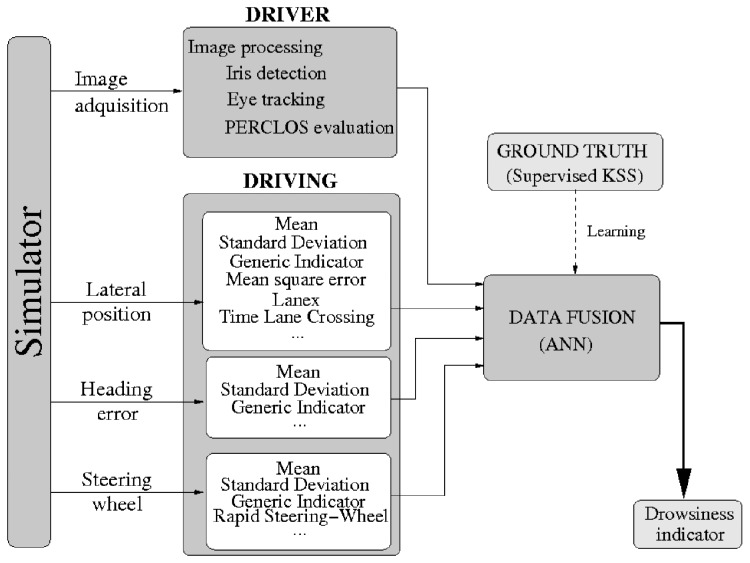
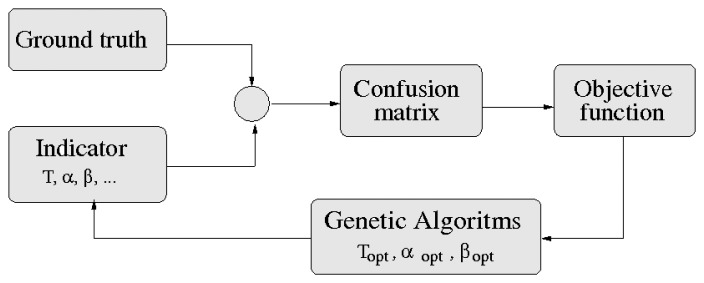
This paper presents a non-intrusive approach for monitoring driver drowsiness using the fusion of several optimized indicators based on driver physical and driving performance measures, obtained from ADAS (Advanced Driver Assistant Systems) in simulated conditions. The paper is focused on real-time drowsiness detection technology rather than on long-term sleep/awake regulation prediction technology. We have developed our own vision system in order to obtain robust and optimized driver indicators able to be used in simulators and future real environments. These indicators are principally based on driver physical and driving performance skills. The fusion of several indicators, proposed in the literature, is evaluated using a neural network and a stochastic optimization method to obtain the best combination. We propose a new method for ground-truth generation based on a supervised Karolinska Sleepiness Scale (KSS). An extensive evaluation of indicators, derived from trials over a third generation simulator with several test subjects during different driving sessions, was performed. The main conclusions about the performance of single indicators and the best combinations of them are included, as well as the future works derived from this study.
本文提出了一种非侵入式方法,用于在模拟条件下,基于从高级驾驶辅助系统(ADAS)获得的驾驶员身体和驾驶性能测量数据,融合多个优化指标来监测驾驶员困倦状态。本文聚焦于实时困倦检测技术,而非长期睡眠/清醒调节预测技术。为了获得能够在模拟器和未来实际环境中使用的强大且优化的驾驶员指标,我们开发了自己的视觉系统。这些指标主要基于驾驶员的身体和驾驶性能技能。使用神经网络和随机优化方法对文献中提出的多个指标的融合进行评估,以获得最佳组合。我们基于有监督的卡罗林斯卡嗜睡量表(KSS)提出了一种新的地面真值生成方法。对来自第三代模拟器上不同驾驶时段多名测试对象试验得出的指标进行了广泛评估。文中包含了关于单个指标性能及其最佳组合的主要结论,以及本研究衍生出的未来工作。