Gonzales M M, Kaur S, Eagan D E, Goudarzi K, Pasha E, Doan D C, Tanaka H, Haley A P
Department of Psychology, The University of Texas at Austin, Austin, TX, USA.
Department of Kinesiology and Health Education, The University of Texas at Austin, Austin, TX, USA.
Int J Obes (Lond). 2014 Sep;38(9):1193-9. doi: 10.1038/ijo.2014.5. Epub 2014 Jan 14.
Excessive adipose tissue, particularly with a centralized distribution, propagates hormonal and metabolic disturbance. The detrimental effects of adiposity may extend beyond the periphery and target the central nervous system, increasing vulnerability to cognitive decline. The aim of the current study was to determine how central adiposity impacts the brain at midlife by examining the blood oxygen level-dependent (BOLD) response to a challenging cognitive task.
Seventy-three adults, aged 40-60 years, completed a 2-back verbal working memory task during functional magnetic resonance imaging. Central adiposity was assessed with waist circumference. The association between waist circumference and task-related activation in a priori regions of interest was modeled using bootstrapping regression models corrected for multiple-comparisons.
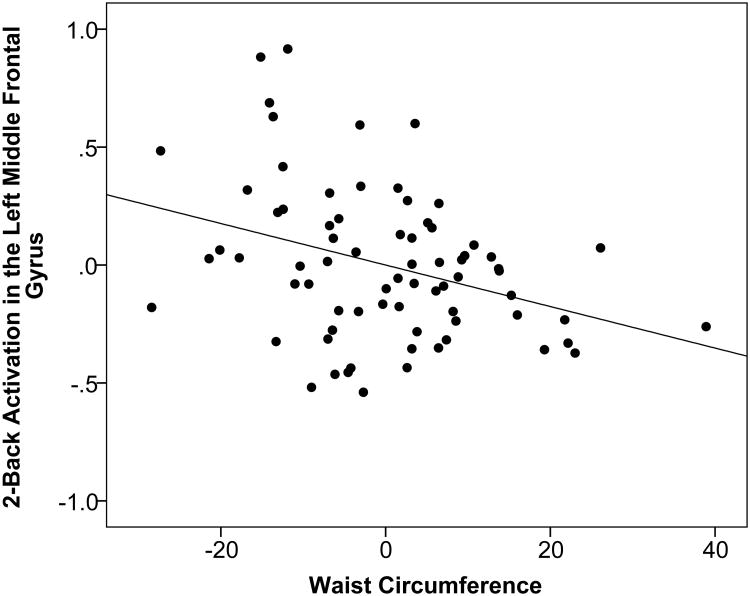
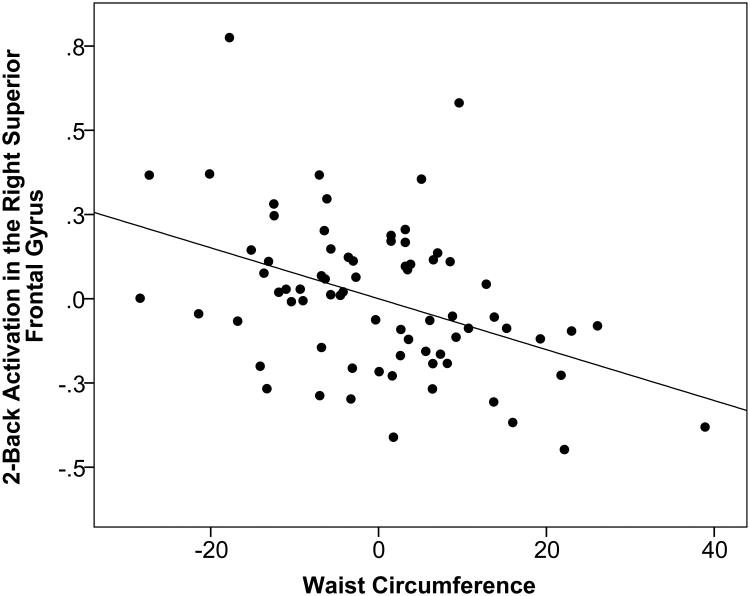
Larger waist circumference was associated with diminished working-memory-related BOLD response in the right superior frontal gyrus (β=-0.008, P=0.001, 95% CI: -0.012 to -0.004) and left middle frontal gyrus (β=-0.009, P=0.002, 95% CI: -0.015 to -0.003), statistically adjusting for age, sex, systolic blood pressure and total cholesterol. Reduced task-related activation in the right superior frontal gyrus (r=-0.369, P=0.002) and left middle frontal gyrus (r=-0.266, P=0.025) were related to slower reaction time on the task, controlling for age and education.
Larger waist circumference predicted alterations in the BOLD response that coupled with decrements in task performance. While future studies are necessary, the results suggest that similar to its role in the periphery, central adiposity may be a robust predictor of metabolic and hormonal alterations that impinge upon central nervous system functioning.
过多的脂肪组织,尤其是集中分布的脂肪组织,会引发激素和代谢紊乱。肥胖的有害影响可能不仅限于外周,还会影响中枢神经系统,增加认知能力下降的易感性。本研究的目的是通过检查对具有挑战性的认知任务的血氧水平依赖(BOLD)反应,来确定中年时期的中心性肥胖如何影响大脑。
73名年龄在40至60岁之间的成年人在功能磁共振成像期间完成了一项2-back言语工作记忆任务。用腰围评估中心性肥胖。使用经多重比较校正的自抽样回归模型,对腰围与先验感兴趣区域中与任务相关的激活之间的关联进行建模。
在对年龄、性别、收缩压和总胆固醇进行统计学调整后,腰围越大,右侧额上回(β=-0.008,P=0.001,95%CI:-0.012至-0.004)和左侧额中回(β=-0.009,P=0.002,95%CI:-0.015至-0.003)中与工作记忆相关的BOLD反应减弱。在控制年龄和教育程度的情况下,右侧额上回(r=-0.369,P=0.002)和左侧额中回(r=-0.266,P=0.025)中与任务相关的激活减少与任务反应时间延长有关。
腰围越大,预测的BOLD反应改变与任务表现下降相关。虽然未来还需要进一步研究,但结果表明,与它在外周的作用类似,中心性肥胖可能是影响中枢神经系统功能的代谢和激素改变的有力预测指标。