Center for Neural Science, New York University, New York, New York 10003, USA.
Department of Neurology, New York University School of Medicine, New York, New York 10016, USA.
Nature. 2014 Mar 6;507(7490):94-8. doi: 10.1038/nature12935. Epub 2014 Jan 15.
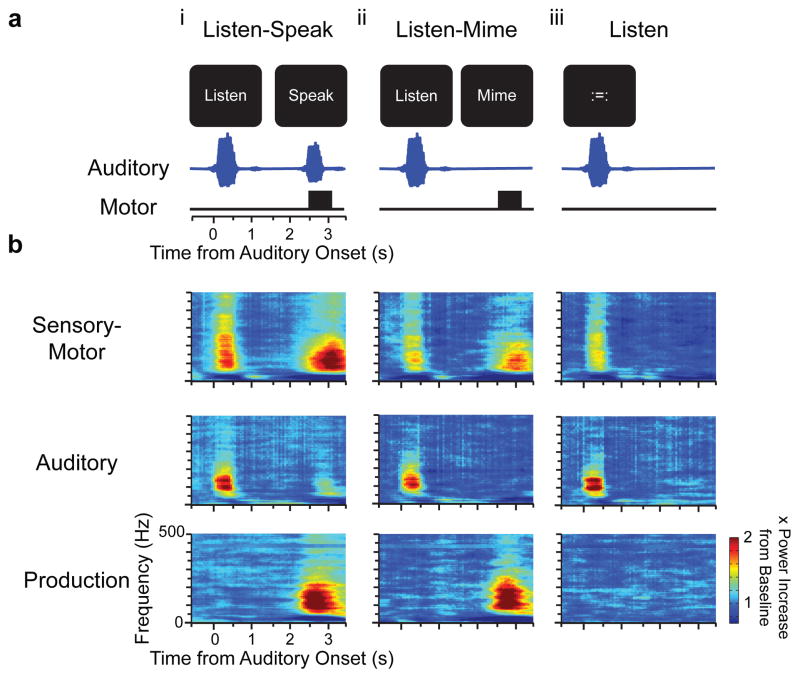
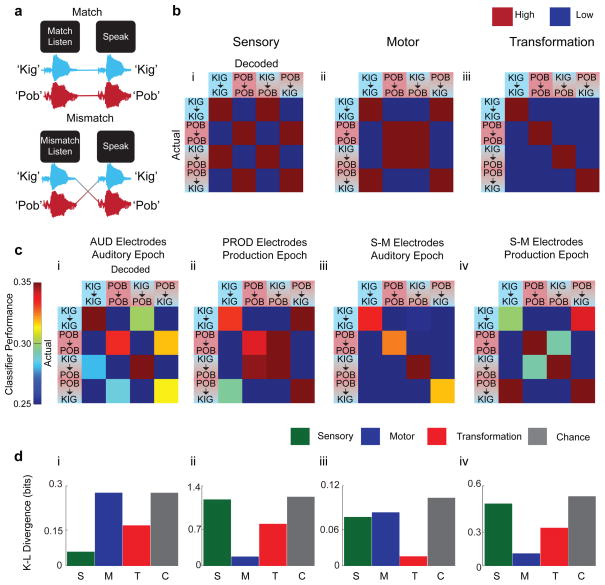
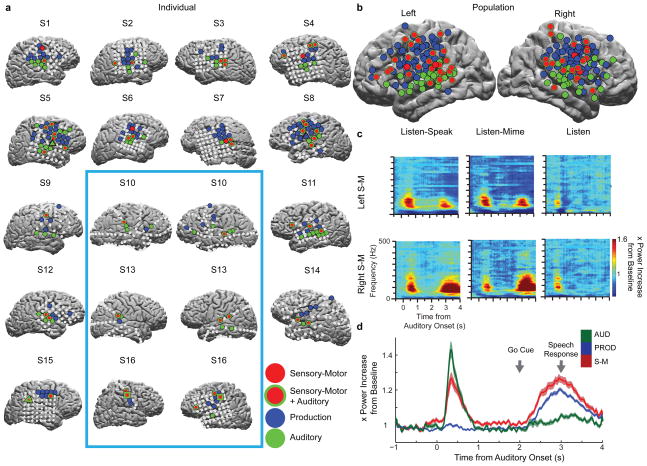
Historically, the study of speech processing has emphasized a strong link between auditory perceptual input and motor production output. A kind of 'parity' is essential, as both perception- and production-based representations must form a unified interface to facilitate access to higher-order language processes such as syntax and semantics, believed to be computed in the dominant, typically left hemisphere. Although various theories have been proposed to unite perception and production, the underlying neural mechanisms are unclear. Early models of speech and language processing proposed that perceptual processing occurred in the left posterior superior temporal gyrus (Wernicke's area) and motor production processes occurred in the left inferior frontal gyrus (Broca's area). Sensory activity was proposed to link to production activity through connecting fibre tracts, forming the left lateralized speech sensory-motor system. Although recent evidence indicates that speech perception occurs bilaterally, prevailing models maintain that the speech sensory-motor system is left lateralized and facilitates the transformation from sensory-based auditory representations to motor-based production representations. However, evidence for the lateralized computation of sensory-motor speech transformations is indirect and primarily comes from stroke patients that have speech repetition deficits (conduction aphasia) and studies using covert speech and haemodynamic functional imaging. Whether the speech sensory-motor system is lateralized, like higher-order language processes, or bilateral, like speech perception, is controversial. Here we use direct neural recordings in subjects performing sensory-motor tasks involving overt speech production to show that sensory-motor transformations occur bilaterally. We demonstrate that electrodes over bilateral inferior frontal, inferior parietal, superior temporal, premotor and somatosensory cortices exhibit robust sensory-motor neural responses during both perception and production in an overt word-repetition task. Using a non-word transformation task, we show that bilateral sensory-motor responses can perform transformations between speech-perception- and speech-production-based representations. These results establish a bilateral sublexical speech sensory-motor system.
从历史上看,言语处理的研究强调了听觉感知输入和运动产生输出之间的紧密联系。一种“等价性”是必不可少的,因为基于感知和基于运动的表示都必须形成一个统一的接口,以促进对更高层次的语言过程(如语法和语义)的访问,这些过程被认为是在占主导地位的、通常是左半球中计算的。尽管已经提出了各种将感知和运动结合起来的理论,但潜在的神经机制尚不清楚。早期的言语和语言处理模型提出,感知处理发生在左后颞上回(Wernicke 区),运动产生过程发生在左额下回(Broca 区)。感觉活动被提议通过连接纤维束与产生活动联系起来,形成左侧化的言语感觉运动系统。尽管最近的证据表明言语感知是双侧的,但流行的模型仍然认为言语感觉运动系统是左侧化的,并促进了从基于感觉的听觉表示到基于运动的产生表示的转换。然而,关于感觉运动言语转换的偏侧化计算的证据是间接的,主要来自于有言语重复缺陷(传导性失语症)的中风患者和使用隐蔽言语和血液动力学功能成像的研究。言语感觉运动系统是否像更高层次的语言过程那样是偏侧化的,还是像言语感知那样是双侧化的,这是有争议的。在这里,我们使用进行涉及显性言语产生的感觉运动任务的受试者的直接神经记录来显示感觉运动转换是双侧发生的。我们证明,在执行显性单词重复任务时,双侧额下回、顶下小叶、颞上回、运动前皮质和躯体感觉皮质的电极在感知和产生过程中都表现出强烈的感觉运动神经反应。使用非单词转换任务,我们表明双侧感觉运动反应可以在基于言语感知和基于言语产生的表示之间进行转换。这些结果确立了一个双侧的亚词言语感觉运动系统。