Zhang Y, Tang Y J, Li Z H, Pan F, Huang K, Xu G H
Zhabei District Central Hospital.
Eur J Histochem. 2013 Oct 29;57(4):e30. doi: 10.4081/ejh.2013.e30.
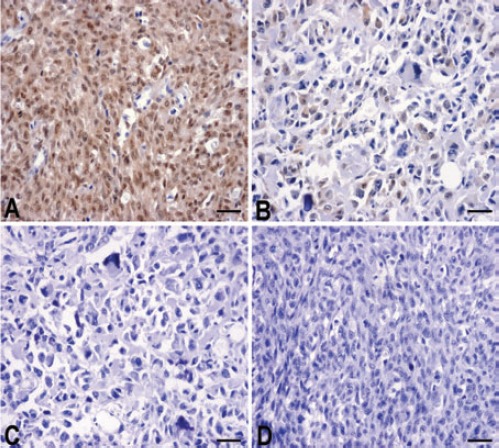
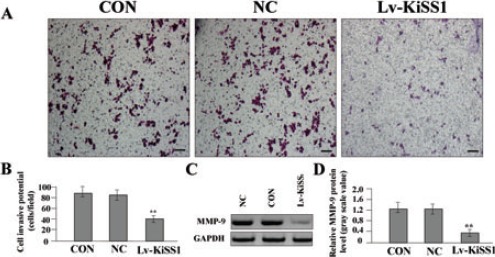
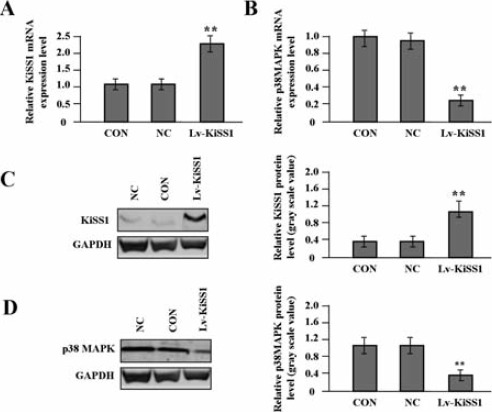
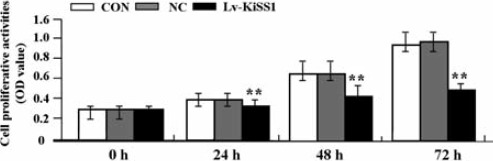
As a metastasis suppressor, KiSS1 has been implicated in numerous human cancers. However, recent studies have demonstrated that KiSS1 promotes tumor growth and metastasis in breast cancer, and it is unclear about the expression and function of KiSS1 in human osteosarcoma (OS). The aim of the present study was to investigate the role and molecular mechanisms of KiSS1 in human OS. The expression of KiSS1 was assessed by immunohistochemical assay using a tissue microarray procedure in forty cases of OS tissues. A gain-of-function approach was used to observe the effects of lentiviral vector-mediated overexpression of KiSS1 (Lv-KiSS1) on the biological behaviors including proliferative activities and invasive potential of OS MG-63 cells, indicated by MTT and Transwell assays, respectively. The results showed that the expression of KiSS1 protein in OS tissues was significantly lowered compared to that in adjacent non-cancerous tissues (ANCT) (42.5% vs 70.0%, P=0.023), and had negative correlation with distant metastases of the tumor (P=0.019). Overexpression of KiSS1 inhibited proliferation and invasion of OS cells with the decreased expression of p38 MAPK and matrix metalloproteinase-9 (MMP-9). Taken together, our findings indicate that the decreased expression of KiSS1 is correlated with distant metastasis of OS, and KiSS1 may function as a tumor suppressor in OS cells through inhibition of the MAPK pathway, suggesting that KiSS1 may serve as a potential therapeutic target for the treatment of cancer.
作为一种转移抑制因子,KiSS1与多种人类癌症相关。然而,最近的研究表明,KiSS1在乳腺癌中促进肿瘤生长和转移,并且KiSS1在人类骨肉瘤(OS)中的表达和功能尚不清楚。本研究的目的是探讨KiSS1在人类骨肉瘤中的作用及其分子机制。采用组织芯片技术,通过免疫组织化学分析评估了40例骨肉瘤组织中KiSS1的表达。采用功能获得性方法,观察慢病毒载体介导的KiSS1过表达(Lv-KiSS1)对骨肉瘤MG-63细胞增殖活性和侵袭潜能等生物学行为的影响,分别通过MTT法和Transwell法进行检测。结果显示,与相邻非癌组织(ANCT)相比,骨肉瘤组织中KiSS1蛋白的表达显著降低(42.5%对70.0%,P=0.023),并且与肿瘤的远处转移呈负相关(P=0.019)。KiSS1的过表达抑制了骨肉瘤细胞的增殖和侵袭,同时p38丝裂原活化蛋白激酶(MAPK)和基质金属蛋白酶-9(MMP-9)的表达降低。综上所述,我们的研究结果表明,KiSS1表达降低与骨肉瘤的远处转移相关,并且KiSS1可能通过抑制MAPK通路在骨肉瘤细胞中发挥肿瘤抑制作用,提示KiSS1可能作为癌症治疗的潜在靶点。