Montaño Daniel E, Kasprzyk Danuta, Hamilton Deven T, Tshimanga Mufuta, Gorn Gerald
Health and Analytics, Battelle, 1100 Dexter Avenue North, Suite 400, Seattle, WA, 98109-3598, USA,
AIDS Behav. 2014 May;18(5):885-904. doi: 10.1007/s10461-013-0686-7.
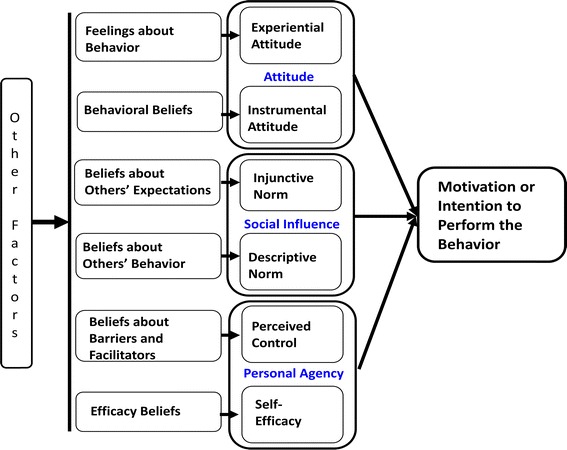
Male circumcision (MC) reduces HIV acquisition among men, leading WHO/UNAIDS to recommend a goal to circumcise 80 % of men in high HIV prevalence countries. Significant investment to increase MC capacity in priority countries was made, yet only 5 % of the goal has been achieved in Zimbabwe. The integrated behavioral model (IBM) was used as a framework to investigate the factors affecting MC motivation among men in Zimbabwe. A survey instrument was designed based on elicitation study results, and administered to a representative household-based sample of 1,201 men aged 18-30 from two urban and two rural areas in Zimbabwe. Multiple regression analysis found all five IBM constructs significantly explained MC Intention. Nearly all beliefs underlying the IBM constructs were significantly correlated with MC Intention. Stepwise regression analysis of beliefs underlying each construct respectively found that 13 behavioral beliefs, 5 normative beliefs, 4 descriptive norm beliefs, 6 efficacy beliefs, and 10 control beliefs were significant in explaining MC Intention. A final stepwise regression of the five sets of significant IBM construct beliefs identified 14 key beliefs that best explain Intention. Similar analyses were carried out with subgroups of men by urban-rural and age. Different sets of behavioral, normative, efficacy, and control beliefs were significant for each sub-group, suggesting communication messages need to be targeted to be most effective for sub-groups. Implications for the design of effective MC demand creation messages are discussed. This study demonstrates the application of theory-driven research to identify evidence-based targets for intervention messages to increase men's motivation to get circumcised and thereby improve demand for male circumcision.
男性包皮环切术可降低男性感染艾滋病毒的几率,因此世界卫生组织/联合国艾滋病规划署建议在艾滋病毒高流行国家设定一个目标,即让80%的男性接受包皮环切术。已在优先国家投入大量资金以提高包皮环切术的实施能力,但在津巴布韦,仅实现了该目标的5%。综合行为模型(IBM)被用作框架,以调查影响津巴布韦男性接受包皮环切术动机的因素。基于诱导性研究结果设计了一份调查问卷,并对来自津巴布韦两个城市和两个农村地区的1201名年龄在18至30岁的具有代表性的男性样本进行了调查。多元回归分析发现,IBM的所有五个构成要素均能显著解释接受包皮环切术的意愿。几乎所有构成IBM要素的信念都与接受包皮环切术的意愿显著相关。分别对每个要素的信念进行逐步回归分析发现,13个行为信念、5个规范信念、4个描述性规范信念、6个效能信念和10个控制信念在解释接受包皮环切术的意愿方面具有显著性。对五组显著的IBM要素信念进行最终的逐步回归分析,确定了最能解释意愿的14个关键信念。还对城乡和年龄分组的男性亚组进行了类似分析。不同组的行为、规范、效能和控制信念对每个亚组都具有显著性,这表明宣传信息需要针对不同亚组,才能最有效。文中讨论了对设计有效的促进包皮环切术需求信息的启示。本研究展示了理论驱动研究的应用,以确定基于证据的干预信息目标,从而提高男性接受包皮环切术的动机,进而改善对男性包皮环切术的需求。