Borondo J, Borondo F, Rodriguez-Sickert C, Hidalgo C A
1] Macro Connections, The MIT Media Lab, Massachusetts Institute of Technology, Cambridge, MA [2] Grupo de Sistemas Complejos and Departamento de Física y Mecánica, Universidad Politécnica de Madrid, ETSI Agrónomos, 28040 Madrid, Spain.
1] Macro Connections, The MIT Media Lab, Massachusetts Institute of Technology, Cambridge, MA [2] Instituto de Ciencias Matemáticas (ICMAT), Cantoblanco, 28049-Madrid, Spain [3] Departamento de Química, Universidad Autónoma de Madrid, Cantoblanco, 28049-Madrid, Spain.
Sci Rep. 2014 Jan 21;4:3784. doi: 10.1038/srep03784.
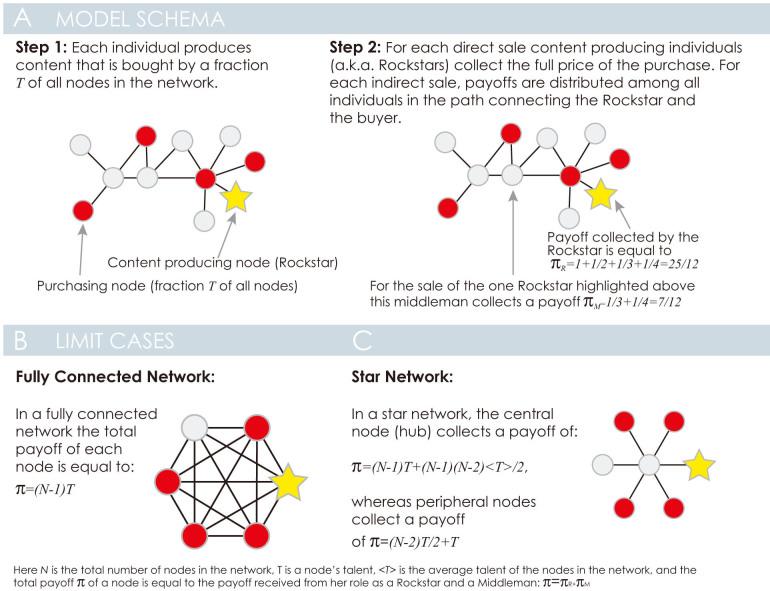
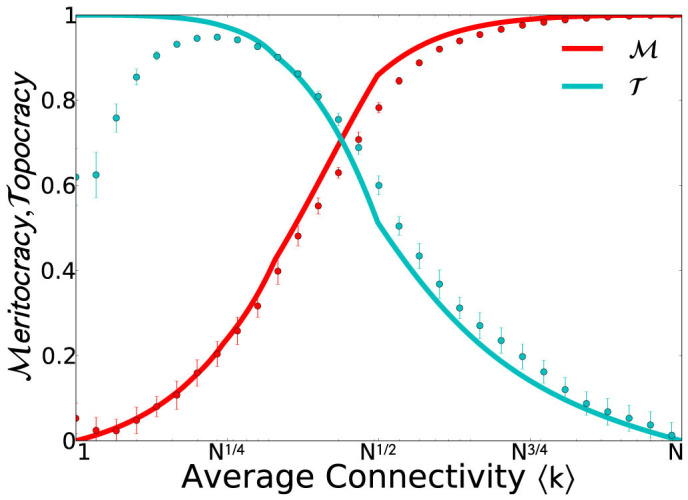
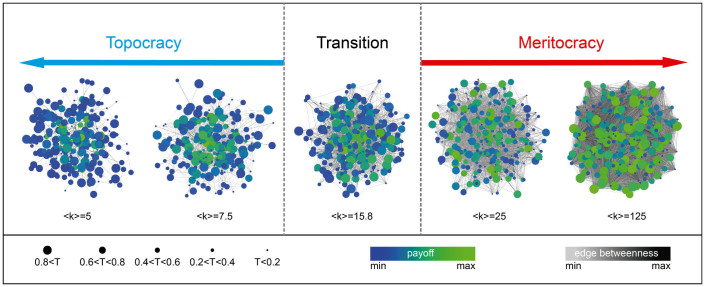
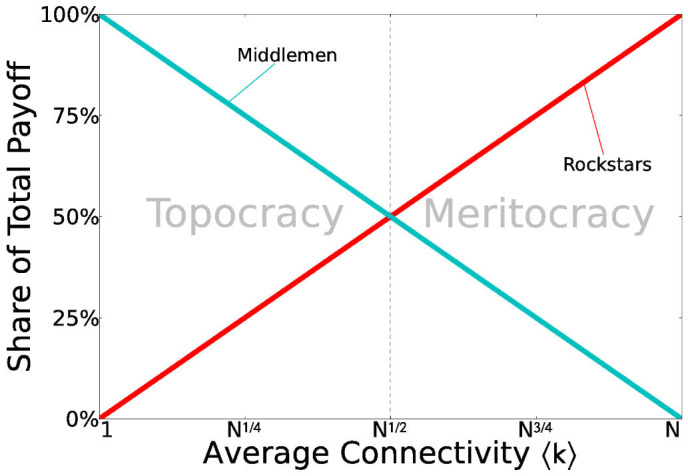
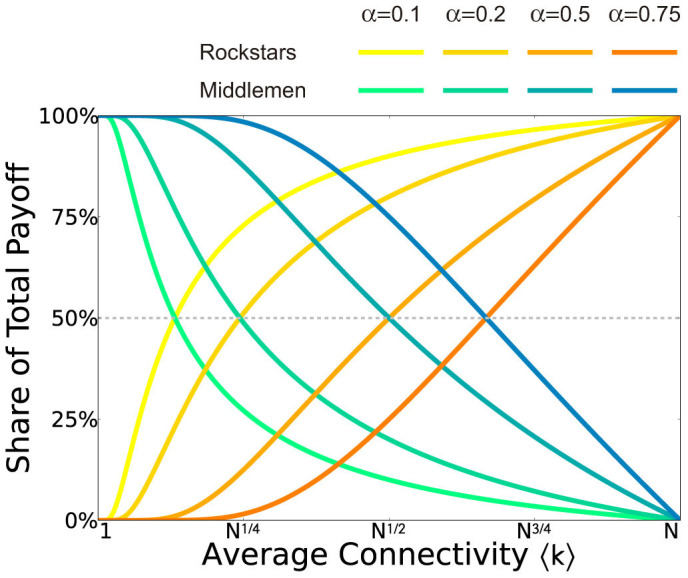
A system is said to be meritocratic if the compensation and power available to individuals is determined by their abilities and merits. A system is topocratic if the compensation and power available to an individual is determined primarily by her position in a network. Here we introduce a model that is perfectly meritocratic for fully connected networks but that becomes topocratic for sparse networks-like the ones in society. In the model, individuals produce and sell content, but also distribute the content produced by others when they belong to the shortest path connecting a buyer and a seller. The production and distribution of content defines two channels of compensation: a meritocratic channel, where individuals are compensated for the content they produce, and a topocratic channel, where individual compensation is based on the number of shortest paths that go through them in the network. We solve the model analytically and show that the distribution of payoffs is meritocratic only if the average degree of the nodes is larger than a root of the total number of nodes. We conclude that, in the light of this model, the sparsity and structure of networks represents a fundamental constraint to the meritocracy of societies.
如果个人所能获得的报酬和权力由其能力与功绩决定,那么该系统就被称为精英管理的。如果个人所能获得的报酬和权力主要由其在网络中的位置决定,那么该系统就是等级制的。在此,我们引入一个模型,对于完全连接的网络而言,它是完全精英管理的,但对于稀疏网络(如社会中的网络)而言,它会变成等级制的。在该模型中,个体生产并销售内容,而且当他们属于连接买家和卖家的最短路径时,还会传播他人生产的内容。内容的生产和传播定义了两种报酬渠道:一种是精英管理渠道,个体因自己生产的内容而获得报酬;另一种是等级制渠道,个体报酬基于网络中通过他们的最短路径数量。我们通过解析求解该模型,并表明只有当节点的平均度大于节点总数的平方根时,收益分配才是精英管理的。我们得出结论,鉴于此模型,网络的稀疏性和结构是社会精英管理的一个基本限制因素。