Department of Plant Physiology, Slovak Agricultural University, Tr. A. Hlinku 2, 949 76, Nitra, Slovak Republic,
Photosynth Res. 2014 Mar;119(3):339-54. doi: 10.1007/s11120-014-9969-8. Epub 2014 Jan 21.
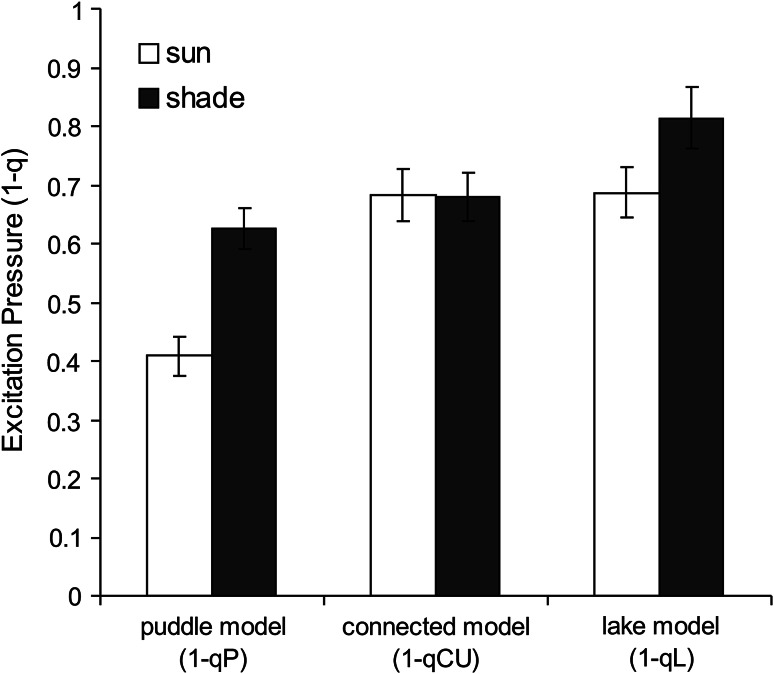
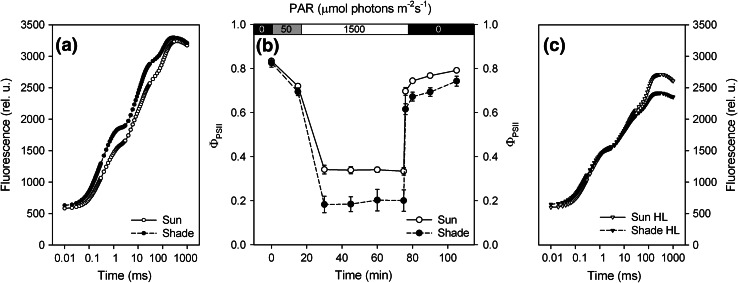
In this study, we have compared photosynthetic performance of barley leaves (Hordeum vulgare L.) grown under sun and shade light regimes during their entire growth period, under field conditions. Analyses were based on measurements of both slow and fast chlorophyll (Chl) a fluorescence kinetics, gas exchange, pigment composition; and of light incident on leaves during their growth. Both the shade and the sun barley leaves had similar Chl a/b and Chl/carotenoid ratios. The fluorescence induction analyses uncovered major functional differences between the sun and the shade leaves: lower connectivity among Photosystem II (PSII), decreased number of electron carriers, and limitations in electron transport between PSII and PSI in the shade leaves; but only low differences in the size of PSII antenna. We discuss the possible protective role of low connectivity between PSII units in shade leaves in keeping the excitation pressure at a lower, physiologically more acceptable level under high light conditions.
在这项研究中,我们在田间条件下比较了整个生长期间在阳光和遮荫光条件下生长的大麦叶片(Hordeum vulgare L.)的光合作用性能。分析基于对慢速和快速叶绿素(Chl)a 荧光动力学、气体交换、色素组成以及叶片在生长过程中接收的光的测量。遮荫和阳光大麦叶片的 Chl a/b 和 Chl/carotenoid 比值相似。荧光诱导分析揭示了阳光和遮荫叶片之间的主要功能差异:PSII 之间的连接性较低、电子载体数量减少以及 PSII 和 PSI 之间的电子传递受限;但 PSII 天线的大小仅存在微小差异。我们讨论了在高光条件下,PSII 单元之间的低连接性在保持较低、生理上更可接受的激发压力方面可能具有的保护作用。