Suppr超能文献

22q11.2缺失综合征的神经认知发育:与有发育迟缓及合并症的青少年的比较。

Neurocognitive development in 22q11.2 deletion syndrome: comparison with youth having developmental delay and medical comorbidities.

作者信息

Gur R E, Yi J J, McDonald-McGinn D M, Tang S X, Calkins M E, Whinna D, Souders M C, Savitt A, Zackai E H, Moberg P J, Emanuel B S, Gur R C

机构信息

Department of Psychiatry, Neuropsychiatry Section, Prelman School of Medicine, University of Pennsylvania, Philadelphia, PA, USA.

1] Department of Psychiatry, Neuropsychiatry Section, Prelman School of Medicine, University of Pennsylvania, Philadelphia, PA, USA [2] Department of Child and Adolescent Psychiatry, Children's Hospital of Philadelphia, Philadelphia, PA, USA.

出版信息

Mol Psychiatry. 2014 Nov;19(11):1205-11. doi: 10.1038/mp.2013.189. Epub 2014 Jan 21.

Abstract

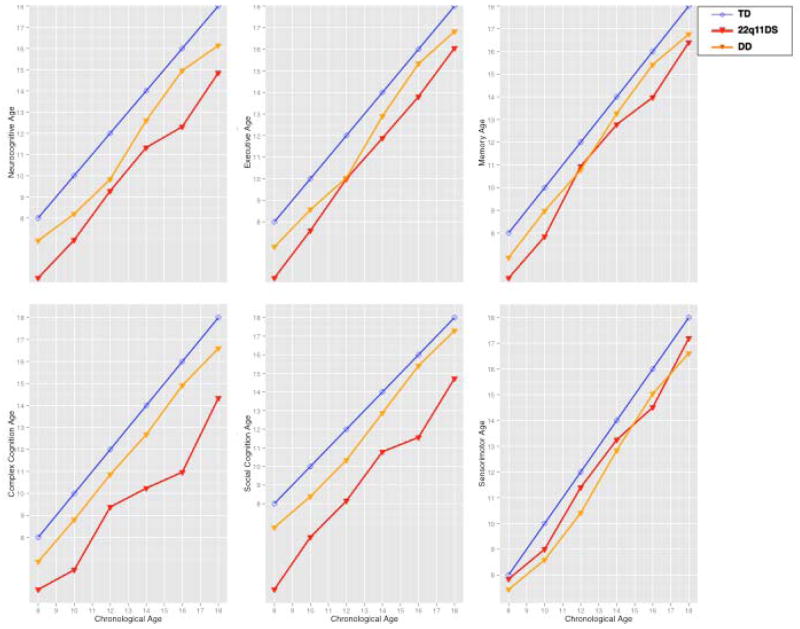
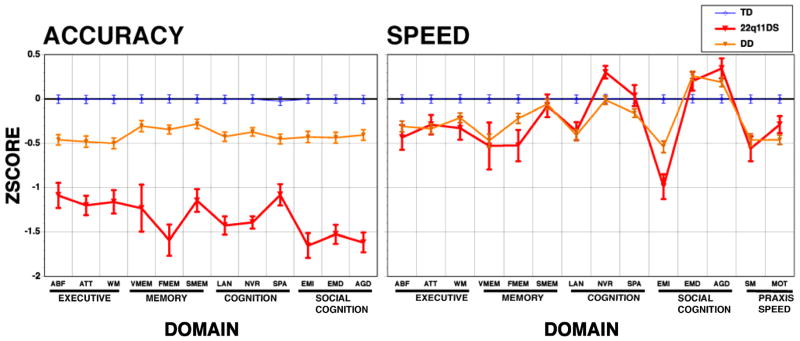
The 22q11.2 deletion syndrome (22q11DS) presents with medical and neuropsychiatric manifestations including neurocognitive deficits. Quantitative neurobehavioral measures linked to brain circuitry can help elucidate genetic mechanisms contributing to deficits. To establish the neurocognitive profile and neurocognitive 'growth charts', we compared cross-sectionally 137 individuals with 22q11DS ages 8-21 to 439 demographically matched non-deleted individuals with developmental delay (DD) and medical comorbidities and 443 typically developing (TD) participants. We administered a computerized neurocognitive battery that measures performance accuracy and speed in executive, episodic memory, complex cognition, social cognition and sensorimotor domains. The accuracy performance profile of 22q11DS showed greater impairment than DD, who were impaired relative to TD. Deficits in 22q11DS were most pronounced for face memory and social cognition, followed by complex cognition. Performance speed was similar for 22q11DS and DD, but 22q11DS individuals were differentially slower in face memory and emotion identification. The growth chart, comparing neurocognitive age based on performance relative to chronological age, indicated that 22q11DS participants lagged behind both groups from the earliest age assessed. The lag ranged from less than 1 year to over 3 years depending on chronological age and neurocognitive domain. The greatest developmental lag across the age range was for social cognition and complex cognition, with the smallest for episodic memory and sensorimotor speed, where lags were similar to DD. The results suggest that 22q11.2 microdeletion confers specific vulnerability that may underlie brain circuitry associated with deficits in several neuropsychiatric disorders, and therefore help identify potential targets and developmental epochs optimal for intervention.

摘要

22q11.2缺失综合征(22q11DS)会出现包括神经认知缺陷在内的医学和神经精神症状。与脑回路相关的定量神经行为测量有助于阐明导致缺陷的遗传机制。为了建立神经认知概况和神经认知“生长图表”,我们对137名年龄在8至21岁的22q11DS个体与439名在人口统计学上匹配的有发育迟缓(DD)和医学合并症的非缺失个体以及443名发育正常(TD)的参与者进行了横断面比较。我们使用了一个计算机化神经认知测试组合,测量执行、情景记忆、复杂认知、社会认知和感觉运动领域的表现准确性和速度。22q11DS的准确性表现概况显示出比DD更严重的损伤,而DD相对于TD也有损伤。22q11DS在面部记忆和社会认知方面的缺陷最为明显,其次是复杂认知。22q11DS和DD的表现速度相似,但22q11DS个体在面部记忆和情绪识别方面的速度差异更大。根据表现相对于实际年龄的神经认知年龄比较得出的生长图表表明,22q11DS参与者从最早评估的年龄起就落后于两组。根据实际年龄和神经认知领域的不同,落后时间从不到1年到超过3年不等。在整个年龄范围内,社会认知和复杂认知的发育滞后最大,情景记忆和感觉运动速度的滞后最小,后者的滞后与DD相似。结果表明,22q11.2微缺失赋予了特定的易损性,这可能是与几种神经精神疾病缺陷相关的脑回路基础,因此有助于确定潜在的干预靶点和最佳发育时期。
相似文献

2
Neurocognitive profile in psychotic versus nonpsychotic individuals with 22q11.2 deletion syndrome.
Eur Neuropsychopharmacol. 2016 Oct;26(10):1610-8. doi: 10.1016/j.euroneuro.2016.08.003. Epub 2016 Aug 12.
5
Computerized neurocognitive profile in young people with 22q11.2 deletion syndrome compared to youths with schizophrenia and at-risk for psychosis.
Am J Med Genet B Neuropsychiatr Genet. 2012 Jan;159B(1):87-93. doi: 10.1002/ajmg.b.32005. Epub 2011 Dec 13.
6
Social cognition in 22q11.2 deletion syndrome and idiopathic developmental neuropsychiatric disorders.
J Neurodev Disord. 2021 Apr 17;13(1):15. doi: 10.1186/s11689-021-09363-4.
8
Musical auditory processing, cognition, and psychopathology in 22q11.2 deletion syndrome.
Am J Med Genet B Neuropsychiatr Genet. 2018 Dec;177(8):765-773. doi: 10.1002/ajmg.b.32690. Epub 2018 Nov 16.
9
Impact of psychiatric comorbidity and cognitive deficit on function in 22q11.2 deletion syndrome.
J Clin Psychiatry. 2015 Oct;76(10):e1262-70. doi: 10.4088/JCP.14m09197.

引用本文的文献

1
Review: Child Psychiatry in the Era of Genomics: The Promise of Translational Genetics Research for the Clinic.
JAACAP Open. 2024 Aug 9;3(2):157-170. doi: 10.1016/j.jaacop.2024.06.002. eCollection 2025 Jun.
2
An exploratory fetal MRI study examining the impact of 22q11.2 microdeletion syndrome on early brain growth.
J Neurodev Disord. 2025 Feb 12;17(1):7. doi: 10.1186/s11689-025-09594-9.
3
Sleep difficulties related to psychopathology and neurocognition in people with 22q11.2 deletion syndrome.
Psychiatry Res. 2025 Feb;344:116336. doi: 10.1016/j.psychres.2024.116336. Epub 2024 Dec 22.
4
Highly demarcated structural alterations in the brain and impaired social incentive learning in Tbx1 heterozygous mice.
Mol Psychiatry. 2025 May;30(5):1876-1886. doi: 10.1038/s41380-024-02797-x. Epub 2024 Oct 27.
5
Social Cognition Impairments in 22q11.2DS Individuals With and Without Psychosis: A Comparison Study With a Large Population of Patients With Schizophrenia.
Schizophr Bull Open. 2021 Nov 10;3(1):sgab049. doi: 10.1093/schizbullopen/sgab049. eCollection 2022 Jan.
6
Neurocognitive profiles of 22q11.2 and 16p11.2 deletions and duplications.
Mol Psychiatry. 2025 Feb;30(2):379-387. doi: 10.1038/s41380-024-02661-y. Epub 2024 Jul 24.
7
Neuroanatomical Correlates of Cognitive Dysfunction in 22q11.2 Deletion Syndrome.
Genes (Basel). 2024 Mar 30;15(4):440. doi: 10.3390/genes15040440.
8
A Developmentally Informed Systematic Review and Meta-Analysis of the Strength of General Psychopathology in Childhood and Adolescence.
Clin Child Fam Psychol Rev. 2024 Mar;27(1):130-164. doi: 10.1007/s10567-023-00464-1. Epub 2023 Dec 19.
9
Distinct neurocognitive profiles and clinical phenotypes associated with copy number variation at the 22q11.2 locus.
Autism Res. 2023 Dec;16(12):2247-2262. doi: 10.1002/aur.3049. Epub 2023 Nov 23.

本文引用的文献

1
Mouse Models of 22q11.2-Associated Autism Spectrum Disorder.
Autism Open Access. 2012;Suppl 1:001. doi: 10.4172/2165-7890.S1-001.
2
Neurocognitive growth charting in psychosis spectrum youths.
JAMA Psychiatry. 2014 Apr;71(4):366-74. doi: 10.1001/jamapsychiatry.2013.4190.
3
Neuroimaging predictors of cognitive performance across a standardized neurocognitive battery.
Neuropsychology. 2014 Mar;28(2):161-176. doi: 10.1037/neu0000011. Epub 2013 Dec 23.
5
Psychiatric disorders in 22q11.2 deletion syndrome are prevalent but undertreated.
Psychol Med. 2014 Apr;44(6):1267-77. doi: 10.1017/S0033291713001669. Epub 2013 Sep 9.
6
The 22q11.2 deletion syndrome as a window into complex neuropsychiatric disorders over the lifespan.
Biol Psychiatry. 2014 Mar 1;75(5):351-60. doi: 10.1016/j.biopsych.2013.07.019. Epub 2013 Aug 28.
7
Neuroimaging of the Philadelphia neurodevelopmental cohort.
Neuroimage. 2014 Feb 1;86:544-53. doi: 10.1016/j.neuroimage.2013.07.064. Epub 2013 Aug 3.
8
Copy number variation at 22q11.2: from rare variants to common mechanisms of developmental neuropsychiatric disorders.
Mol Psychiatry. 2013 Nov;18(11):1153-65. doi: 10.1038/mp.2013.92. Epub 2013 Aug 6.
9
Elevated amygdala response to faces and gaze aversion in autism spectrum disorder.
Soc Cogn Affect Neurosci. 2014 Jan;9(1):106-17. doi: 10.1093/scan/nst050. Epub 2013 Apr 16.

文献AI研究员

20分钟写一篇综述,助力文献阅读效率提升50倍。

立即体验

用中文搜PubMed

大模型驱动的PubMed中文搜索引擎

马上搜索

文档翻译

学术文献翻译模型,支持多种主流文档格式。

立即体验