Sadraei H, Asghari G, Emami S
Department of Pharmacology & Toxicology and Isfahan Pharmaceutical Sciences Research Center, School of Pharmacy and Pharmaceutical Sciences, Isfahan University of Medical Sciences, Isfahan, I.R. Iran.
Department of Pharmacognosy, School of Pharmacy and Pharmaceutical Sciences, Isfahan University of Medical Sciences, Isfahan, I.R. Iran.
Res Pharm Sci. 2013 Jan;8(1):17-23.
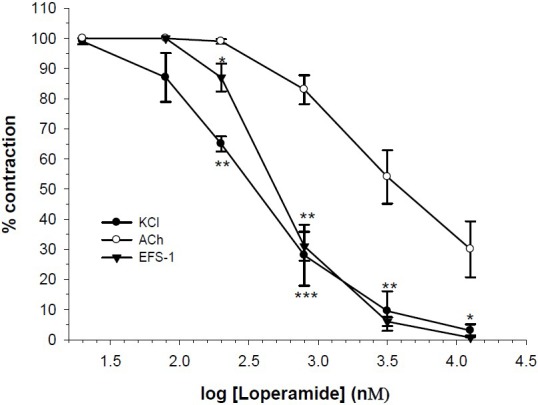
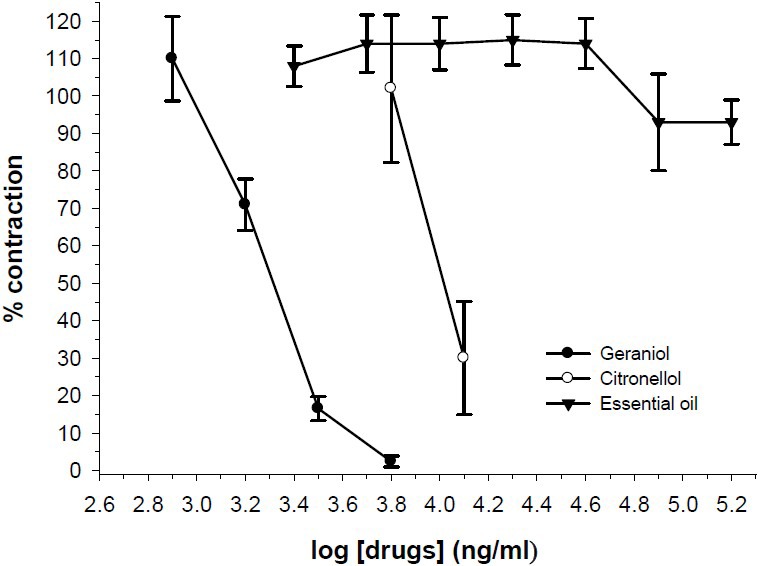
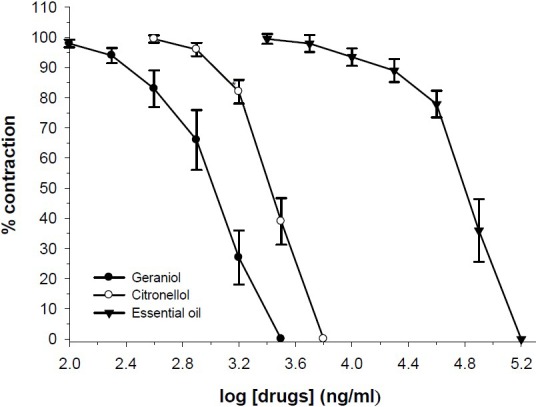
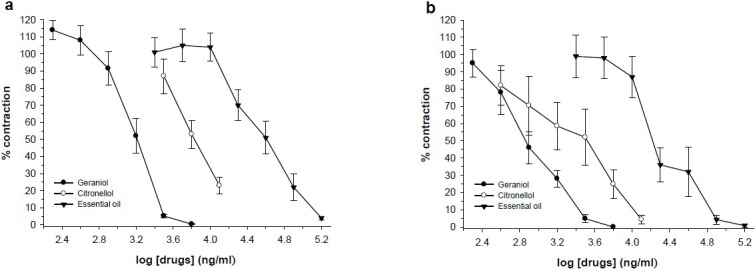
Flower of Rosa damascena Mill is widely used in Iran for gastrointestinal (GI) disorders. However, its pharmacological action on ileum contraction has not been studied. In this research we have investigated ileum motility effect of essential oil of flower petals of R. damascena growing in Kashan, Iran, and two of its constituents. The essential oils obtained by hydrodistillation were investigated by a combination of GC and GC/MS. More than 34 compounds have been identified. The main constituents of the essential oil were β-citronellol (23%), nonadecane (16%), geraniol (16%) and heneicosane (5%). A portion of rat isolated ileum was suspended under 1g tension in Tyrode's solution at 37°C and gassed with O2. Effect of the R. damascena essential oil (2.5-160 μg/ml), geraniol (0.2-3.2 μg/ml) and citronellol (0.8-6.4 μg/ml) were studied on ileum contractions induced by KCl, acetylcholine (ACh) and electrical field stimulation (EFS) and compared with standard drugs atropine and loperamide. The contractile response of EFS was mediated mainly through the intramural nerve plexuses, because its response was inhibited by loperamide and partially reduced by atropine. The essential oil concentration dependently inhibited the response to KCl (IC50=67 ± 8.4μg/ml) and EFS (IC50=47 ± 10.6 μg/ml). Geraniol (IC50=1.7 ± 0.15 μg/ml for KCl) and citronellol (IC50=2.9 ± 0.3 μg/ml for KCl) also had inhibitory effect of ileum contraction and both were more potent than the essential oil. It was concluded that R. damascena essential oil mainly had an inhibitory effect on ileum contractions and geraniol and citronellol had a major role in inhibitory effect of the essential.
大马士革蔷薇花在伊朗被广泛用于治疗胃肠道疾病。然而,其对回肠收缩的药理作用尚未得到研究。在本研究中,我们调查了生长在伊朗卡尚的大马士革蔷薇花瓣精油及其两种成分对回肠蠕动的影响。通过水蒸馏法获得的精油采用气相色谱(GC)和气相色谱 - 质谱联用(GC/MS)进行分析。已鉴定出34种以上的化合物。该精油的主要成分是β - 香茅醇(23%)、十九烷(16%)、香叶醇(16%)和二十一烷(5%)。将一部分大鼠离体回肠在37°C的台氏液中以1g张力悬挂,并通入氧气。研究了大马士革蔷薇精油(2.5 - 160μg/ml)、香叶醇(0.2 - 3.2μg/ml)和香茅醇(0.8 - 6.4μg/ml)对氯化钾(KCl)、乙酰胆碱(ACh)和电场刺激(EFS)诱导的回肠收缩的影响,并与标准药物阿托品和洛哌丁胺进行比较。EFS的收缩反应主要通过肠壁神经丛介导,因为其反应被洛哌丁胺抑制,且被阿托品部分减弱。精油浓度依赖性地抑制对KCl(IC50 = 67 ± 8.4μg/ml)和EFS(IC50 = 47 ± 10.6μg/ml)的反应。香叶醇(对KCl的IC50 = 1.7 ± 0.15μg/ml)和香茅醇(对KCl的IC50 = 2.9 ± 0.3μg/ml)也具有抑制回肠收缩的作用,且两者均比精油更有效。得出的结论是,大马士革蔷薇精油主要对回肠收缩有抑制作用,香叶醇和香茅醇在该精油的抑制作用中起主要作用。