Department of Psychiatry, Yonsei University College of Medicine, Seoul, Korea. ; Institute of Behavioral Science in Medicine, Yonsei University College of Medicine, Seoul, Korea.
Department of Psychiatry, Konyang University College of Medicine, Daejeon, Korea.
Clin Psychopharmacol Neurosci. 2013 Dec;11(3):126-31. doi: 10.9758/cpn.2013.11.3.126. Epub 2013 Dec 24.
It has been reported that working and learning efficiency might be increased through artificially controlling the color temperature and brightness of light. However, the neurological bases of these outcomes are not well established. Our study was designed to observe whether electroencephalogram (EEG) alpha frequency, as a candidate biological marker, demonstrates significant changes in response to alterations of specific light parameters.
Thirty-two healthy subjects performed cognitive tasks under four different polychromatic light conditions: a combination of two different levels of color temperature (2766K vs. 5918K) and brightness (300 lux vs. 600 lux). Spectrum analyses were performed on alpha frequency.
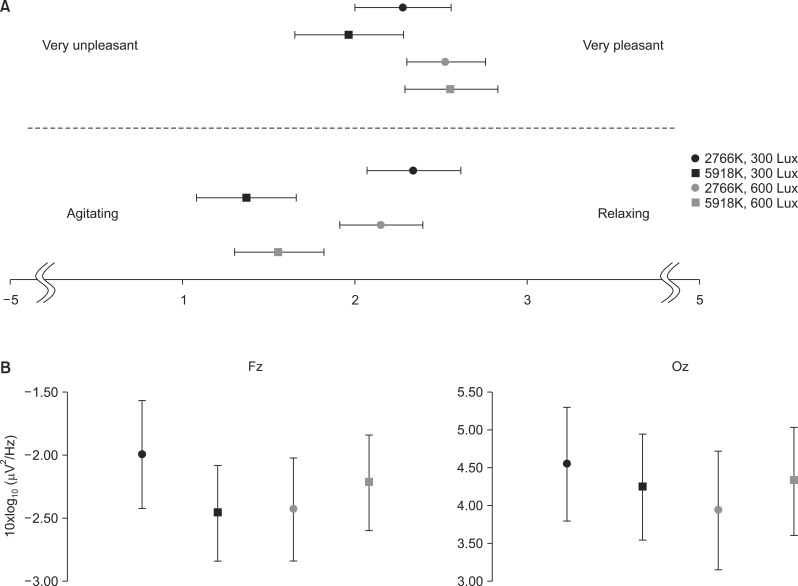
Subjects reported that they felt more pleasant in bright conditions and more relaxed in warm color temperature conditions. Our findings indicate that alpha power increases in warm, low-light and cool, high-light conditions, and there is a significant interaction between color temperature and brightness.
EEGs might serve as a useful biological marker for further research related to the effects of polychromatic light on cognitive function.
据报道,通过人为控制光的色温与亮度,可以提高工作和学习效率。然而,这些结果的神经学基础尚未明确。本研究旨在观察脑电图(EEG)中的阿尔法频率是否会发生显著变化,以此作为候选生物标志物,来响应特定光参数的变化。
32 名健康受试者在四种不同的多色光条件下完成认知任务:两种不同色温(2766K 与 5918K)与两种不同亮度(300 勒克斯与 600 勒克斯)的组合。对阿尔法频率进行频谱分析。
受试者报告称,他们在明亮的环境中感觉更愉悦,在温暖的色温环境中感觉更放松。研究结果表明,在温暖、低亮度和凉爽、高亮度的条件下,阿尔法功率增加,并且色温与亮度之间存在显著的相互作用。
EEG 可能成为进一步研究多色光对认知功能影响的有用生物标志物。