Wei Lu, Ye Xiaoshuang, Pei Xiaohua, Wu Jianqing, Zhao Weihong
Department of Geriatrics, the First Affiliated Hospital of Nanjing Medical University, Nanjing, Jiangsu, China.
PLoS One. 2014 Jan 21;9(1):e86066. doi: 10.1371/journal.pone.0086066. eCollection 2014.
The present study aimed to establish reference intervals for serum cystatin C (Scys-C) stratified by stages of chronic kidney disease, explore factors influencing Scys-C and compare the performance of Scys-C with serum creatinine (Scr) in the young and elderly.
A total of 800 participants, 516 young (<60 years) and 284 old (≥60 years) subjects were included in this study. Scys-C and Scr were assayed by the partical-enhanced immunoturbidimetry method and enzymatic method respectively. 95% reference interval was adopted to evaluate reference intervals. Influencing factors were characterized by multivariate linear regression analysis. Relationship between reference glomerular filtration rate (rGFR) and Scys-C or Scr was determined by correlation coefficient.
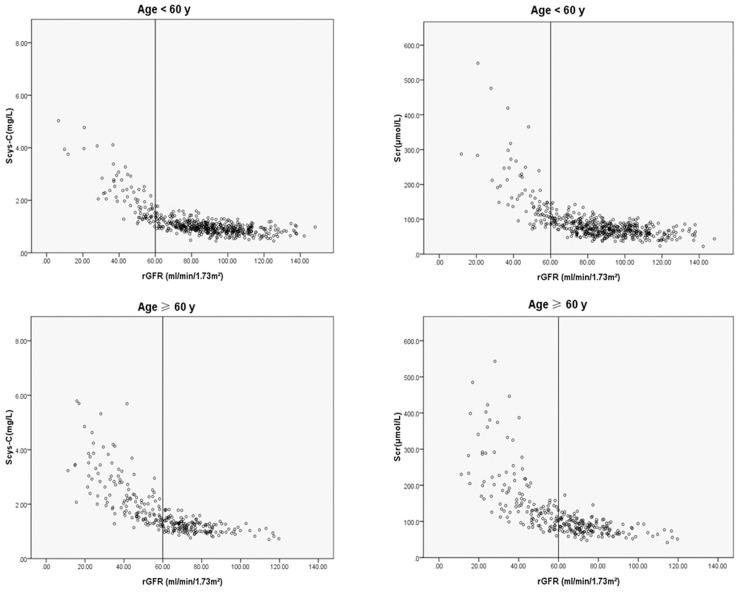
Reference intervals for Scys-C were calculated to be 0.71-1.38 mg/L, 0.83-1.67 mg/L, 1.02-2.61 mg/L, 1.32-4.48 mg/L, 1.95-6.11 mg/L in the aged in CKD G1, G2, G3a, G3b and G4-5 stages, respectively. Body mass index(BMI), nephritis, kidney neoplasm and hypertension were demonstrated as factors affecting Scys-C in the elderly while gender, nephritis and kidney neoplasm were clarified as influencing factors in the young group. Scr levels were affected by more factors, such as body surface area and hematological disease. Correlation coefficient between rGFR and Scys-C or Scr showed that serum Scys-C was superior to Scr, especially in the subjects with mildly decreased renal function (-0.593 vs. -0.520).
Factors other than renal function influenced Scys-C when applying to evaluate glomerular filtration rate (GFR), such as BMI, nephritis, kidney neoplasm and hypertension, and Scys-C had higher correlation with GFR than Scr in the elderly.
本研究旨在建立按慢性肾脏病分期分层的血清胱抑素C(Scys-C)参考区间,探索影响Scys-C的因素,并比较Scys-C与血清肌酐(Scr)在年轻人和老年人中的性能。
本研究共纳入800名参与者,其中516名年轻人(<60岁)和284名老年人(≥60岁)。分别采用颗粒增强免疫比浊法和酶法检测Scys-C和Scr。采用95%参考区间评估参考区间。通过多元线性回归分析确定影响因素。通过相关系数确定参考肾小球滤过率(rGFR)与Scys-C或Scr之间的关系。
CKD G1、G2、G3a、G3b和G4-5期老年人的Scys-C参考区间分别计算为0.71-1.38mg/L、0.83-1.67mg/L、1.02-2.61mg/L、1.32-4.48mg/L、1.95-6.11mg/L。体重指数(BMI)、肾炎、肾肿瘤和高血压被证明是影响老年人Scys-C的因素,而性别、肾炎和肾肿瘤被明确为年轻组的影响因素。Scr水平受更多因素影响,如体表面积和血液系统疾病。rGFR与Scys-C或Scr之间的相关系数表明,血清Scys-C优于Scr,尤其是在肾功能轻度下降的受试者中(-0.593对-0.520)。
在应用Scys-C评估肾小球滤过率(GFR)时,除肾功能外的其他因素如BMI、肾炎、肾肿瘤和高血压也会产生影响,且Scys-C与老年人GFR的相关性高于Scr。