Saint-Maurice Pedro F, Welk Gregory J, Russell Daniel W, Huberty Jennifer
Iowa State University, Department of Kinesiology, Ames, IA 50011, USA.
BMC Public Health. 2014 Feb 1;14:103. doi: 10.1186/1471-2458-14-103.
A limitation of traditional outcome studies from behavioral interventions is the lack of attention given to evaluating the influence of moderating variables. This study examined possible moderation effect of baseline activity levels on physical activity change as a result of the Ready for Recess intervention.
Ready for Recess (August 2009-September 2010) was a controlled trial with twelve schools randomly assigned to one of four conditions: control group, staff supervision, equipment availability, and the combination of staff supervision and equipment availability. A total of 393 children (181 boys and 212 girls) from grades 3 through 6 (8-11 years old) were asked to wear an Actigraph monitor during school time on 4-5 days of the week. Assessments were conducted at baseline (before intervention) and post intervention (after intervention).
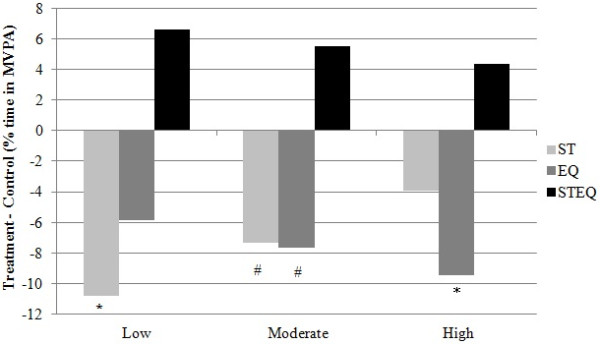
Initial MVPA moderated the effect of Staff supervision (β = -0.47%; p < .05), but not Equipment alone and Staff + Equipment (p > .05). Participants in the Staff condition that were 1 standard deviation (SD) below the mean for baseline MVPA (classified as "low active") had lower MVPA levels at post-intervention when compared with their low active peers in the control condition (Mean diff = -10.8 ± 2.9%; p = .005). High active individuals (+1SD above the mean) in the Equipment treatment also had lower MVPA values at post-intervention when compared with their highly active peers in the control group (Mean diff = -9.5 ± 2.9%; p = .009).
These results indicate that changes in MVPA levels at post-intervention were reduced in highly active participants when recess staff supervision was provided. In this study, initial MVPA moderated the effect of Staff supervision on children's MVPA after 6 months of intervention. Staff training should include how to work with inactive youth but also how to assure that active children remain active.
行为干预传统结果研究的一个局限性在于,缺乏对调节变量影响评估的关注。本研究考察了基线活动水平对“课间休息准备”干预导致的身体活动变化的可能调节作用。
“课间休息准备”(2009年8月至2010年9月)是一项对照试验,12所学校被随机分配到四种条件之一:对照组、教师监督、提供设备以及教师监督与提供设备相结合。共有393名3至6年级(8至11岁)的儿童(181名男孩和212名女孩)被要求在一周中的4至5天上学期间佩戴活动记录仪。在基线(干预前)和干预后(干预后)进行评估。
初始中度至剧烈身体活动(MVPA)调节了教师监督的效果(β = -0.47%;p <.05),但单独设备以及教师 + 设备的条件下未出现调节作用(p >.05)。在教师监督条件下,基线MVPA低于均值1个标准差(SD)(归类为“低活动水平”)的参与者,与对照组中低活动水平的同龄人相比,干预后的MVPA水平更低(平均差异 = -10.8 ± 2.9%;p =.005)。在设备干预组中,高于均值1个标准差(+1SD)的高活动水平个体,与对照组中的高活动水平同龄人相比,干预后的MVPA值也更低(平均差异 = -9.5 ± 2.9%;p =.009)。
这些结果表明,当提供课间休息教师监督时,高活动水平参与者干预后的MVPA水平变化有所降低。在本研究中,初始MVPA在干预6个月后调节了教师监督对儿童MVPA的影响。教师培训应包括如何与不活跃的青少年合作,同时也要确保活跃的儿童保持活跃。