Nanoscale Physics Research Laboratories, School of Physics and Astronomy, University of Birmingham, Birmingham, UK.
BMC Nephrol. 2014 Feb 1;15:24. doi: 10.1186/1471-2369-15-24.
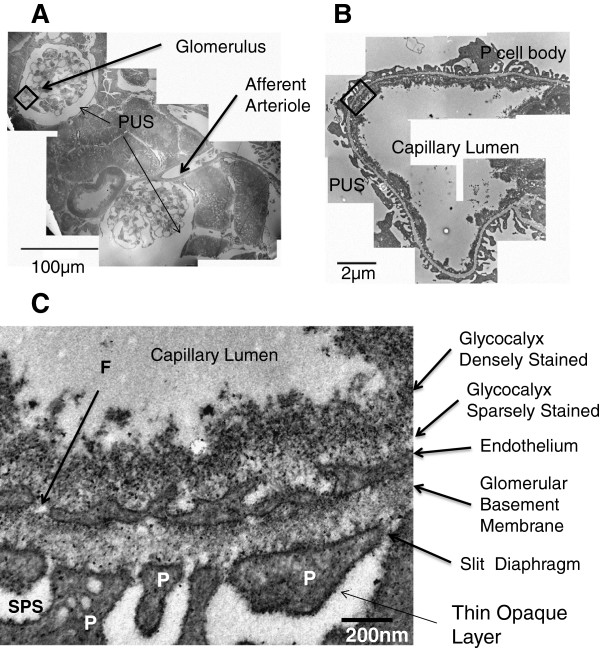
The human glomerulus is the primary filtration unit of the kidney, and contains the Glomerular Filtration Barrier (GFB). The GFB had been thought to comprise 3 layers - the endothelium, the basement membrane and the podocyte foot processes. However, recent studies have suggested that at least two additional layers contribute to the function of the GFB, the endothelial glycocalyx on the vascular side, and the sub-podocyte space on the urinary side. To investigate the structure of these additional layers is difficult as it requires three-dimensional reconstruction of delicate sub-microscopic (<1 μm) cellular and extracellular elements.
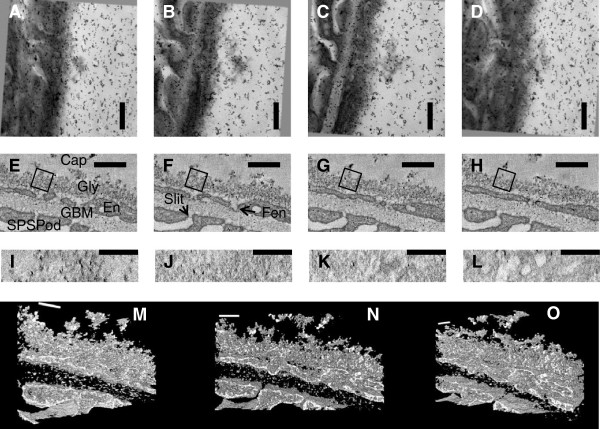
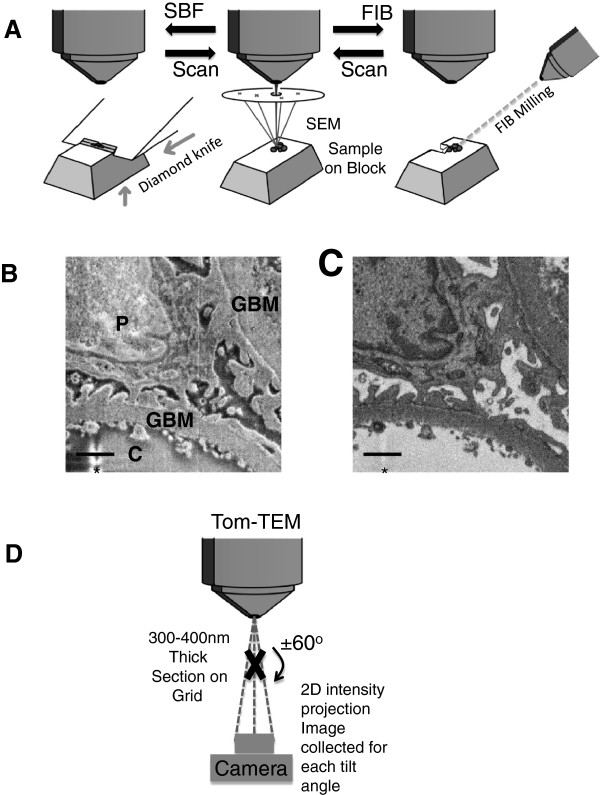
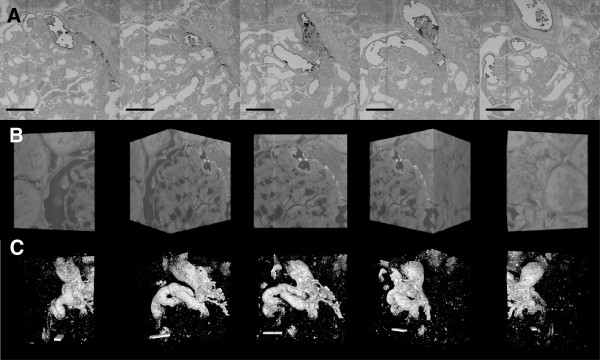
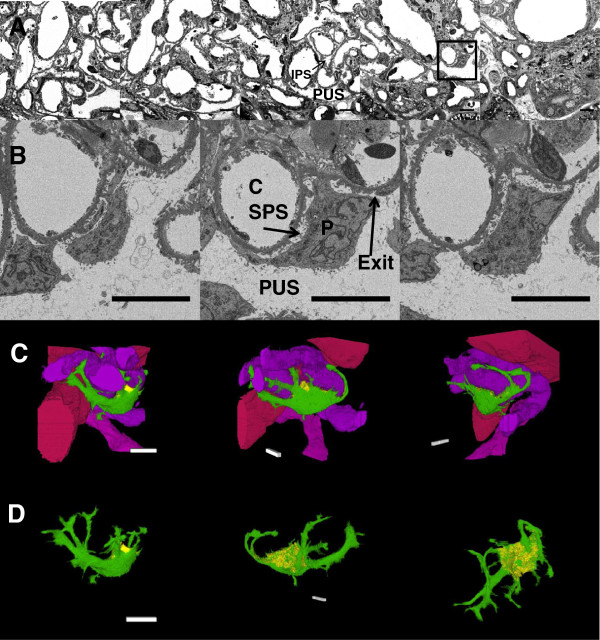
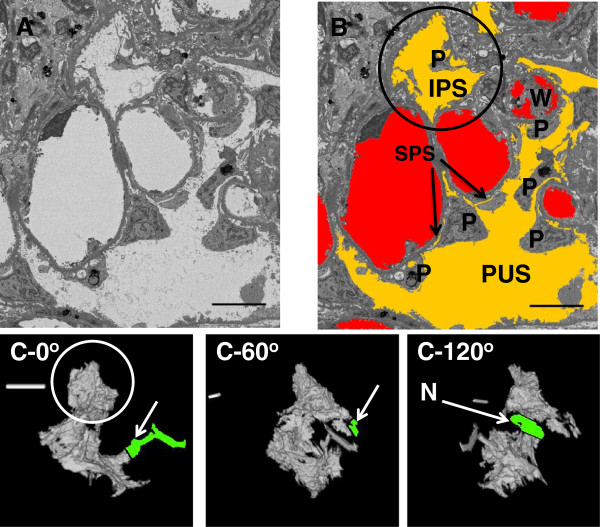
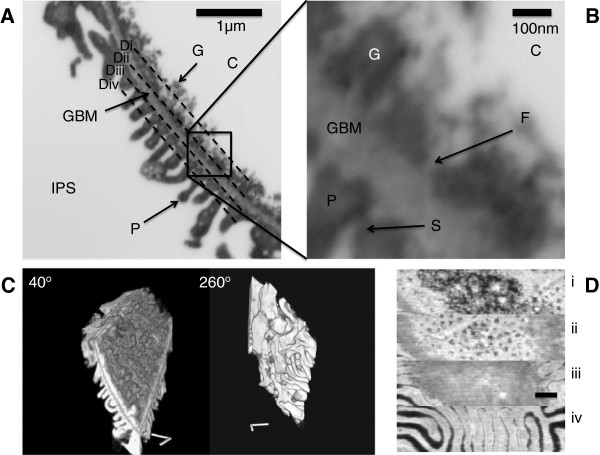
Here we have combined three different advanced electron microscopic techniques that cover multiple orders of magnitude of volume sampled, with a novel staining methodology (Lanthanum Dysprosium Glycosaminoglycan adhesion, or LaDy GAGa), to determine the structural basis of these two additional layers. Serial Block Face Scanning Electron Microscopy (SBF-SEM) was used to generate a 3-D image stack with a volume of a 5.3 x 105 μm3 volume of a whole kidney glomerulus (13% of glomerular volume). Secondly, Focused Ion Beam milling Scanning Electron Microscopy (FIB-SEM) was used to image a filtration region (48 μm3 volume). Lastly Transmission Electron Tomography (Tom-TEM) was performed on a 0.3 μm3 volume to identify the fine structure of the glycocalyx.
Tom-TEM clearly showed 20 nm fibre spacing in the glycocalyx, within a limited field of view. FIB-SEM demonstrated, in a far greater field of view, how the glycocalyx structure related to fenestrations and the filtration slits, though without the resolution of TomTEM. SBF-SEM was able to determine the extent of the sub-podocyte space and glycocalyx coverage, without additional heavy metal staining. Neither SBF- nor FIB-SEM suffered the anisotropic shrinkage under the electron beam that is seen with Tom-TEM.
These images demonstrate that the three dimensional structure of the GFB can be imaged, and investigated from the whole glomerulus to the fine structure of the glycocalyx using three dimensional electron microscopy techniques. This should allow the identification of structural features regulating physiology, and their disruption in pathological states, aiding the understanding of kidney disease.
人类肾小球是肾脏的主要过滤单位,包含肾小球滤过屏障 (GFB)。GFB 曾被认为由 3 层组成 - 内皮细胞、基底膜和足细胞的足突。然而,最近的研究表明,至少还有另外两层有助于 GFB 的功能,即血管侧的内皮糖萼和尿侧的亚足突空间。研究这些额外层的结构非常困难,因为它需要对细微的亚微观 (<1μm) 细胞和细胞外元素进行三维重建。
在这里,我们结合了三种不同的先进电子显微镜技术,这些技术涵盖了多个体积采样数量级,并采用了一种新的染色方法(镧钕糖胺聚糖粘连,或 LaDy GAGa),以确定这两个额外层的结构基础。连续块面扫描电子显微镜 (SBF-SEM) 用于生成一个 3-D 图像堆栈,其体积为整个肾脏肾小球的 5.3 x 105 μm3 体积(肾小球体积的 13%)。其次,聚焦离子束铣削扫描电子显微镜 (FIB-SEM) 用于对过滤区域进行成像(48 μm3 体积)。最后,在 0.3 μm3 体积上进行透射电子断层扫描 (Tom-TEM) 以识别糖萼的精细结构。
Tom-TEM 清楚地显示了糖萼中的 20nm 纤维间距,在有限的视野内。FIB-SEM 在更大的视野中展示了糖萼结构如何与窗孔和过滤缝隙相关,尽管没有 TomTEM 的分辨率。SBF-SEM 能够确定亚足突空间和糖萼覆盖范围的程度,而无需额外的重金属染色。SBF- 和 FIB-SEM 都没有像 Tom-TEM 那样在电子束下出现各向异性收缩。
这些图像表明,可以使用三维电子显微镜技术从整个肾小球到糖萼的精细结构来对 GFB 的三维结构进行成像和研究。这应该允许识别调节生理学的结构特征及其在病理状态下的破坏,从而有助于理解肾脏疾病。