Bjørk Petersen Christina, Bauman Adrian, Grønbæk Morten, Wulff Helge Jørn, Thygesen Lau Caspar, Tolstrup Janne S
National Institute of Public Health, University of Southern Denmark, Øster Farimagsgade 5A, Copenhagen 1353, Denmark.
Int J Behav Nutr Phys Act. 2014 Feb 5;11:13. doi: 10.1186/1479-5868-11-13.
Evidence suggests that sitting time is adversely associated with health risks. However, previous epidemiological studies have mainly addressed mortality whereas little is known of the risk of coronary heart disease. This study aimed to investigate total sitting time and risk of myocardial infarction, coronary heart disease incidence and all-cause mortality.
In the Danish Health Examination Survey (DANHES) conducted in 2007-2008 we tested the hypothesis that a higher amount of daily total sitting time is associated with greater risk of myocardial infarction, coronary heart disease and all-cause mortality. The study population consisted of 71,363 men and women aged 18-99 years without coronary heart disease. Participants were followed for myocardial infarction, coronary heart disease and mortality in national registers to August 10, 2012. Cox regression analyses were performed with adjustment for potential confounders and multiple imputation for missing values.
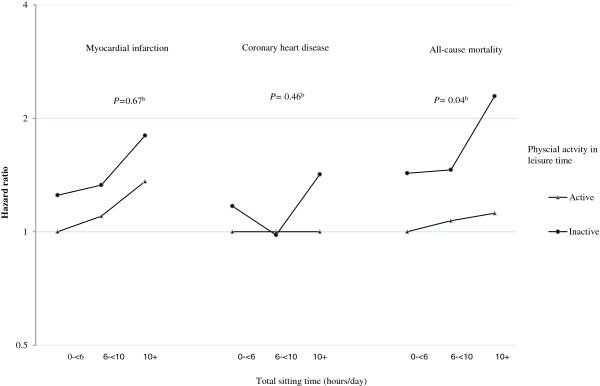
During a mean follow-up period of 5.4 years 358 incident cases of myocardial infarction, 1,446 of coronary heart disease, and 1,074 deaths from all causes were registered. The hazard ratios associated with 10 or more hours of daily sitting compared to less than 6 hours were 1.38 (95% CI: 1.01, 1.88) for myocardial infarction, 1.07 (95% CI: 0.91, 1.27) for coronary heart disease and 1.31 (95% CI: 1.09, 1.57). Compared to sitting less than 6 hours per day and being physically active in leisure time, the hazard ratios of sitting more than 10 hours per day and also being physically inactive in leisure time were 1.80 (95% CI: 1.15, 2.82) for myocardial infarction, 1.42 (95% CI: 1.11, 1.81) for coronary heart disease, and 2.29 (95% CI: 1.82, 2.89) for all-cause mortality.
The results suggest that a higher amount of daily total sitting time is associated with all-cause mortality, particularly among inactive adults. In relation to coronary heart, disease results were less clear. This paper adds new evidence to the limited data on the evidence of sitting time and cardiovascular disease and mortality.
有证据表明久坐时间与健康风险存在负相关。然而,以往的流行病学研究主要关注死亡率,而对冠心病风险的了解甚少。本研究旨在调查总久坐时间与心肌梗死风险、冠心病发病率及全因死亡率之间的关系。
在2007 - 2008年进行的丹麦健康检查调查(DANHES)中,我们检验了以下假设:每日总久坐时间越长,心肌梗死、冠心病及全因死亡率的风险越高。研究人群包括71363名年龄在18 - 99岁且无冠心病的男性和女性。在国家登记处对参与者进行随访,记录心肌梗死、冠心病及死亡率,直至2012年8月10日。采用Cox回归分析,并对潜在混杂因素进行调整,对缺失值进行多重填补。
在平均5.4年的随访期内,共记录到358例心肌梗死新发病例、1446例冠心病病例以及1074例全因死亡病例。与每天久坐少于6小时相比,每天久坐10小时或更长时间,心肌梗死的风险比为1.38(95%可信区间:1.01, 1.88),冠心病的风险比为1.07(95%可信区间:0.91, 1.27),全因死亡的风险比为1.31(95%可信区间:1.09, 1.57)。与每天久坐少于6小时且闲暇时进行体育活动相比,每天久坐超过10小时且闲暇时不进行体育活动,心肌梗死的风险比为1.80(95%可信区间:1.15, 2.82),冠心病的风险比为1.42(95%可信区间:1.11, 1.81),全因死亡的风险比为2.29(95%可信区间:1.82, 2.89)。
结果表明,每日总久坐时间越长,全因死亡率越高,尤其是在不活动的成年人中。关于冠心病,结果不太明确。本文为久坐时间与心血管疾病及死亡率关系的有限数据增添了新证据。