Grimm Alexander, Teschner Ulrike, Porzelius Christine, Ludewig Katrin, Zielske Jörg, Witte Otto W, Brunkhorst Frank M, Axer Hubertus
Crit Care. 2013 Oct 7;17(5):R227. doi: 10.1186/cc13050.
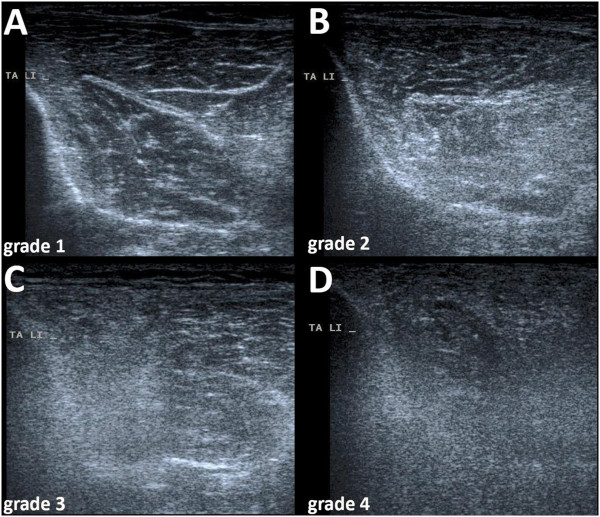
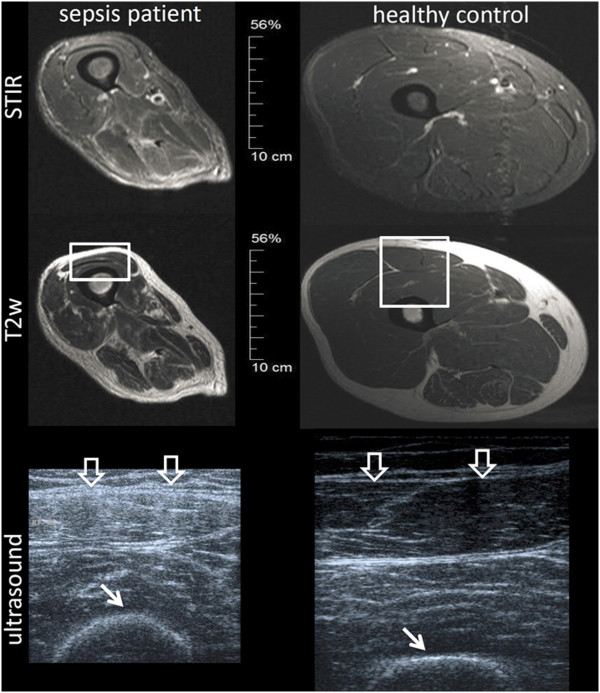
Muscle ultrasound is emerging as a promising tool in the diagnosis of neuromuscular diseases. The current observational study evaluates the usefulness of muscle ultrasound in patients with severe sepsis for assessment of critical illness polyneuropathy and myopathy (CINM) in the intensive care unit.
28 patients with either septic shock or severe sepsis underwent clinical neurological examinations, muscle ultrasound, and nerve conduction studies on days 4 and 14 after onset of sepsis. 26 healthy controls of comparable age underwent clinical neurological evaluation and muscle ultrasound only.
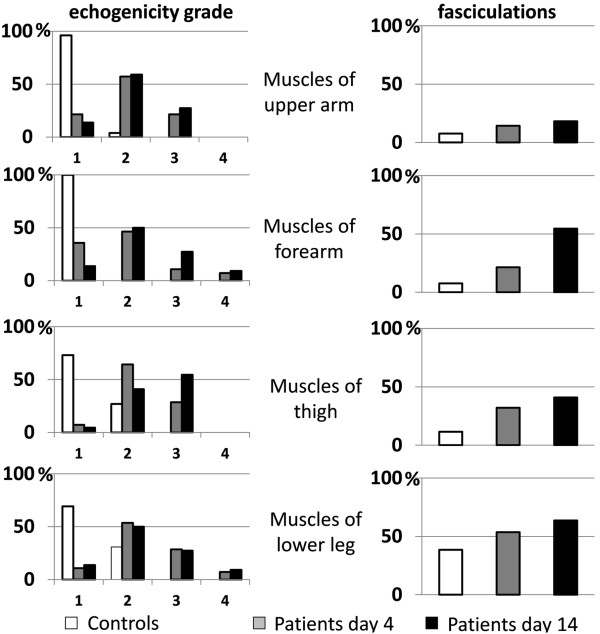
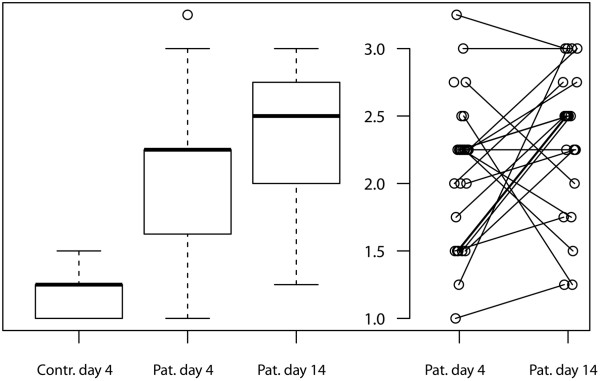
26 of the 28 patients exhibited classic electrophysiological characteristics of CINM, and all showed typical clinical signs. Ultrasonic echogenicity of muscles was graded semiquantitatively and fasciculations were evaluated in muscles of proximal and distal arms and legs. 75% of patients showed a mean echotexture greater than 1.5, which was the maximal value found in the control group. A significant difference in mean muscle echotexture between patients and controls was found at day 4 and day 14 (both p < 0.001). In addition, from day 4 to day 14, the mean grades of muscle echotexture increased in the patient group, although the values did not reach significance levels (p = 0.085). Controls revealed the lowest number of fasciculations. In the patients group, fasciculations were detected in more muscular regions (lower and upper arm and leg) in comparison to controls (p = 0.08 at day 4 and p = 0.002 at day 14).
Muscle ultrasound represents an easily applicable, non-invasive diagnostic tool which adds to neurophysiological testing information regarding morphological changes of muscles early in the course of sepsis. Muscle ultrasound could be useful for screening purposes prior to subjecting patients to more invasive techniques such as electromyography and/or muscle biopsy.
German Clinical Trials Register, DRKS-ID: DRKS00000642.
肌肉超声正逐渐成为诊断神经肌肉疾病的一种有前景的工具。当前的观察性研究评估了肌肉超声在重症脓毒症患者中用于评估重症监护病房中的重症疾病多发性神经病和肌病(CINM)的效用。
28例感染性休克或重症脓毒症患者在脓毒症发作后的第4天和第14天接受了临床神经学检查、肌肉超声检查和神经传导研究。26名年龄相仿的健康对照者仅接受了临床神经学评估和肌肉超声检查。
28例患者中有26例表现出CINM的典型电生理特征,且均表现出典型的临床体征。对肌肉的超声回声进行半定量分级,并评估上臂和下肢近端及远端肌肉的肌束震颤。75%的患者显示平均回声纹理大于1.5,这是在对照组中发现的最大值。在第4天和第14天,患者与对照组之间的平均肌肉回声纹理存在显著差异(均p<0.001)。此外,从第4天到第14天,患者组的平均肌肉回声纹理等级有所增加,尽管这些值未达到显著水平(p=0.085)。对照组的肌束震颤数量最少。与对照组相比,患者组在更多肌肉区域(上臂和下肢)检测到肌束震颤(第4天p=0.08,第14天p=0.002)。
肌肉超声是一种易于应用的非侵入性诊断工具,可在脓毒症病程早期为神经生理学检测提供有关肌肉形态学变化的信息。在让患者接受诸如肌电图和/或肌肉活检等更具侵入性的技术之前,肌肉超声可用于筛查目的。
德国临床试验注册中心,DRKS编号:DRKS00000642。