Department of Mathematical Sciences and Technology, Norwegian University of Life Sciences Ås, Norway.
Institute of Neuroscience and Medicine (INM-6) and Institute for Advanced Simulation (IAS-6), Jülich Research Centre and JARA Jülich, Germany.
Front Comput Neurosci. 2014 Jan 7;7:187. doi: 10.3389/fncom.2013.00187. eCollection 2013.
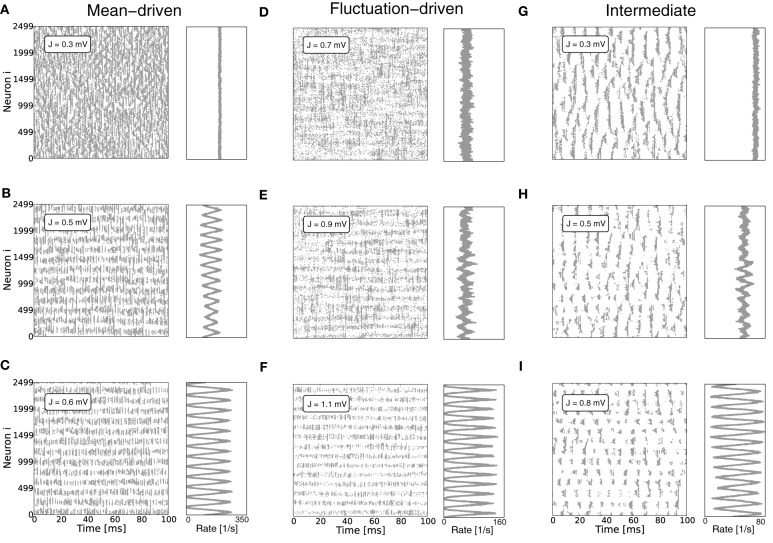
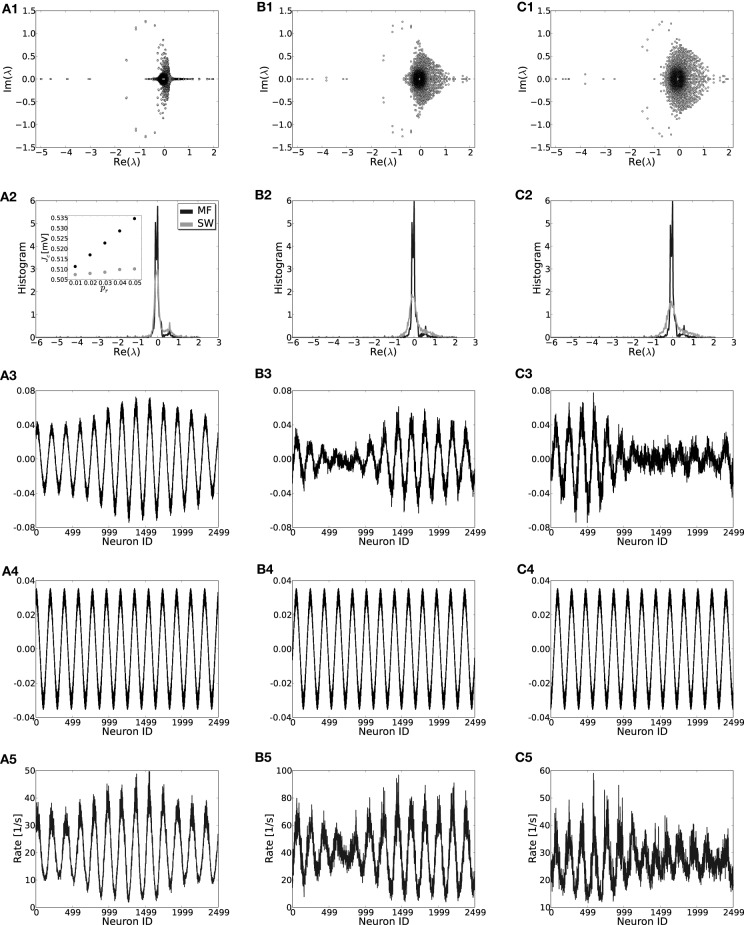
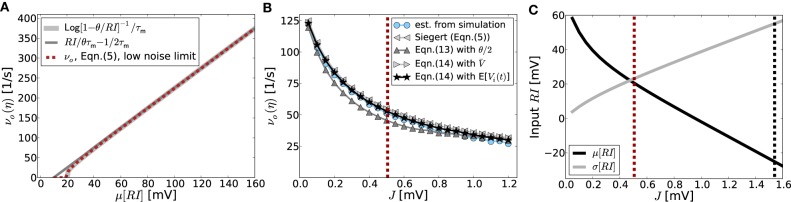
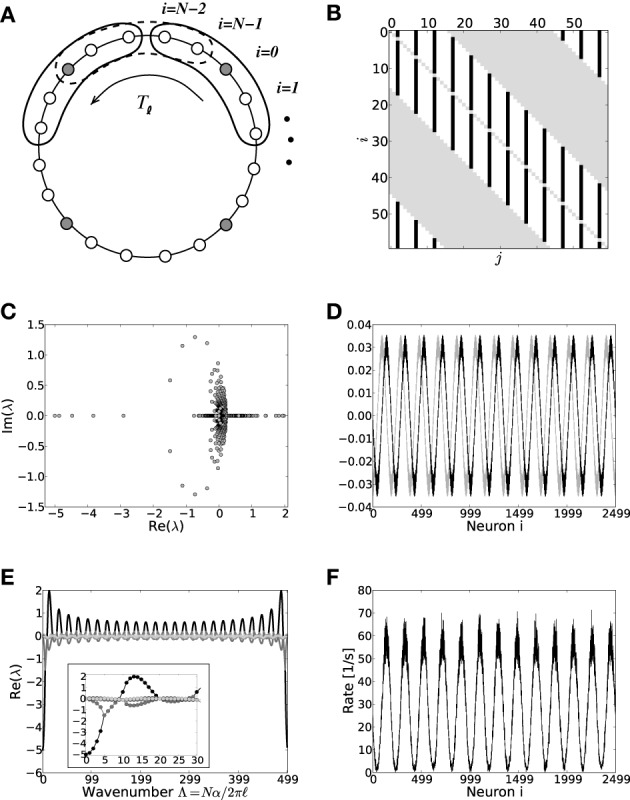
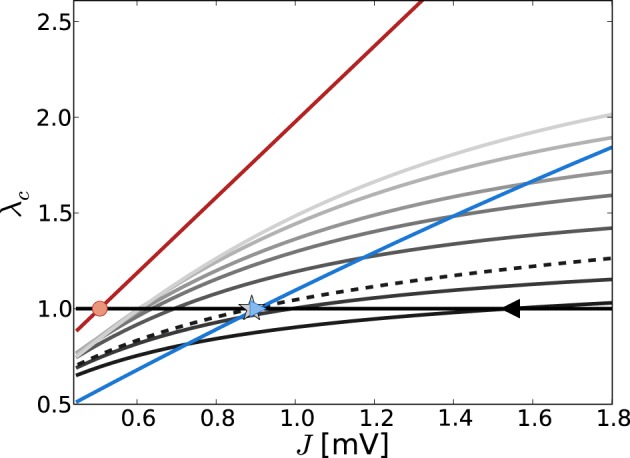
Pattern formation, i.e., the generation of an inhomogeneous spatial activity distribution in a dynamical system with translation invariant structure, is a well-studied phenomenon in neuronal network dynamics, specifically in neural field models. These are population models to describe the spatio-temporal dynamics of large groups of neurons in terms of macroscopic variables such as population firing rates. Though neural field models are often deduced from and equipped with biophysically meaningful properties, a direct mapping to simulations of individual spiking neuron populations is rarely considered. Neurons have a distinct identity defined by their action on their postsynaptic targets. In its simplest form they act either excitatorily or inhibitorily. When the distribution of neuron identities is assumed to be periodic, pattern formation can be observed, given the coupling strength is supracritical, i.e., larger than a critical weight. We find that this critical weight is strongly dependent on the characteristics of the neuronal input, i.e., depends on whether neurons are mean- or fluctuation driven, and different limits in linearizing the full non-linear system apply in order to assess stability. In particular, if neurons are mean-driven, the linearization has a very simple form and becomes independent of both the fixed point firing rate and the variance of the input current, while in the very strongly fluctuation-driven regime the fixed point rate, as well as the input mean and variance are important parameters in the determination of the critical weight. We demonstrate that interestingly even in "intermediate" regimes, when the system is technically fluctuation-driven, the simple linearization neglecting the variance of the input can yield the better prediction of the critical coupling strength. We moreover analyze the effects of structural randomness by rewiring individual synapses or redistributing weights, as well as coarse-graining on the formation of inhomogeneous activity patterns.
模式形成,即在具有平移不变结构的动力系统中产生不均匀的空间活动分布,是神经元网络动力学中一个研究得很好的现象,特别是在神经场模型中。这些是群体模型,用于根据宏观变量(如群体放电率)描述大量神经元的时空动力学。尽管神经场模型通常是从具有生理意义的性质推导出并配备的,但很少考虑直接映射到单个尖峰神经元群体的模拟。神经元具有由其对突触后靶标作用定义的独特身份。在最简单的形式中,它们要么兴奋性作用,要么抑制性作用。当神经元身份的分布被假定为周期性时,如果耦合强度是超临界的,即大于临界权重,则可以观察到模式形成。我们发现,这个临界权重强烈依赖于神经元输入的特征,即取决于神经元是均值驱动还是波动驱动,并且为了评估稳定性,在线性化完整非线性系统时适用不同的限制。特别是,如果神经元是均值驱动的,则线性化具有非常简单的形式,并且与固定点放电率和输入电流的方差都无关,而在非常强烈的波动驱动状态下,固定点率以及输入均值和方差是确定临界权重的重要参数。我们证明了,有趣的是,即使在系统在技术上是波动驱动的“中间”状态下,忽略输入方差的简单线性化也可以更好地预测临界耦合强度。此外,我们通过重新连接单个突触或重新分配权重,以及在不均匀活动模式形成方面的粗粒化,分析了结构随机性的影响。