Lee Chia-Jie, Huang Yhu-Chering, Yang Shuan, Tsao Kuo-Chien, Chen Chih-Jung, Hsieh Yu-Chia, Chiu Cheng-Hsun, Lin Tzou-Yien
Department of Pediatrics, Chang Gung Memorial Hospital at Linkou, Kweishan, Taoyuan, Taiwan.
Department of Pediatrics, Chang Gung Memorial Hospital at Linkou, Kweishan, Taoyuan, Taiwan ; Chang Gung University College of Medicine, Kweishan, Taoyuan, Taiwan.
PLoS One. 2014 Feb 4;9(2):e87391. doi: 10.1371/journal.pone.0087391. eCollection 2014.
Clinical features of coxsackievirus A4 (CA4), B3 (CB3) and B4 (CB4) infections in children have not been comprehensively described.
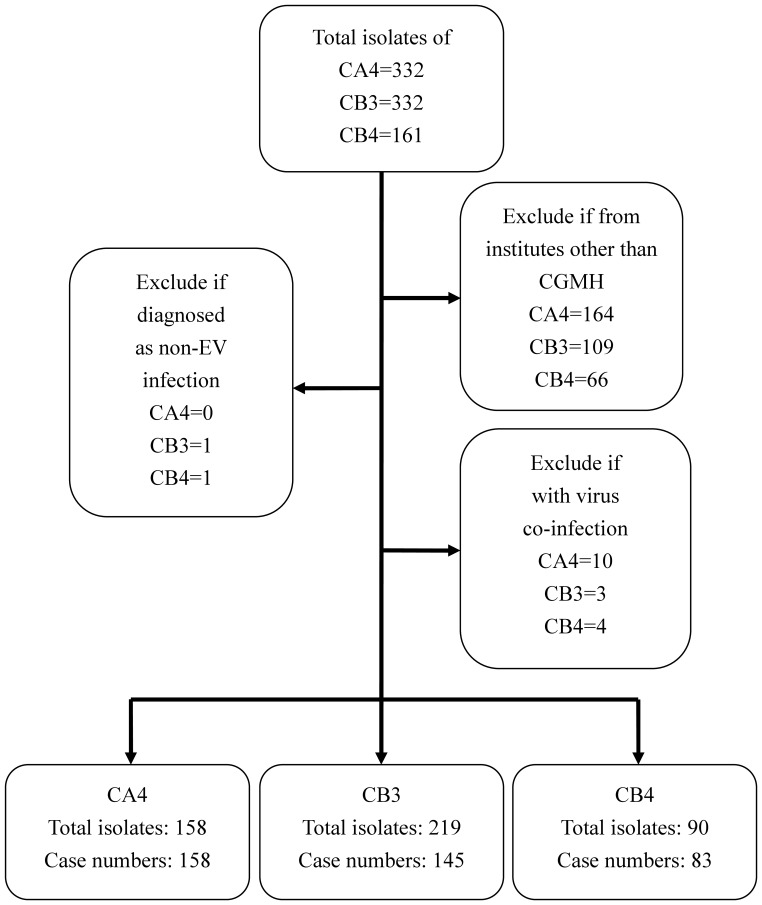
METHODS/PRINCIPAL FINDINGS: From January 2004 to June 2012, a total of 386 children with culture-proven CA4, CB3 and CB4 infections treated at Chang Gung Memorial Hospital, including 296 inpatients (CA4, 103; CB3, 131; CB4, 62) and 90 outpatients (CA4, 55; CB3, 14; CB4, 21), were included. From outpatients, only demographics were extracted and from inpatients, detailed clinical and laboratory data were collected retrospectively. The mean age was 32.1 ± 30.2 months; male to female ratio was 1.3 ∶ 1. Children with CB3 infection were youngest (76.6% <3 years of age), and had a highest hospitalization rate (90.3%) and a longest duration of hospitalization (mean ± SD, 7.5 ± 6.2 days). Herpangina (74.8%) was the most common presentation for children with CA4 infection, aseptic meningitis (26.7%) and young infant with fever (23.7%) for those with CB3 infection, and herpangina (32.3%) and tonsillitis/pharyngitis (27.4%) for children with CB4 infection. Almost all the inpatients had fever (97.6%). Twelve out of thirteen (92.3%) children with complications and ten of 11 children with long-term sequelae had CB3 infections. Two fatal cases were noted, one due to myocarditis with CA4 infection and CB3 were detected from the other case which had hepatic necrosis with coagulopathy. The remaining 285 children (96.3%) recovered uneventfully.
CA4, CB3 and CB4 infections in children had different clinical disease spectrums and involved different age groups. Though rare, severe diseases may occur, particularly caused by CB3.
柯萨奇病毒A4(CA4)、B3(CB3)和B4(CB4)感染儿童的临床特征尚未得到全面描述。
方法/主要发现:2004年1月至2012年6月,共有386名在长庚纪念医院接受治疗且经培养证实为CA4、CB3和CB4感染的儿童纳入研究,其中包括296名住院患儿(CA4,103例;CB3,131例;CB4,62例)和90名门诊患儿(CA4,55例;CB3,14例;CB4,21例)。对于门诊患儿,仅提取人口统计学数据,对于住院患儿,回顾性收集详细的临床和实验室数据。平均年龄为32.1±30.2个月;男女比例为1.3∶1。CB3感染患儿最年幼(76.6%<3岁),住院率最高(90.3%),住院时间最长(平均±标准差,7.5±6.2天)。疱疹性咽峡炎(74.8%)是CA4感染患儿最常见的表现,无菌性脑膜炎(26.7%)和发热的小婴儿(23.7%)是CB3感染患儿的常见表现,疱疹性咽峡炎(32.3%)和扁桃体炎/咽炎(27.4%)是CB4感染患儿的常见表现。几乎所有住院患儿都有发热(97.6%)。13例有并发症的患儿中有12例(92.3%)以及11例有长期后遗症的患儿中有10例感染的是CB3。记录到2例死亡病例,1例因CA4感染并发心肌炎死亡,另1例因肝坏死伴凝血障碍死亡,检测出感染的是CB3。其余285名患儿(96.3%)康复顺利。
儿童CA4、CB3和CB4感染具有不同的临床疾病谱,涉及不同年龄组。虽然罕见,但可能发生严重疾病,尤其是由CB3引起的。