Marie Curie Palliative Care Research Unit, UCL Mental Health Sciences Unit, University College Medical School, 67-73 Riding House Street, London, UK.
BMC Palliat Care. 2014 Feb 10;13(1):3. doi: 10.1186/1472-684X-13-3.
Volunteers make a major contribution to palliative patient care, and qualitative studies have been undertaken to explore their involvement. With the aim of making connections between existing studies to derive enhanced meanings, we undertook a systematic review of these qualitative studies including synthesising the findings. We sought to uncover how the role of volunteers with direct contact with patients in specialist palliative care is understood by volunteers, patients, their families, and staff.
We searched for relevant literature that explored the role of the volunteer including electronic citation databases and reference lists of included studies, and also undertook handsearches of selected journals to find studies which met inclusion criteria. We quality appraised included studies, and synthesised study findings using a novel synthesis method, thematic synthesis.
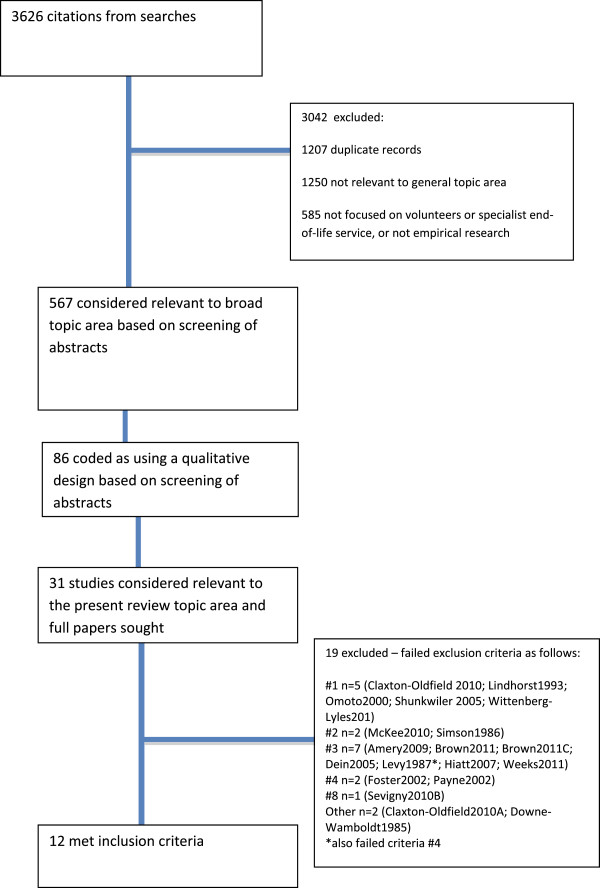
We found 12 relevant studies undertaken in both inpatient and home-care settings, with volunteers, volunteer coordinators, patients and families. Studies explored the role of general volunteers as opposed to those offering any professional skills. Three theme clusters were found: the distinctness of the volunteer role, the characteristics of the role, and the volunteer experience of the role. The first answers the question, is there a separate volunteer role? We found that to some extent the role was distinctive. The volunteer may act as a mediator between the patient and the staff. However, we also found some contradictions. Volunteers may take on temporary surrogate family-type relationship roles. They may also take on some of the characteristics of a paid professional. The second cluster helps to describe the essence of the role. Here, we found that the dominant feature was that the role is social in nature. The third helps to explain aspects of the role from the point of view of volunteers themselves. It highlighted that the role is seen by volunteers as flexible, informal and sometimes peripheral. These characteristics some volunteers find stressful.
This paper demonstrates how qualitative research can be sythnesised systematically, extending methodological techniques to help answer difficult research questions. It provides information that may help managers and service planners to support volunteers appropriately.
志愿者为姑息治疗患者的护理做出了重大贡献,已经进行了定性研究来探索他们的参与情况。为了使现有研究之间建立联系,得出更有意义的结论,我们对这些定性研究进行了系统综述,包括综合研究结果。我们旨在揭示与患者有直接接触的志愿者在专科姑息治疗中的角色如何被志愿者、患者、他们的家人和工作人员所理解。
我们搜索了探索志愿者角色的相关文献,包括电子引文数据库和纳入研究的参考文献列表,还对手头选定的期刊进行了检索,以找到符合纳入标准的研究。我们对纳入的研究进行了质量评估,并使用一种新的综合方法——主题综合法,对研究结果进行了综合。
我们发现了 12 项在住院和家庭护理环境中进行的相关研究,涉及志愿者、志愿者协调员、患者和家属。这些研究探讨了一般志愿者的角色,而不是那些提供任何专业技能的志愿者的角色。我们发现了三个主题集群:志愿者角色的独特性、角色的特征以及志愿者对角色的体验。第一个问题是,是否存在一个单独的志愿者角色?我们发现,在某种程度上,这个角色是独特的。志愿者可以在患者和工作人员之间充当调解人。然而,我们也发现了一些矛盾。志愿者可能会承担临时的代理家庭类型的关系角色。他们也可能承担一些有偿专业人员的特征。第二个集群有助于描述角色的本质。在这里,我们发现角色的主要特征是它具有社会性。第三个集群有助于从志愿者自身的角度解释角色的某些方面。它强调志愿者认为该角色灵活、非正式,有时是次要的。这些特点让一些志愿者感到有压力。
本文展示了如何系统地综合定性研究,扩展方法学技术以帮助回答困难的研究问题。它提供了可能有助于管理人员和服务规划者适当地支持志愿者的信息。