UMVE, Centre International de Recherches Médicales de Franceville, Franceville, Gabon.
UMVE, Centre International de Recherches Médicales de Franceville, Franceville, Gabon ; MIVEGEC, Institut de Recherche pour le Développement (IRD-224, CNRS-5290, Universités de Montpellier 1 & 2), Montpellier, France.
PLoS Negl Trop Dis. 2014 Feb 6;8(2):e2681. doi: 10.1371/journal.pntd.0002681. eCollection 2014 Feb.
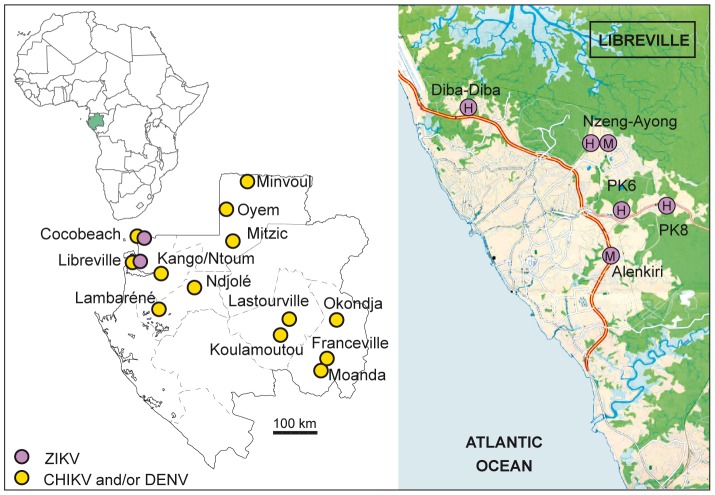
Chikungunya and dengue viruses emerged in Gabon in 2007, with large outbreaks primarily affecting the capital Libreville and several northern towns. Both viruses subsequently spread to the south-east of the country, with new outbreaks occurring in 2010. The mosquito species Aedes albopictus, that was known as a secondary vector for both viruses, recently invaded the country and was the primary vector involved in the Gabonese outbreaks. We conducted a retrospective study of human sera and mosquitoes collected in Gabon from 2007 to 2010, in order to identify other circulating arboviruses.
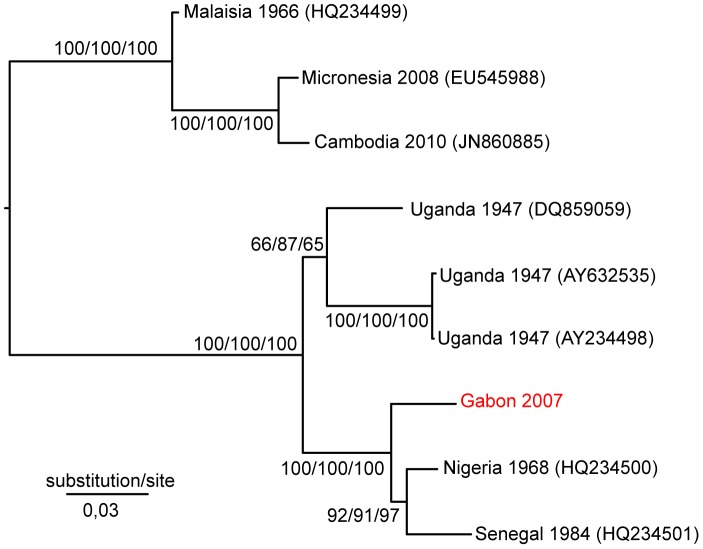
METHODOLOGY/PRINCIPAL FINDINGS: Sample collections, including 4312 sera from patients presenting with painful febrile disease, and 4665 mosquitoes belonging to 9 species, split into 247 pools (including 137 pools of Aedes albopictus), were screened with molecular biology methods. Five human sera and two Aedes albopictus pools, all sampled in an urban setting during the 2007 outbreak, were positive for the flavivirus Zika (ZIKV). The ratio of Aedes albopictus pools positive for ZIKV was similar to that positive for dengue virus during the concomitant dengue outbreak suggesting similar mosquito infection rates and, presumably, underlying a human ZIKV outbreak. ZIKV sequences from the envelope and NS3 genes were amplified from a human serum sample. Phylogenetic analysis placed the Gabonese ZIKV at a basal position in the African lineage, pointing to ancestral genetic diversification and spread.
CONCLUSIONS/SIGNIFICANCE: We provide the first direct evidence of human ZIKV infections in Gabon, and its first occurrence in the Asian tiger mosquito, Aedes albopictus. These data reveal an unusual natural life cycle for this virus, occurring in an urban environment, and potentially representing a new emerging threat due to this novel association with a highly invasive vector whose geographic range is still expanding across the globe.
基孔肯雅热和登革热病毒于 2007 年在加蓬出现,大规模疫情主要影响首都利伯维尔和几个北部城镇。随后,这两种病毒传播到该国东南部,2010 年又出现了新的疫情。白纹伊蚊(Aedes albopictus)是这两种病毒的次要传播媒介,最近入侵该国,成为加蓬疫情的主要传播媒介。我们对 2007 年至 2010 年期间在加蓬采集的人类血清和蚊子进行了回顾性研究,以确定其他循环的虫媒病毒。
方法/主要发现:采用分子生物学方法对包括 4312 份来自有疼痛发热疾病患者的血清样本和 4665 只分属 9 个种的蚊子(分为 247 个池,包括 137 个白纹伊蚊池)进行了采集。有 5 份人类血清和 2 份白纹伊蚊池在 2007 年疫情期间的城市环境中检测到黄病毒寨卡病毒(ZIKV)呈阳性。寨卡病毒阳性白纹伊蚊池的比例与同期登革热疫情中登革热病毒阳性的比例相似,这表明蚊子感染率相似,推测存在人类寨卡病毒疫情。从一份人类血清样本中扩增了包膜和 NS3 基因的 ZIKV 序列。系统发育分析将加蓬的 ZIKV 置于非洲谱系的基础位置,表明其遗传多样化和传播具有祖先特征。
结论/意义:我们首次提供了加蓬存在人类寨卡病毒感染的直接证据,也是首次在亚洲虎蚊(Aedes albopictus)中发现寨卡病毒。这些数据揭示了该病毒在城市环境中发生的不寻常自然生活史,可能由于这种新型病毒与高度入侵性的媒介有关,而构成新的出现威胁,而这种媒介的地理范围仍在全球范围内扩大。