Morabito Marco, Crisci Alfonso, Messeri Alessandro, Capecchi Valerio, Modesti Pietro Amedeo, Gensini Gian Franco, Orlandini Simone
Department of Agrifood Production and Environmental Sciences, University of Florence, Piazzale delle Cascine 18, 50144 Florence, Italy ; Interdepartmental Centre of Bioclimatology, University of Florence, Piazzale delle Cascine 18, 50144 Florence, Italy ; Center for Civil Protection and Risk Studies, University of Florence (CESPRO), Viale Morgagni 48, 50134 Florence, Italy.
Institute of Biometeorology, National Research Council, Via Giovanni Caproni 8, 50145 Florence, Italy.
ScientificWorldJournal. 2014 Jan 8;2014:961750. doi: 10.1155/2014/961750. eCollection 2014.
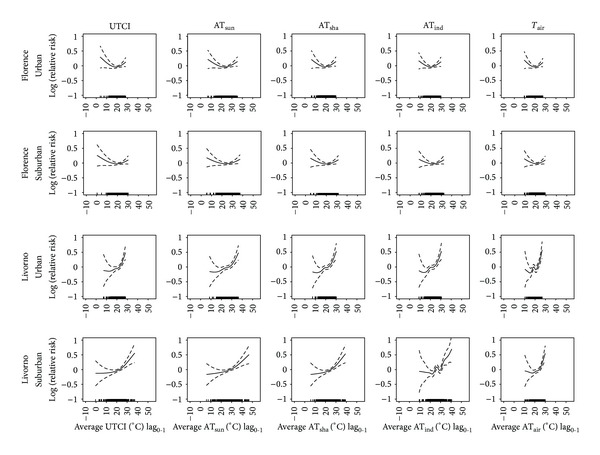
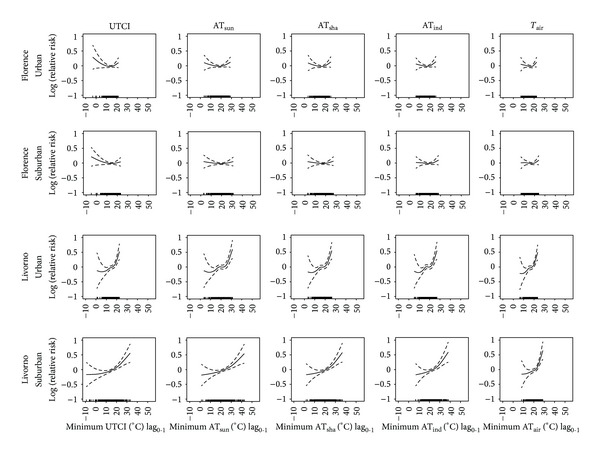
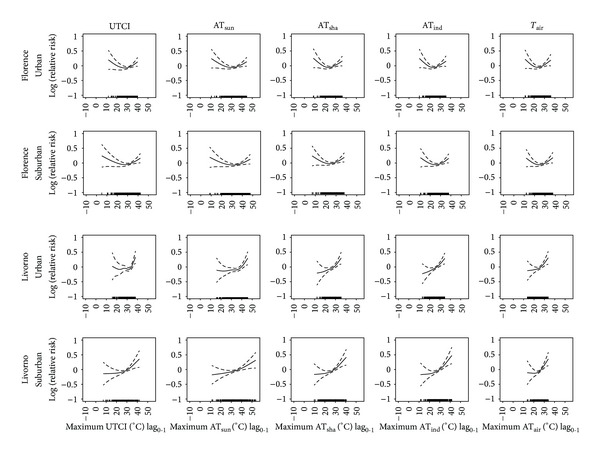
The aim of this study is to identify the most effective thermal predictor of heat-related very-elderly mortality in two cities located in different geographical contexts of central Italy. We tested the hypothesis that use of the state-of-the-art rational thermal indices, the Universal Thermal Climate Index (UTCI), might provide an improvement in predicting heat-related mortality with respect to other predictors. Data regarding very elderly people (≥ 75 years) who died in inland and coastal cities from 2006 to 2008 (May-October) and meteorological and air pollution were obtained from the regional mortality and environmental archives. Rational (UTCI) and direct thermal indices represented by a set of bivariate/multivariate apparent temperature indices were assessed. Correlation analyses and generalized additive models were applied. The Akaike weights were used for the best model selection. Direct multivariate indices showed the highest correlations with UTCI and were also selected as the best thermal predictors of heat-related mortality for both inland and coastal cities. Conversely, the UTCI was never identified as the best thermal predictor. The use of direct multivariate indices, which also account for the extra effect of wind speed and/or solar radiation, revealed the best fitting with all-cause, very-elderly mortality attributable to heat stress.
本研究的目的是在意大利中部不同地理环境的两个城市中,确定与高温相关的高龄死亡率最有效的热指标。我们检验了这样一个假设:使用最先进的合理热指标——通用热气候指数(UTCI),相对于其他指标,在预测与高温相关的死亡率方面可能会有所改进。从地区死亡率和环境档案中获取了2006年至2008年(5月至10月)在内陆和沿海城市死亡的高龄人群(≥75岁)的数据以及气象和空气污染数据。评估了以一组双变量/多变量体感温度指数表示的合理(UTCI)和直接热指标。应用了相关分析和广义相加模型。使用赤池权重进行最佳模型选择。直接多变量指标与UTCI的相关性最高,并且也被选为内陆和沿海城市与高温相关死亡率的最佳热预测指标。相反地,UTCI从未被确定为最佳热预测指标。使用直接多变量指标(该指标还考虑了风速和/或太阳辐射的额外影响)显示,其与因热应激导致的全因高龄死亡率拟合度最佳。