The Howard Hughes Medical Institute, Harvard Stem Cell Institute, Stanley Center for Psychiatric Research, Department of Stem Cell and Regenerative Biology, Harvard University, 7 Divinity Avenue, Cambridge, MA 02138, USA.
Stem Cell Reports. 2014 Jan 31;2(2):119-26. doi: 10.1016/j.stemcr.2013.12.010. eCollection 2014 Feb 11.
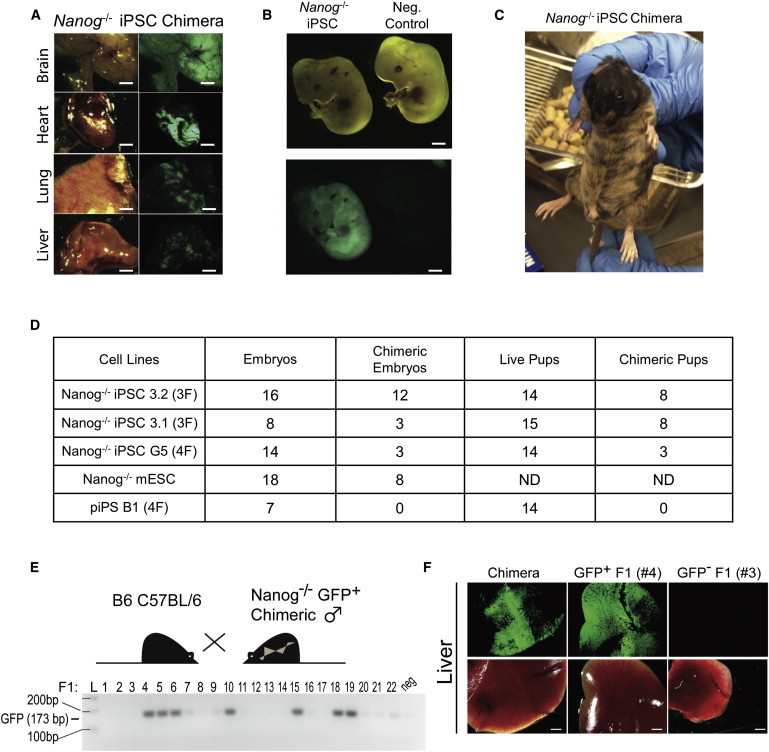
It has been suggested that the transcription factor Nanog is essential for the establishment of pluripotency during the derivation of embryonic stem cells and induced pluripotent stem cells (iPSCs). However, successful reprogramming to pluripotency with a growing list of divergent transcription factors, at ever-increasing efficiencies, suggests that there may be many distinct routes to a pluripotent state. Here, we have investigated whether Nanog is necessary for reprogramming murine fibroblasts under highly efficient conditions using the canonical-reprogramming factors Oct4, Sox2, Klf4, and cMyc. In agreement with prior results, the efficiency of reprogramming Nanog (-/-) fibroblasts was significantly lower than that of control fibroblasts. However, in contrast to previous findings, we were able to reproducibly generate iPSCs from Nanog (-/-) fibroblasts that effectively contributed to the germline of chimeric mice. Thus, whereas Nanog may be an important mediator of reprogramming, it is not required for establishing pluripotency in the mouse, even under standard conditions.
有人认为,转录因子 Nanog 对于胚胎干细胞和诱导多能干细胞(iPSCs)的多能性建立至关重要。然而,越来越多的不同转录因子在不断提高的效率下成功地重新编程为多能性,这表明可能有许多不同的途径通向多能状态。在这里,我们研究了在使用经典重编程因子 Oct4、Sox2、Klf4 和 cMyc 的高效条件下,Nanog 是否对于重新编程小鼠成纤维细胞是必需的。与先前的结果一致,Nanog(-/-)成纤维细胞的重编程效率明显低于对照成纤维细胞。然而,与先前的发现相反,我们能够从 Nanog(-/-)成纤维细胞中重复产生有效地有助于嵌合小鼠生殖系的 iPSCs。因此,虽然 Nanog 可能是重编程的重要介质,但即使在标准条件下,它对于在小鼠中建立多能性也不是必需的。