INRA, UMR1313 Génétique Animale et Biologie Intégrative, F-78350 Jouy-en-Josas, France.
Genet Sel Evol. 2014 Feb 14;46(1):12. doi: 10.1186/1297-9686-46-12.
Numerous quantitative trait loci (QTL) have been detected in pigs over the past 20 years using microsatellite markers. However, due to the low density of these markers, the accuracy of QTL location has generally been poor. Since 2009, the dense genome coverage provided by the Illumina PorcineSNP60 BeadChip has made it possible to more accurately map QTL using genome-wide association studies (GWAS). Our objective was to perform high-density GWAS in order to identify genomic regions and corresponding haplotypes associated with production traits in a French Large White population of pigs.
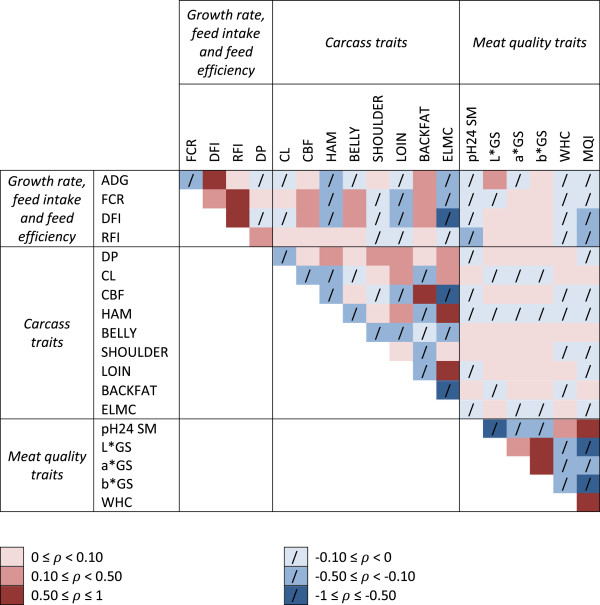
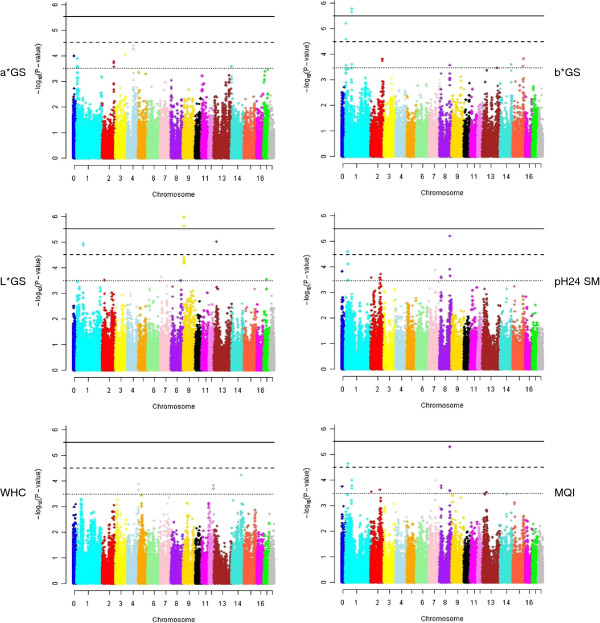
Animals (385 Large White pigs from 106 sires) were genotyped using the PorcineSNP60 BeadChip and evaluated for 19 traits related to feed intake, growth, carcass composition and meat quality. Of the 64,432 SNPs on the chip, 44,412 were used for GWAS with an animal mixed model that included a regression coefficient for the tested SNPs and a genomic kinship matrix. SNP haplotype effects in QTL regions were then tested for association with phenotypes following phase reconstruction based on the Sscrofa10.2 pig genome assembly.
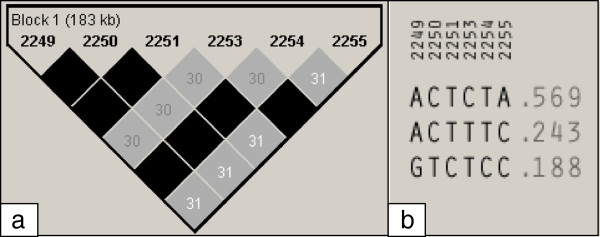
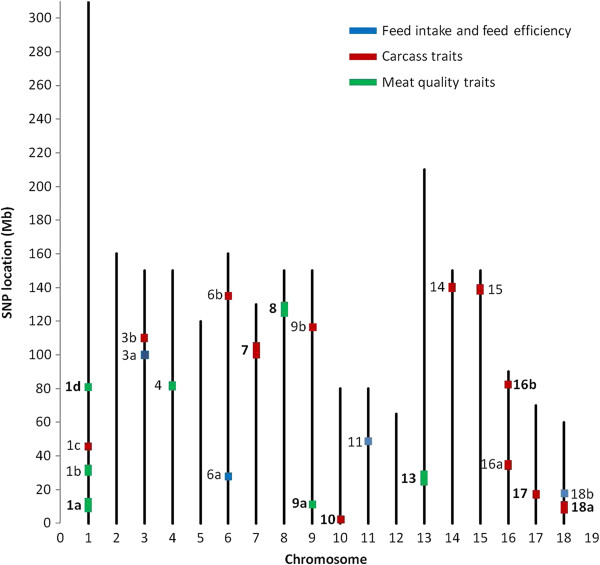
Twenty-three QTL regions were identified on autosomes and their effects ranged from 0.25 to 0.75 phenotypic standard deviation units for feed intake and feed efficiency (four QTL), carcass (12 QTL) and meat quality traits (seven QTL). The 10 most significant QTL regions had effects on carcass (chromosomes 7, 10, 16, 17 and 18) and meat quality traits (two regions on chromosome 1 and one region on chromosomes 8, 9 and 13). Thirteen of the 23 QTL regions had not been previously described. A haplotype block of 183 kb on chromosome 1 (six SNPs) was identified and displayed three distinct haplotypes with significant (0.0001 < P < 0.03) associations with all evaluated meat quality traits.
GWAS analyses with the PorcineSNP60 BeadChip enabled the detection of 23 QTL regions that affect feed consumption, carcass and meat quality traits in a LW population, of which 13 were novel QTL. The proportionally larger number of QTL found for meat quality traits suggests a specific opportunity for improving these traits in the pig by genomic selection.
在过去的 20 年中,使用微卫星标记物在猪身上检测到了许多数量性状基因座(QTL)。然而,由于这些标记物密度较低,QTL 定位的准确性通常较差。自 2009 年以来,Illumina PorcineSNP60 BeadChip 提供的密集基因组覆盖范围使得使用全基因组关联研究(GWAS)更准确地定位 QTL 成为可能。我们的目标是进行高密度 GWAS,以鉴定与法国大白猪群体生产性状相关的基因组区域和相应单倍型。
使用 PorcineSNP60 BeadChip 对 385 头大白猪(来自 106 头公猪)进行基因分型,并评估与饲料摄入、生长、胴体组成和肉质相关的 19 个性状。在芯片上的 64432 个 SNP 中,使用包含测试 SNP 回归系数和基因组亲缘关系矩阵的动物混合模型对 44412 个 SNP 进行 GWAS。然后,在基于 Sscrofa10.2 猪基因组组装进行相位重建后,测试 SNP 单倍型效应与表型的关联。
在常染色体上鉴定出 23 个 QTL 区域,其对饲料摄入和饲料效率(四个 QTL)、胴体(12 个 QTL)和肉质性状(七个 QTL)的影响范围为 0.25 至 0.75 个表型标准差单位。10 个最重要的 QTL 区域对胴体(染色体 7、10、16、17 和 18)和肉质性状(染色体 1 上的两个区域和染色体 8、9 和 13 上的一个区域)有影响。23 个 QTL 区域中有 13 个以前没有描述过。在染色体 1 上发现了一个 183kb 的单倍型块(六个 SNP),显示出三个不同的单倍型,与所有评估的肉质性状均具有显著(0.0001<P<0.03)关联。
使用 PorcineSNP60 BeadChip 的 GWAS 分析检测到了 23 个影响 LW 群体饲料消耗、胴体和肉质性状的 QTL 区域,其中 13 个是新的 QTL。在肉质性状中发现的 QTL 数量相对较多,表明通过基因组选择改善这些性状具有特定的机会。